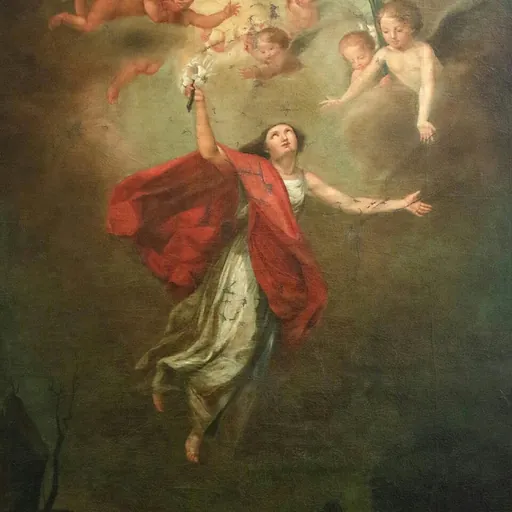
Philomena
Christian saint, martyr and wonderworker
About Philomena
Lived 291 – 304 (aged 13). Philomena was a Roman.
Biography On 21 December 1833, the Holy Office declared that there was nothing contrary to the Catholic faith in the revelations that Maria Luisa di Gesù, a Dominican tertiary from Naples, claimed to have received from Philomena herself.
The belief that such vials were signs of the grave of a martyr was rejected by the investigations of Giovanni Battista De Rossi (1822–1894), but more recently this original view has found advocates, such as theologian Mark Miravalle.
In 1805, Canon Francesco De Lucia of Mugnano del Cardinale requested relics for his oratory and, on 8 June, obtained the remains discovered in May 1802 (then reduced to dust and fragments). The relics arrived in Mugnano on August 10, and were placed in the Church of Our Lady of Grace. A new Church of Our Lady of Grace was built, containing a chapel to which the sacred relics were moved on 29 September 1805.
In 1827, Pope Leo XII gave the church in Mugnano del Cardinale the three inscribed terracotta slabs taken from the tomb. Canon De Lucia recounted that wonders accompanied the arrival of the relics to his church: among them a statue that sweated some liquid continuously for three days.
Devotion to Philomena includes the wearing of the "Cord of Philomena", a red and white cord, which had a number of indulgences attached to it, including a plenary indulgence on the day on which the cord was worn for the first time, indulgences that were not renewed in Indulgentiarum doctrina, the 1967 general revision of the discipline concerning them. There is also the chaplet of Saint Philomena, with three white beads in honour of the Christian Trinity and thirteen red beads in honour of the thirteen years of Philomena's life. A sacramental associated with devotion to Philomena is the Oil of Saint Philomena, used for the putative healing of the body and soul.
In August 1876, the first issue of Messenger of Saint Philomena was published in Paris, France. On 6 October 1876, Louis Petit, a priest, founded the Confraternity of Saint Philomena in Paris. In November 1886, the Confraternity was raised to the rank of Archconfraternity by Pope Leo XIII. On 21 May 1912, Pope Pius X raised it to the rank of Universal Archconfraternity with the Apostolic brief Pias Fidelium Societates stating that: "The current statements (regarding St. Philomena) are and remain always fixed, valid and effective; in this way it has to be judged as normative; and if it is proceeded in another way, it will be null and void, whatever its authority."
Liturgy
In 1834, due to many supposed miracles, Pope Gregory XVI allowed the veneration of Saint Philomena and, in 1837, authorized the celebration of the feast of Saint Philomena on 11 August In the 1920 typical edition of the Roman Missal, Philomena is mentioned under 11 August with an indication that the Mass for her feast day was to be taken entirely from the common liturgy. This order was given as part of an instruction on the application to local calendars of the principles enunciated in the 1960 Code of Rubrics that had already been applied to the General Roman Calendar. Section 33
Veneration by other saints The spread of devotion to her in France and Italy was helped when John Vianney built a shrine in her honour and referred to her often, attributing to her the miracles that others attributed to him. Many other saints were devoted to Philomena, including Peter Julian Eymard, Peter Chanel, Pio of Pietrelcina, Anthony Mary Claret, Madeleine Sophie Barat, Euphrasier Pelletier, John Neumann, and Anna Maria Taigi.
Places dedicated to Saint Philomena Sanctuary of St. Philomena, Mugnano del Cardinale, Avellino, Italy, which houses her remains within a life-size, richly robed effigy St. Philomena's Cathedral (India) St. Philomena's Church (Cincinnati, Ohio) St. Philomena's Church (Pittsburgh, PA) St Philomena's Catholic High School for Girls St Philomena’s Catholic Church (Lansdowne, PA) St. Philomena's Roman Catholic Church (Franklinville, New York) Sanctuary of St. Philomena (Sorocaba, Brazil) St. Philomena's Catholic Church and School (Peoria, Illinois) St. Philomena's Catholic Church (Monticello, Illinois) St. Philomena Coptic Orthodox Children’s Home (Suva, Fiji) St Philomena Catholic Church (Chicago, Illinois)
In Art
Criticism Although correlation does not prove causation, the Holy See's instruction to remove the name of Philomena even from local calendars followed the raising of questions by certain scholars, whose interest had been drawn to the phenomenon more especially in connection with the revelations of Sister Maria Luisa di Gesù. Historian Michael S. Carter (who supports Miravalle's position) has written about devotion to Saint Philomena within the broader context of veneration of "catacomb martyrs" and their relics in the history of the United States. Moreover, In April 2005, at the Conference of Philomenian Studies – 1805-2005, findings of a study carried out on the tiles by the Opificio delle Pietre Dure e Laboratori di Restauro (Factory of Hard Stones and Restoration Laboratories) of Florence were made public. The analysis confirmed that only one type of mortal lime could be found on the tiles, thus giving strong support to the theory that the tiles had not been re-arranged.
Others stress that the authenticity of her cult can be grounded on account of the miracles attributed to her, its long-standing papal approbation, and the saint's continued popularity. This has been the position of the rector of the shrine in Mugnano del Cardinale and the view presented in the Italian-language Enciclopedia Dei Santi. Pilgrims from all over the world arrive continually at Philomena's shrine in the Diocese of Nola, Italy, displaying an intense degree of popular devotion.
Don’t just read it —
keep it.
Full-length biographies made to live with: read them, listen on the way to work, watch them tonight.
- E-book
- Audio
- Video
Instant download · yours to keep · every purchase keeps this site free
Important facts
People in Philomena's life
Named in this biography and alive at the same time
Frequently asked questions
Who was Philomena?
Christian saint, martyr and wonderworker
When was Philomena born?
Philomena was born on 10 January 291 in Corfu.
When did Philomena die?
Philomena died on 10 August 304 in Rome.
What nationality was Philomena?
Philomena was Roman.
Sources & further reading
Cite this page
APA: Biography.guide. (2026). Philomena. https://biography.guide/philomena/
MLA: "Philomena." Biography.guide, https://biography.guide/philomena/.
Chicago: "Philomena." Biography.guide. https://biography.guide/philomena/.
Data last updated: 2026-09-20 · Spot an error? Report a correction.
Portrait: Wikimedia Commons · author & licence
Page generated 2026-09-27 04:57 UTC