
About Philippe Petit
Born 1949. Philippe Petit is a French acrobat, tightrope walker, performance artist, screenwriter and stunt performer.
Philippe Petit (; born 13 August 1949) is a French highwire artist who gained fame for his unauthorized highwire walks between the towers of Notre-Dame Cathedral in Paris in 1971 and of Sydney Harbour Bridge in 1973, as well as between the Twin Towers of the World Trade Center in New York City on August 7, 1974.
Since then, Petit has lived in New York, where he has been artist-in-residence at the Cathedral of St. John the Divine, another site of his aerial performances. He has done wire walking as part of official celebrations in New York, across the United States, and in France and other countries, as well as teaching workshops on the art. In 2008, Man on Wire, a documentary directed by James Marsh about Petit's walk between the towers, won numerous awards including the 2009 Academy Award for Best Documentary Feature. The Walk, a film based on Petit's walk, was released in September 2015, starring Joseph Gordon-Levitt as Petit and directed by Robert Zemeckis. Petit was also the subject of a children's book and an animated adaptation of it, released in 2005.
He also became adept at equestrianism, juggling, fencing, carpentry, rock-climbing, and bullfighting. Spurning circuses and their formulaic performances, he created his street persona on the sidewalks of Paris. In the early 1970s, he visited New York City, where he frequently juggled and worked on a slackline in Washington Square Park.
Early life and career Petit was born in Nemours, Seine-et-Marne, France; his father Edmond Petit was an author and an Army Pilot. At an early age, Petit discovered magic and juggling. He loved to climb, and at 16, he took his first steps on a tightrope wire. He told a reporter, Within one year, I taught myself to do all the things you could do on a wire. I learned the backward somersault, the front somersault, the unicycle, the bicycle, the chair on the wire, jumping through hoops. But I thought, "What is the big deal here? It looks almost ugly." So I started to discard those tricks and to reinvent my art.
In June 1971, Petit secretly installed a cable between the two towers of Notre-Dame de Paris. On the morning of 26 June 1971, he "juggled balls" and "pranced back and forth" as he crossed the wire on foot to the applause of the crowd below.
World Trade Center stunt
Petit became known to New Yorkers in the early 1970s for his frequent tightrope-walking performances and magic shows in the city parks, especially Washington Square Park. Petit's most famous performance was in August 1974, conducted on a wire between the roofs of the Twin Towers of the World Trade Center in Lower Manhattan, New York City, above the ground. He performed for 45 minutes, making eight passes along the wire, during which he walked, danced, lay down on the wire, and saluted watchers from a kneeling position. Office workers, construction crews, and policemen cheered him on.
Planning Petit conceived his "coup" when he was 18, when he first read about the proposed construction of the Twin Towers and saw drawings of the project in a magazine he read in 1968 while sitting at a dentist's office.
What was called the "artistic crime of the century" took Petit six years of planning. During this period, he learned everything he could about the buildings and their construction. In the same period, he began to perform highwire walking at other famous places. Rigging his wire secretly, he performed as a combination of circus act and public display. In 1971, he performed his first such walk between the towers of the cathedral of Notre-Dame de Paris, while priests were being ordained inside the building. In 1973, he walked a wire rigged between the two north pylons of the Sydney Harbour Bridge.
In planning for the Twin Towers walk, Petit had to learn how to accommodate issues such as the swaying of the high towers due to wind, which was part of their design; effects of wind and weather on the wire at that height; how to rig a steel cable across the gap between the towers (at a height of ); and how to gain entry with his collaborators, first to scope out the conditions and lastly to stage the project. Two more collaborators, Jean François Heckel and Jean-Louis Blondeau, helped him practice in a field in France, and accompanied him to take part in the final rigging of the project, as well as to photograph it. Francis Brunn, a German juggler, provided financial support for the proposed project and its planning.
Petit and his crew gained entry into the towers several times and hid in upper floors and on the roofs of the unfinished buildings to study security measures. They also analyzed the construction and identified places to anchor the wire and cavaletti. Using his own observations, drawings, and Moore's photographs, Petit constructed a scale model of the towers to design the needed rigging for the wire walk.
Working from the ID of an American who worked in the building, Petit made fake identification cards for himself and his collaborators (claiming they were contractors who were installing an electrified fence on the roof) to gain access to the buildings. Prior to this, Petit had carefully observed the clothes worn by construction workers and the kinds of tools they carried. He also took note of the clothing of office workers so that some of his collaborators could pose as white-collar workers. He observed what time the workers arrived and left, so he could determine when he would have roof access. 1974 Hess's ad, with an image of Petit's walk across the Twin TowersOn the night of Tuesday, 6 August 1974, Petit and his crew had a lucky break and got a ride in a freight elevator to the 104th floor with their equipment. They stored it 19 steps below the roof. To pass the cable across the void, Petit and his crew had decided on using a bow and arrow attached to monofilament, attached to a rope. They had to practice this many times to perfect their technique. They first shot the fishing line, which was attached to larger ropes, and finally to the steel cable. The team was delayed when the heavy cable sank too fast, and had to be pulled up manually for hours. Petit had already identified points at which to anchor two cavaletti (guy lines) to other points to stabilize the cable and keep the swaying of the wire to a minimum.
Aftermath There was extensive news coverage and public appreciation of Petit's highwire walk. District attorney Richard Kuh dropped all formal charges of trespassing and other items relating to his walk on condition that Petit give a free aerial show for children in Central Park. On Thursday, 29 August, he performed on a highwire walk in the park above Belvedere Lake (now Turtle Pond).
The Port Authority of New York and New Jersey gave Petit a lifetime pass to the Twin Towers' observation deck. He autographed a steel beam close to the point where he began his walk, which was later destroyed in the September 11 attacks.
Petit's highwire walk is credited with bringing the Twin Towers much-needed attention and even affection, as they initially had been unpopular. Critics such as historian Lewis Mumford had regarded them as ugly and utilitarian in design, and too large a development for the area. The Port Authority was having trouble renting out all of the office space.
The same stunt was fictionalized in a biographical drama entitled The Walk (2015), directed by Robert Zemeckis and starring Joseph Gordon-Levitt as Petit.
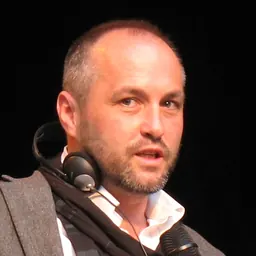
Author Colum McCann fictionalized Petit's appearance above New York as a unifying thread throughout his 2009 novel Let the Great World Spin.
Later life Petit has made dozens of public highwire performances in his career. For example, in 1986 he re-enacted the crossing of the Niagara River by Blondin for an IMAX film. In 1989, to celebrate the 200th anniversary of the French Revolution, mayor Jacques Chirac invited him to walk an inclined wire strung from the ground at the Place du Trocadéro to the second level of the Eiffel Tower, crossing the Seine.
Petit briefly headlined with the Ringling Brothers Circus, but preferred staging his own performances. During his stint with the circus and a practice walk, he suffered his only fall, from , breaking several ribs. He says he has never fallen during a performance: "If I had, I wouldn't be here talking about it." In 2011, he published his eighth book, A Square Peg. He has also created an ebook for TED Books, entitled Cheating the Impossible: Ideas and Recipes from a Rebellious High-Wire Artist. Petit divides his time between New York City, where he is an artist in residence at the Cathedral of Saint John the Divine, and a hideaway in the Catskill Mountains.
Director James Signorelli assisted with creation of Petit's book To Reach the Clouds (2002), about the Twin Towers walk. Petit not only wrote about his feat, and events that led to the performance, but also expressed his emotions following the September 11 attacks, during which the Twin Towers were destroyed. He wrote that on that morning, "My towers became our towers. I saw them collapse – hurling, crushing thousands of lives. Disbelief preceded sorrow for the obliteration of the buildings, perplexity descended before rage at the unbearable loss of life." Petit paid tribute to those who were killed and supported rebuilding the towers, promising that "When the towers again twin-tickle the clouds, I offer to walk again, to be the expression of the builders' collective voice. Together, we will rejoice in an aerial song of victory."
Vallauris Vallauris, Alpes-Maritimes, France performance for artist Pablo Picasso's 90th birthday Notre-Dame Cathedral Notre-Dame CathedralParis, France staged walk between towers without permission 1973 Sydney Harbour Bridge Sydney Harbour Bridge Sydney, Australia staged walk between towers without permission
World Trade Center World Trade CenterNew York City, United States staged walk between towers without permission Central Park Central ParkNew York City Publicly authorized walk on inclined wire over Turtle Pond Laon Cathedral Laon CathedralLaon, France performing on wire between the cathedral's two spires for an international television special 1975 Louisiana Superdome Louisiana SuperdomeNew Orleans, Louisiana, United States walk on wire across interior for the opening of the stadium
Cathedral of Saint John the Divine Cathedral of Saint John the DivineNew York City, United States interior walk in height of nave to celebrate renewal of the cathedral's construction following a 40-year hiatus Concert in the Sky Denver, Colorado, United States Highwire play directed and produced by Petit for the opening of the World Theatre Festival
Skysong Purchase, New York, United States Highwire play directed and produced by Petit for the opening of "Summerfare," the State University of New York Arts Festival Centre Georges Pompidou Centre Georges PompidouParis, France
Corde Raide-Piano Volant Paris, France Highwire play directed and produced by Petit with pop-music singer-songwriter Jacques Higelin Paris Opera Paris OperaParis, France Highwire improvisation with opera singer Margherita Zimmermann Museum of the City of New York Museum of the City of New YorkNew York City, United States Highwire performance for the opening of the museum's Daring New York exhibit
Ascent Cathedral of Saint John the DivineNew York City, United States Concert for grand piano and highwire on an inclined cable above the nave of the cathedral Lincoln Center Lincoln CenterNew York City, United States Highwire performance for the reopening of the Statue of Liberty
Walking the Harp/A Bridge for Peace Jerusalem, Israel Highwire performance on an inclined cable linking the Jewish and Arab quarters for opening of Israel Festival under Jerusalemite Mayor Teddy Kollek Moondancer Portland Center for the Performing ArtsPortland, Oregon, United States Highwire opera for the opening of the center Grand Central Dances Grand Central TerminalNew York City, United States Highwire choreography on wire set above the interior concourse of the terminal 1988 House of the Dead Paris, France Creation of the role of the eagle in a production of From the House of the Dead (1930), an opera by Leoš Janáček, directed by Volker Schlöndorff 1989 Tour Eiffel Paris, France Spectacular walk – for an audience of 250,000 – on an inclined cable linking the Palais de Chaillot with the second story of the Eiffel Tower, commemorating the French Bicentennial and anniversary of the Declaration of the Rights of Man and of the Citizen, under Parisian Mayor Jacques Chirac
American Overture American CenterParis, France Highwire play for the ground-breaking ceremony of the center Tokyo Walk Tokyo, Japan Japan's first highwire performance, to celebrate the opening of the Plaza Mikado building in Tokyo's Akasaka district 1991 Viennalewalk Vienna, Austria Highwire performance evoking the history of cinema for the opening of the Vienna International Film Festival, directed by Werner Herzog
Namur Namur, Belgium Inclined walk to the Citadel of Vauban for a telethon benefiting children with leukemia Farinet Funambule! Switzerland Highwire walk portraying the 19th-century Robin Hood of the Alps culminated by harvesting the world's-smallest registered vineyard, to benefit abused children The Monk's Secret Longing Cathedral of Saint John the DivineNew York City, United States Highwire performance for the Regents' Dinner, at the centennial celebrations of the cathedral 1994 Historischer Hochseillauf Frankfurt, Germany Historic highwire walk on an inclined cable to celebrate the city's 1,200th anniversary, viewed by 500,000 spectators and the subject of a live, nationally broadcast television special 1995 Catenary Curve New York City, United States Performance during a conference on suspended structures, led by the architect Santiago Calatrava
ACT New York City, United States Medieval performance to celebrate the 25th anniversary of a New York City youth program Crescendo Cathedral of Saint John the DivineNew York City, United States Theatrical, allegorical New Year's Eve performance on three different wires set in the nave of the cathedral as the farewell tribute to The Very Reverend James Parks Morton, Dean of the Cathedral, and his wife Pamela 1999 Millennium Countdown Walk Rose Center for Earth and Space at the American Museum of Natural HistoryNew York City, United States Inauguration of the center
Arts on the High Wire 11 January 2002 Hammerstein BallroomNew York City, United States Benefit performance for the New York Arts Recovery Fund on an inclined wire, with clown Bill Irwin and pianist Évelyne Crochet Crystal Palace Jacob K. Javits Convention CenterNew York City, United States Crossing Broadway New York City, United States Inclined walk, fourteen stories high, for the television talk show the Late Show with David Letterman (performed regularly since 1993)
Don’t just read it —
keep it.
Full-length biographies made to live with: read them, listen on the way to work, watch them tonight.
- E-book
- Audio
- Video
Instant download · yours to keep · every purchase keeps this site free
Important facts
People in Philippe Petit's life
Named in this biography and alive at the same time





Related people
Same field, nearest in time




Contemporaries
People whose lives overlapped Philippe Petit's


Frequently asked questions
Who is Philippe Petit?
French high-wire artist (1949- )
When was Philippe Petit born?
Philippe Petit was born on 13 August 1949 in Nemours.
What is Philippe Petit's occupation?
Philippe Petit is an acrobat, tightrope walker, performance artist, screenwriter and stunt performer.
What nationality is Philippe Petit?
Philippe Petit is French.
Sources & further reading
Cite this page
APA: Biography.guide. (2026). Philippe Petit. https://biography.guide/philippe-petit/
MLA: "Philippe Petit." Biography.guide, https://biography.guide/philippe-petit/.
Chicago: "Philippe Petit." Biography.guide. https://biography.guide/philippe-petit/.
Data last updated: 2026-09-22 · Spot an error? Report a correction.
Page generated 2026-09-27 05:25 UTC