
About Philippe de Villiers
Born 1949. Philippe de Villiers is a French politician, official, essayist, conspiracy theorist and writer.
Philippe Marie Jean Joseph Le Jolis de Villiers de Saintignon (born 25 March 1949), known as Philippe de Villiers , is a French entrepreneur, politician and novelist. He is the founder of the Puy du Fou theme park in Vendée, which is centred around the history of France. Appointed Secretary of State for Culture in 1986 by President François Mitterrand, de Villiers entered the National Assembly the following year and the European Parliament in 1994.
After leaving the Republican Party (PR) to found the Movement for France (MPF), he was its nominee in the 1995 and 2007 presidential elections. He received 4.74% of the vote the first time, placing seventh; he won 2.23% of the vote twelve years later, putting him in sixth place. De Villiers has been internationally notable for his criticism of mass immigration and Islam in France, as well as his ardent support of the French way of life.
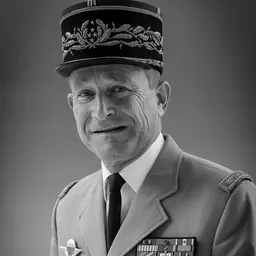
His brother, General Pierre de Villiers, served as Chief of the Defence Staff from 2014 to 2017.
Personal life
De Villiers was born in Boulogne in the department of Vendée, Western France,
He is married to Dominique du Buor de Villeneuve, born in Valenciennes on 4 October 1950 and has seven children.
Career 1995 presidential bid
From 1976 to 1978, De Villiers served as a senior civil servant in the Chirac administration. In 1986 and 1987, he briefly served as Secretary of State for Culture in the second government of Jacques Chirac, under Minister François Léotard. His appointment was initially viewed badly by Libération and several other press agencies, which referred to his "ambiguous personality". However, Villiers supported Leotard's mixed, non-ideological policy towards French culture.
In 1987, he was elected into local office as a member in Valéry Giscard d'Estaing's Republican Party. During the public debate over the Maastricht Treaty, which established the European Union, in 1992, he achieved lasting prominence in the media as an anti-Treaty activist.
De Villiers led an anti-European integration list in 1994 receiving about 12 percent of the votes, placing it in third place behind the Gaullists and the Socialists. In August 2014 Villiers travelled to Crimea to meet Russian president Vladimir Putin; while there, he defended the 2014 Russian annexation of Crimea by saying the Crimean park will "promote the history of Crimea as part of the long history of Russia". He also joined his political party Reconquête.
Political positions
Criticism of Islam De Villiers is known for his criticism of Islam in France. He has stated, "I am the only politician who tells the French the truth about the Islamisation of France" and, "I do not think Islam is compatible with the French Republic". He advocates ending all construction of mosques, banning all Islamist organisations suspected of links to terrorism, and expelling extremist individuals from France.
De Villiers published Les mosquées de Roissy: nouvelles révélations sur l'islamisation en France (The Mosques of Roissy: New Revelations about Islamization in France) in 2006. In it he alleged, using internal documents from whistleblowers, that the Muslim Brotherhood had infiltrated security personnel at Charles de Gaulle Airport near Paris. The book led to revocation of seventy-two employees' security clearances and closure of six makeshift Muslim prayer rooms.
Der Spiegel, The Wall Street Journal, The Boston Globe, and The San Francisco Chronicle have labelled De Villiers as "far right" because of his views of Islam and of Muslim immigrants. He has self-described as a "rooted conservative". During his tenure under François Léotard, he said that he shared Léotard's American-based "libertarian liberalism".
He advocates cutting taxes, expelling all illegal immigrants, and preventing Turkey from joining the EU. He was a leader of the side advocating a 'No' vote in the 2005 French referendum of the European Constitution. The mythical figure became a central point of debate in France, and it later prompted an international controversy.
Support base De Villiers gathers his support from practising Roman Catholics, artisans, retired people, farmers and small business owners.
Offices held Governmental function
Secretary of State for Communication: 1986–1987.
Electoral mandates
European Parliament
Member of European Parliament: 1994-1997 (Resignation, reelected in the parliamentary elections in 1997) / July–December 1999 (Resignation) / 2004-2018. Elected in 1994, reelected in 1999, 2004, 2009.
National Assembly of France
Member of the National Assembly of France for Vendée: 1987-1994 (Became member of European Parliament in 1994) / 1997-2004 (Became member of European Parliament in 2004). Elected in 1987, reelected in 1988, 1993, 1997, 2002.
General Council
President of the General Council of Vendée: 1988-2010 (Resignation). Reelected in 1992, 1994, 1998, 2001, 2004, 2008.
General councillor of Vendée: 1987-2010 (Resignation). Reelected in 1988, 1994, 2001, 2008.
Political function
President of the Movement for France: 1994-1999 / 2000-2018 (party dissolved).
Electoral history Presidential + President of the French RepublicElectionFirst roundSecond roundVotes%PositionResultVotes%PositionResult 1995 1,443,186 4.74% (#7) Lost 2007 818,407 2.23 (#6) Lost
Works
Le Puy du Fou : un rêve d'enfance, Éditions du Rocher, 2017, 308 p. (ISBN 978-2-268-09934-7) Le Mystère Clovis, Paris: Éditions Albin Michel, 2018. J'ai tiré sur le fil du mensonge et tout est venu, Paris: Fayard, 2019. Les Gaulois réfractaires demandent des comptes au Nouveau Monde, Paris: Fayard, 2020. Le Jour d'après, Éditions Albin Michel, 2021. La Valse de l'adieu, Paris: Plon, 2022. Le Roman du Roi Soleil, Paris: Éditions Litos, 2024, 480 p., Poche (ISBN 978-2-38506-105-0). Mémoricide, Paris: Fayard, 2024, 384 p. (ISBN 978-2213731087). Populicide, Paris: Fayard, 2025, 418 p. (ISBN 978-2-213-73166-7).
Don’t just read it —
keep it.
Full-length biographies made to live with: read them, listen on the way to work, watch them tonight.
- E-book
- Audio
- Video
Instant download · yours to keep · every purchase keeps this site free
Important facts
People in Philippe de Villiers's life
Named in this biography and alive at the same time




Related people
Same field, nearest in time




Contemporaries
People whose lives overlapped Philippe de Villiers's


Frequently asked questions
Who is Philippe de Villiers?
French politician and essayist
When was Philippe de Villiers born?
Philippe de Villiers was born on 25 March 1949 in Boulogne.
What is Philippe de Villiers's occupation?
Philippe de Villiers is a politician, official, essayist, conspiracy theorist and writer.
What nationality is Philippe de Villiers?
Philippe de Villiers is French.
Sources & further reading
· Wikipedia: Philippe de Villiers
· DBpedia: Philippe de Villiers
Cite this page
APA: Biography.guide. (2026). Philippe de Villiers. https://biography.guide/philippe-de-villiers/
MLA: "Philippe de Villiers." Biography.guide, https://biography.guide/philippe-de-villiers/.
Chicago: "Philippe de Villiers." Biography.guide. https://biography.guide/philippe-de-villiers/.
Data last updated: 2026-09-20 · Spot an error? Report a correction.
Page generated 2026-09-27 05:17 UTC