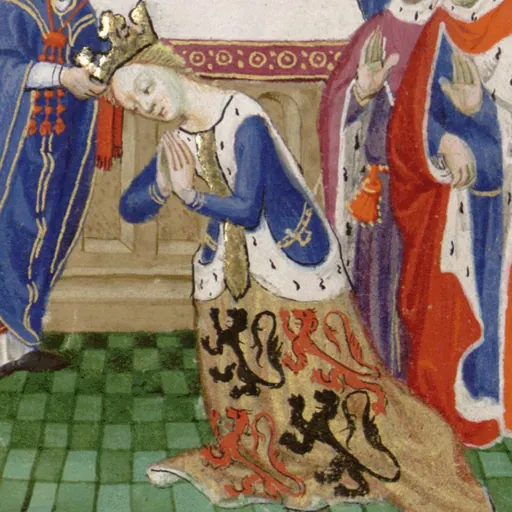
Philippa of Hainault
Queen consort of King Edward III of England
About Philippa of Hainault
Lived 1310 – 1369 (aged 59). Philippa of Hainault was an English regent.
Philippa of Hainault (sometimes spelled Hainaut; Middle French: Philippe de Hainaut; 24 June 1310? (in or by 1315) – 15 August 1369) was Queen of England as the wife and political adviser of King Edward III. She acted as regent in 1346, when her husband was away for the Hundred Years' War.
Daughter of William I, Count of Hainaut, and French princess Joan of Valois, Philippa was engaged to Edward, Prince of Wales, in 1326. Their marriage was celebrated in York Minster on 24 January 1328, some months after Edward's accession to the throne of England and Isabella of France's infamous invasion. After her husband took the throne, Philippa influenced King Edward to take interest in the nation's commercial expansion, was part of the successful Battle of Neville's Cross, and often went on expeditions to Scotland and France. She won much popularity with the English people for her compassion in 1347, when she successfully persuaded the King to spare the lives of the Burghers of Calais. This popularity helped maintain peace in England throughout their long reign.
Childhood
Philippa may have been born on 24 June 1310, but it is possible that she was born as late as 1315, in Valenciennes, Low Countries.
King Edward II of England decided that an alliance with Flanders would benefit England and sent Bishop Stapledon of Exeter on the Continent as an ambassador. On his journey, he crossed into the County of Hainaut to inspect the daughters of Count William, to determine which daughter would be the most suitable as an eventual bride for the king's son Edward. The bishop's report to the King describes one of the Count's daughters in detail. A later annotation says it describes Philippa as a child, but historian Ian Mortimer argues that it is actually an account of her older sister Margaret. The description runs:
Growing up in the Low Countries in the period when this region was growing into a major trading centre, Philippa was well versed in finances and diplomacy. Her older sister Margaret succeeded their brother, William II, upon his death in battle. The counties of Holland and Zeeland and the seigniory of Frisia were devolved to Margaret after agreement between the sisters.
Four years later, in the summer of 1326, Isabella of France, the queen of England, arrived at the court of Hainaut to seek aid from Count William in order to depose her husband, Edward II, from the throne. Her son Edward had accompanied his mother to Hainaut, where she arranged the betrothal to 13-year-old Philippa in exchange for assistance. As the couple were second cousins (as great-grandchildren of Philip III of France), a papal dispensation was required; it was sent from Pope John XXII at Avignon in September 1327. Philippa's retinue arrived in England in December, escorted by her uncle John. On 23 December, she reached London where a "rousing reception was accorded her".
Queen of England
First years In October 1327, Philippa married Edward by proxy through the Bishop of Coventry in Valenciennes. The official marriage was at York Minster on 24 January 1328, eleven months after Edward's accession to the English throne; although the de facto rulers were Queen Mother Isabella and her lover, Roger Mortimer, 1st Earl of March, who jointly acted as his regents. Soon after their marriage, the couple retired to live at Woodstock Palace in Oxfordshire. Unlike many of her predecessors, Philippa did not alienate the English people by retaining her foreign retinue or bringing large numbers of foreigners to the English court. In August, her dower was fixed. She gave birth to her first son, Edward, the following June. In October 1330, King Edward commenced his personal rule by staging a coup and ordering the arrest of the regents. Shortly afterward, Mortimer was executed for treason and the Queen Mother was sent to Castle Rising in Norfolk, where she spent a number of years under house arrest but with her privileges and freedom of movement eventually restored.
She was invested as a Lady of the Order of the Garter (LG) in 1358.
Political influence Queen Philippa interceding for the Burghers of Calais by J. Doyle Penrose
Philippa worked tirelessly for the crown, maintaining balance between royal and familial duties. She was loved and respected even in tumultuous times as the queen who managed to have a successful marriage with Edward.
As the financial demands of the recent Hundred Years' War were enormous, Philippa wisely advised the King to take interest in the nation's commercial expansion as a different method of covering the expenses. She established the textile industry in Norwich by encouraging Flemish weavers to settle there and promoted coal mining in Tynedale.
Military campaigns
Philippa served as regent of England during the absence of her spouse in 1346. Facing a Scottish invasion, she gathered the English army, fought the Scots at the Battle of Neville's Cross near Durham, and rallied the English soldiers on horse before them prior to the battle. This event resulted in an English victory and the Scottish King David II being taken prisoner and held captive for eleven years.
The Queen's College, Oxford was founded by her chaplain Robert de Eglesfield in her honour.
Issue
Philippa and Edward had thirteen children, including five sons who lived into adulthood. Three of their children died of the Black Death in 1348. The rivalry of their numerous descendants would bring about the long-running and bloody dynastic wars known as the Wars of the Roses in the 15th century.
In popular culture
Philippa is a character in The Accursed Kings, a series of French historical novels by Maurice Druon. She was portrayed by Françoise Burgi in the 1972 French miniseries adaptation of the series, and by Marie de Villepin in the 2005 adaptation.
In 2003, she was voted as 5th on the list of 100 Great Black Britons. The decision to include her on the list was heavily criticised, with many historians commenting that there was no evidence to suggest that Philippa had any African ancestry.
Ancestry
Don’t just read it —
keep it.
Full-length biographies made to live with: read them, listen on the way to work, watch them tonight.
- E-book
- Audio
- Video
Instant download · yours to keep · every purchase keeps this site free
Important facts
Family & relationships
People in Philippa of Hainault's life
Named in this biography and alive at the same time

Related people
Same field, nearest in time

Contemporaries
People whose lives overlapped Philippa of Hainault's
Frequently asked questions
Who was Philippa of Hainault?
queen consort of King Edward III of England
When was Philippa of Hainault born?
Philippa of Hainault was born on 24 June 1310 in Valenciennes.
When did Philippa of Hainault die?
Philippa of Hainault died on 15 August 1369 in Windsor Castle.
What was Philippa of Hainault's occupation?
Philippa of Hainault was a regent.
What nationality was Philippa of Hainault?
Philippa of Hainault was English.
Sources & further reading
· Wikipedia: Philippa of Hainault
· DBpedia: Philippa of Hainault
Cite this page
APA: Biography.guide. (2026). Philippa of Hainault. https://biography.guide/philippa-of-hainault/
MLA: "Philippa of Hainault." Biography.guide, https://biography.guide/philippa-of-hainault/.
Chicago: "Philippa of Hainault." Biography.guide. https://biography.guide/philippa-of-hainault/.
Data last updated: 2026-09-23 · Spot an error? Report a correction.
Portrait: Wikimedia Commons · author & licence
Page generated 2026-09-27 05:05 UTC