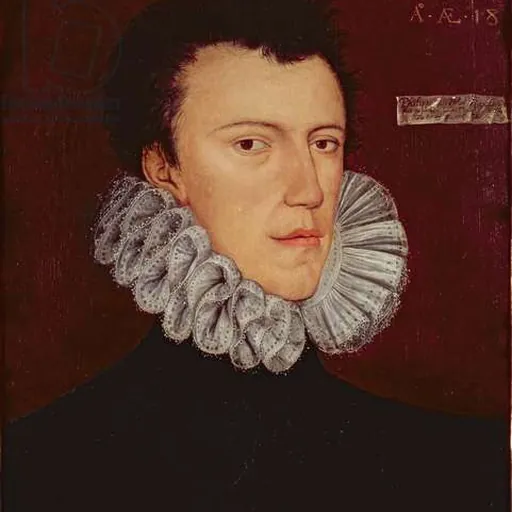
Philip Howard, 20th Earl of Arundel
English nobleman and Catholic saint
About Philip Howard, 20th Earl of Arundel
Lived 1557 – 1595 (aged 38). Philip Howard, 20th Earl of Arundel was a British politician and catholic.
Philip Howard, 13th Earl of Arundel (28 June 155719 October 1595) was an English nobleman. He was canonised by Pope Paul VI in 1970, as one of the Forty Martyrs of England and Wales. Howard lived mainly during the reign of Queen Elizabeth I. He was charged with being a Roman Catholic, quitting England without leave, and sharing in Jesuit plots. For this, he was sent to the Tower of London in 1585. Howard spent ten years in the Tower, until his death from dysentery.
Early life
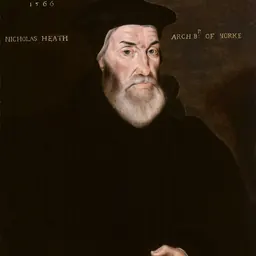
Philip was born at Arundel House, in the Strand, London in 1557, during the upheaval of the English Reformation. He was the only son of Thomas Howard, 4th Duke of Norfolk by his first wife Lady Mary FitzAlan, the youngest daughter of Henry FitzAlan, 12th Earl of Arundel and his first wife, Lady Katherine Grey. He was baptised by the Lord Chancellor and Archbishop of York Nicholas Heath at Whitehall Palace with the royal family in attendance, and named after his co-godfather, King Philip II of Spain, husband of the ruling monarch, Mary I. The baby's other godfather was his grandfather, the 12th Earl of Arundel. His godmother was his great-grandmother, Elizabeth Stafford, widow of the 3rd Duke, who held the child over a gold baptismal font which was kept in the Treasury and normally used only for the baptism of royal children.
Shortly after his birth, his mother became seriously ill and died at Arundel House in August of that year. His mother's death was possibly the result to puerperal infection, a common illness that was caused by poor hygiene during childbirth. From the age of seven, Philip lived in a former Carthusian monastery.
During this time, Philip was sent to study at St John's College, Cambridge. While Howard was studying there, his wife came under the protection of Henry FitzAlan, 12th Earl of Arundel, Philip's maternal grandfather.
Philip graduated in 1574, when he was seventeen. He began to attend Elizabeth I's court by the time he turned eighteen just a few years after his father had been executed for treason against the Queen. His life at Cambridge had been frivolous and remained so at court, where, despite his troubled family past, he nevertheless became a favourite of the Queen.
In July 1578, his maternal aunt, Jane FitzAlan, died without living descendants, as her three children from her marriage to John Lumley, 1st Baron Lumley had all died during infancy. On the death of his aunt, Philip became the sole surviving descendant of his maternal grandfather, and was heir to the earldom of Arundel and its subsidiary titles, and all of FitzAlan's extensive properties in Sussex. These included Arundel Castle, the main residence of the FitzAlan family, which later became the principal home of Philip's descendants. After his grandfather's death in February 1580, Howard received the entire inheritance of his maternal family, and the Queen made him Earl of Arundel. Since then, the Earldom of Arundel has remained linked to the senior line of the Howard family, and with the restoration of the Dukedom of Norfolk in 1660, the title became one of the Dukes' subsidiary (courtesy) titles.
Philip was originally baptised as a Catholic and, although he received a Protestant education, Catholicism was never far below the surface, mostly because his close relations had remained loyal to the Catholic Church during the Reformation. His maternal grandfather was a staunch Catholic and his father, who had also been a Catholic educated as a Protestant, was disgraced for having conspired against Queen Elizabeth with the intention of replacing her with Mary, Queen of Scots and thus restore Catholicism in England. His paternal grandfather, the Earl of Surrey, also fell out of favour and was executed by Henry VIII, partly because he was a Catholic.
In 1583, the Earl was suspected of complicity in the Throckmorton Plot. He prepared to escape to the Spanish Netherlands, but his plans were interrupted by a visit from Elizabeth to his house in London; she ordered him to confine himself there.
The same year, the Countess of Arundel, without her husband's knowledge and in great fear of his displeasure, secretly returned to the illegal and underground Catholic Church in England. After much effort, she successfully regained her husband's affection.
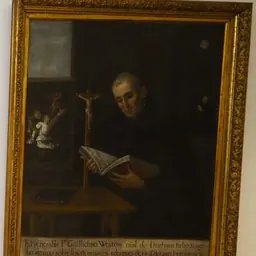
On 30 September 1584, the Earl was secretly received again into the Catholic Church by the Jesuit priest, Father William Weston. At the same time, the Earl's younger half-brother, Lord William Howard, was also received into Catholicism. While still attending Elizabeth's court, Arundel successfully hid his adherence to Catholicism for a time, before withdrawing to his home and attempting to focus on being a better husband and father. The next year, Howard acted against Father Weston's cautions and attempted to flee to mainland Europe in order to live openly as a Catholic with his wife and children.
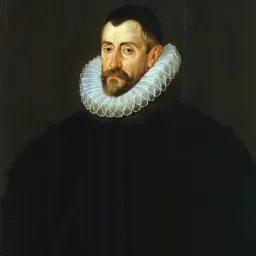
His flight abroad was recommended and planned, and later betrayed to Sir Francis Walsingham, by a trusted servant, whom Father Philip Caraman identifies as the Earl's chaplain, underground Catholic priest and agent provocateur Father Edward Grately. Although many other recusants had been able to flee England successfully, the Earl of Arundel, through his kinship to the late Anne Boleyn, was a second cousin once removed of the Queen and was widely considered by persecuted Catholics who were plotting regime change to be a possible heir presumptive to the English throne. On setting sail from Littlehampton, therefore, the Earl's ship was attacked and boarded by English pirates working for the Tudor Navy. The Earl was at first led to believe that the pirate captain only wanted to extort a ransom but, instead, he was arrested and committed to the Tower of London on 25 April 1585. In July 1586 he was offered his freedom if he would carry the sword of state before the Queen to church; he refused. In 1588 he was accused of praying, together with other Catholics, for the victory of the Spanish Armada. He was tried for high treason on 14 April 1589 and found guilty. He was immediately condemned to death and attainted, with all his titles and property declared forfeit to the Crown.
In a letter to Claudio Aquaviva, dated 1 May 1589, Father Henry Garnet recalled:
When the sentence was pronounced and the crowd saw the Earl coming out of the hall with the axe-edge turned in towards him. Bear in mind in the trial of nobles this is the sign that the prisoner has been condemned. All of a sudden, there was a great uproar that was carried miles along the river bank. It was reported that some people demanded an answer, to the following question: what had come of the Queen's clemency that such a splendid and gallant gentleman should suffer condemnation? Other people were passionately indignant that a man who had prayed to God should be executed for the act of Catholic prayer alone. Amongst the accusations brought against him, and the principal charge, indeed, the one on which the whole case turned, was this: he had asked a certain priest to pray for the success of the Spanish fleet. Whereas, in fact, all his enemies could prove is that he stated that prayers should be given every day and night in the Tower of London and in other prisons at that time. This was a time of fundamental persecution [of Catholics] when everyone was expecting a general massacre of all people who followed the religion . The same phrase can be found today on one of the steps of Howard's shrine in Arundel.
Each day he spent several hours in prayer and meditation; he was noted for his patience in suffering and courtesy to unkind keepers.
Death and burial During the autumn of 1595, while dying of dysentery, the Earl petitioned the Queen to be allowed to see his wife and his son, who had been born after his imprisonment. The Queen responded, 'If he will but once attend the Protestant Service, he shall not only see his wife and children, but be restored to his honours and estates with every mark of my royal favour'. To this, Howard is said to have replied: 'Tell Her Majesty if my religion be the cause for which I suffer, sorry I am that I have but one life to lose'. He remained in the Tower, never to see his wife or son again, and died alone on Sunday 19 October 1595.
Father Weston later recalled:
There were some who thought he was carried off by poison. I, however, made careful inquiries of a certain Catholic who had served him as a page at that time in the Tower, but I was never able to get any confirmation of this. As he lay dying he bequeathed to me the breviary which he used: but Father Garnet decided to keep it himself for posterity like some religious object. He did not dare to entrust it to me, for everything I had was likely to be seized at any moment, and he did not think it right to expose to such manifold risk a possession which, he declared, was more precious than gold.
Howard was buried beneath the floor of the church of St Peter ad Vincula, inside the walls of the Tower, where his father's remains also lay. The Earl's funeral and burial, according to Father Caraman, 'cost his frugal Sovereign two pounds'.
After being widowed, the Countess of Arundel took a vow of chastity and never remarried. She spent her remaining days writing Christian poetry, attending mass, and making other religious observances. She had a passion for helping those in need, especially the sick.
In 1624, the dowager Countess and their son obtained permission from King James I to move Howard's remains, first to the residence of the dowager Countess at West Horsley, Surrey, and finally to the Fitzalan Chapel at Arundel Castle in Sussex. Arundel Cathedral, originally dedicated to St. Philip Neri, was commissioned by the 15th Duke of Norfolk in 1868. It was elevated to the status of a cathedral in 1965 and, shortly after Pope Paul VI canonised the Earl as one of the Forty Martyrs of England and Wales in October 1970, its dedication was changed to Our Lady and Saint Philip Howard. On 10 March 1971, in the presence of Monsignor Michael Bowen, then Coadjutor bishop of Arundel and Brighton, and the Chapter of Canons, Howard's remains were moved from the Fitzalan Chapel to the new shrine erected in the cathedral, where the consecration ceremony was held. before, in at least one case, being smuggled to the Spanish Netherlands for publication by exiled English recusant Richard Verstegan.
One example was the Earl's Latin-Elizabethan English translation of An Epistle in the Person of Jesus Christ to the Faithful Soule by John Justus of Landsberg, which was posthumously published at Antwerp (1595, reprinted 1871). Howard's verse translation of Marko Marulić's poem Carmen de doctrina Domini nostri Iesu Christi pendentis in cruce ('A Dialogue Betwixt a Christian and Christ Hanging on the Crosse), served in lieu of an introduction in the Antwerp edition. Howard's poetry translation of Marulić was published again, with updated English orthography, in the March/April 2022 issue of the Traditionalist Catholic literary magazine, St. Austin Review.
Howard also authored three manuscript treatises On the Excellence and Utility of Virtue.
Further detailed research about the Earl's life, as well as several of his works of Christian poetry, were collected by the poet Louise Imogen Guiney and published as part of her 1939 collection The Recusant Poets.
Don’t just read it —
keep it.
Full-length biographies made to live with: read them, listen on the way to work, watch them tonight.
- E-book
- Audio
- Video
Instant download · yours to keep · every purchase keeps this site free
Important facts
Family & relationships
People in Philip Howard, 20th Earl of Arundel's life
Named in this biography and alive at the same time

Related people
Same field, nearest in time
Contemporaries
People whose lives overlapped Philip Howard, 20th Earl of Arundel's
Frequently asked questions
Who was Philip Howard, 20th Earl of Arundel?
English nobleman and Catholic saint (1557-1595)
When was Philip Howard, 20th Earl of Arundel born?
Philip Howard, 20th Earl of Arundel was born on 28 June 1557 in London.
When did Philip Howard, 20th Earl of Arundel die?
Philip Howard, 20th Earl of Arundel died on 19 October 1595 in London.
What was Philip Howard, 20th Earl of Arundel's occupation?
Philip Howard, 20th Earl of Arundel was a politician and catholic.
What nationality was Philip Howard, 20th Earl of Arundel?
Philip Howard, 20th Earl of Arundel was British.
Sources & further reading
· Wikipedia: Philip Howard, 20th Earl of Arundel
· DBpedia: Philip Howard, 13th Earl of Arundel
Cite this page
APA: Biography.guide. (2026). Philip Howard, 20th Earl of Arundel. https://biography.guide/philip-howard-20th-earl-of-arundel/
MLA: "Philip Howard, 20th Earl of Arundel." Biography.guide, https://biography.guide/philip-howard-20th-earl-of-arundel/.
Chicago: "Philip Howard, 20th Earl of Arundel." Biography.guide. https://biography.guide/philip-howard-20th-earl-of-arundel/.
Data last updated: 2026-09-28 · Spot an error? Report a correction.
Portrait: Wikimedia Commons · author & licence
Page generated 2026-10-04 12:22 UTC