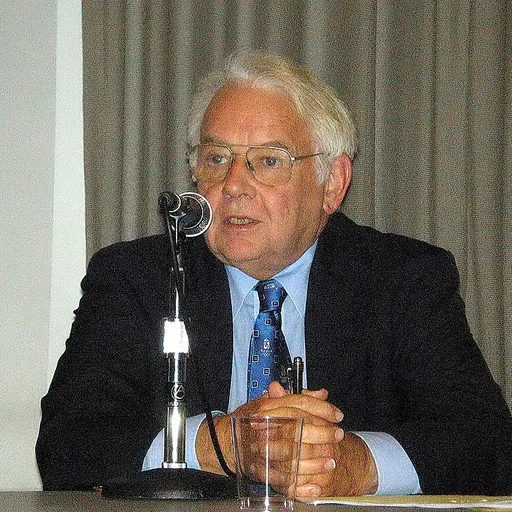
About Peter Stearns
Born 1936. Peter Stearns is an American historian.
Peter Nathaniel Stearns (born March 3, 1936) is a professor at George Mason University, where he was provost from January 1, 2000 to July 2014.
Stearns was chair of the Department of History at Carnegie Mellon University and also served as the Dean of the College of Humanities and Social Sciences (now named Dietrich College of Humanities and Social Sciences) at Carnegie Mellon University. In addition, he founded and edited the Journal of Social History. While at Carnegie Mellon, he developed a pioneering approach to teaching World History, and has contributed to the field as well through editing, and contributing to, the Routledge series, Themes in World History. He is also known for various work on the nature and impact of the industrial revolution and for exploration of new topics, particularly in the history of emotions.
He is active in historical groups such as the Society for French Historical Studies, the American Historical Association, the Social Science History Association and the International Society for Research on Emotion.
Early life Peter Stearns was born in London, but of American parents (Raymond and Elizabeth) and was an American citizen at birth. He was raised in Urbana, Illinois and attended public grade school and then the University of Illinois High School. After graduating from Harvard College, summa cum laude, he had a traveling fellowship in Europe and then returned to complete his PhD at Harvard. He has four children and a stepson, and seven grandchildren. He has held positions at the University of Chicago, Rutgers, Carnegie Mellon, and now George Mason.
Education and career He attended Harvard College and later received his Ph.D. from Harvard University. In his prolific career as an author and editor, he has written or edited over 135 different books. Stearns served as founding chair of the Advanced Placement World History committee and as vice president for teaching of the American Historical Association.
Theoretical work Emotionology Carol Zisowitz Stearns along with her husband Peter were critical of the study of emotions in the field of cultural anthropology because of its overemphasis of the notion that due to their biological and physiological features, emotion can be regarded as a human quality invariant across cultures. Contrary to this bias, their shared view is that emotion is partly cognitive and thus a social phenomenon, so that the forms and conceptions of a single emotion and possibly also its prevalence can vary significantly between communities as well as within one and the same society. In response to the biology vs. culture problem, the Stearns coined the term emotionology by which they refer to the standards according to which emotions are evaluated and the institutions that reflect and promote these standards are developed by different societies. Emotionology is not the same as emotional experience; rather it defines the social norms establishing how one should feel in a given situation. According to this view, emotionological standards also affect the emotional experience itself by shaping articulated expectations.
Works His books include: 1848: The Revolutionary Tide in Europe, Norton, 1974 American Behavioral History
Battleground of Desire
Cultural Change in Modern World History Cultures in Motion Debating the Industrial Revolution (2015) Documents in World History Emotion and Social Change Encyclopedia of European Social History The Encyclopedia of World History
Global Outrage
Guiding the American University: Challenges and Choices (2015) History of Shame (2017) Time in World History (2019)
Knowing, Teaching, and Learning History: National and International Perspectives Lives of Labour: Work in a Maturing Industrial Society (1975)
The Industrial Turn in World History (2016) The Revolutions of 1848 (1974) Tolerance in World History
World Civilizations World History in Brief World History: Patterns of Change and Continuity
Don’t just read it —
keep it.
Full-length biographies made to live with: read them, listen on the way to work, watch them tonight.
- E-book
- Audio
- Video
Instant download · yours to keep · every purchase keeps this site free
Important facts
People in Peter Stearns's life
Named in this biography and alive at the same time

Related people
Same field, nearest in time

Contemporaries
People whose lives overlapped Peter Stearns's






Frequently asked questions
Who is Peter Stearns?
American historian (born 1936)
When was Peter Stearns born?
Peter Stearns was born on 3 March 1936 in London.
What is Peter Stearns's occupation?
Peter Stearns is a historian.
What nationality is Peter Stearns?
Peter Stearns is American.
Sources & further reading
Cite this page
APA: Biography.guide. (2026). Peter Stearns. https://biography.guide/peter-stearns/
MLA: "Peter Stearns." Biography.guide, https://biography.guide/peter-stearns/.
Chicago: "Peter Stearns." Biography.guide. https://biography.guide/peter-stearns/.
Data last updated: 2026-09-23 · Spot an error? Report a correction.
Portrait: Wikimedia Commons · author & licence
Page generated 2026-09-27 05:08 UTC