
About Peter of Bruys
Lived 1095 – 1131 (aged 35–36). Peter of Bruys was a French theologian and priesthood (Catholic Church).
Peter of Bruys (also known as Pierre De Bruys or Peter de Bruis; fl. 1117 – c.1131) was a medieval French proto-Protestant reformer and teacher. He was called a heresiarch and was deprived of his office by the Roman Catholic Church for opposing infant baptism, the erecting of churches and the veneration of crosses, the doctrine of transubstantiation and prayers for the dead. An angry Roman Catholic mob murdered him in or around 1131. His followers became known as Petrobrusians.
Life and teachings Much of the life of Peter of Bruys is unknown; our only information on him is derived from two extant sources, the treatise of Peter the Venerable against the Petrobrusians and a passage written by Peter Abelard. and organ music.
Treatise of Peter the Venerable In the preface to his treatise that attacked Peter of Bruys, Peter the Venerable summed up the five teachings that he saw as the errors of the Petrobrusians. Also known as Peter of Montboissier, he was an abbot and an important religious writer who became a popular figure in the church, an internationally-known scholar and an associate of many national and religious leaders of his day.
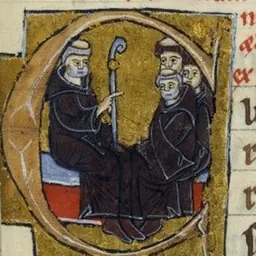
Both Peter the Venerable and Peter Abelard (pictured) attacked the teachings of Peter of Bruys. The first "error" was their denial "that children, before the age of understanding, can be saved by the baptism... According to the Petrobrusians, not another's, but one's own faith, together with baptism, saves, as the Lord says, 'He who will believe and be baptized will be saved, but he who will not believe will be condemned.'" That idea ran counter to the medieval Church's teaching, particularly in the Latin West, following the theology of Augustine, in which the baptism of infants and children played an essential role in their salvation from the ancestral guilt of original sin.
The second error charged (with some exaggeration) was that the Petrobrusians said, "Edifices for temples and churches should not be erected... The Petrobrusians are quoted as saying, 'It is unnecessary to build temples, since the church of God does not consist in a multitude of stones joined together, but in the unity of the believers assembled.'"
The third error enumerated by Peter the Venerable was that the Petrobrusians "command the sacred crosses to be broken in pieces and burned, because that form or instrument by which Christ was so dreadfully tortured, so cruelly slain, is not worthy of any adoration, or veneration or supplication, but for the avenging of his torments and death it should be treated with unseemly dishonor, cut in pieces with swords, burnt in fire." The theory had long been widely accepted as orthodox doctrine at the time of the attacks by Peter of Bruys. Less than two centuries later, in 1215, the Fourth Lateran Council officially declared transubstantiation the necessary, orthodox Catholic explanation of the Eucharist.
The fifth error was that "they deride sacrifices, prayers, alms, and other good works by the faithful living for the faithful dead, and say that these things cannot aid any of the dead even in the least... The good deeds of the living cannot profit the dead, because transferred from this life their merits cannot be increased or diminished, because beyond this life, there is no longer place for merits, only for retribution. Nor can a dead man hope to gain from anybody that which he did not obtain while alive in the world. Therefore those things are pointless that are done by the living for the dead, because they are mortal and have passed by death beyond the way for all flesh, into the state of the future world, and took with them all their merit, to which nothing can be added."
His teachings continued to be frequently condemned by the Roman Catholic Church, meriting mention at the Second Lateran Council in 1139. The sects both disappear from the historical record after that reference.
Peter is considered a forerunner of the Protestant Reformation by some evangelical Protestants and Anabaptists.
Don’t just read it —
keep it.
Full-length biographies made to live with: read them, listen on the way to work, watch them tonight.
- E-book
- Audio
- Video
Instant download · yours to keep · every purchase keeps this site free
Important facts
People in Peter of Bruys's life
Named in this biography and alive at the same time

Related people
Same field, nearest in time




Contemporaries
People whose lives overlapped Peter of Bruys's

Frequently asked questions
Who was Peter of Bruys?
12th century heresiarch
When was Peter of Bruys born?
Peter of Bruys was born in 1095 in Bruis.
When did Peter of Bruys die?
Peter of Bruys died in 1131 in Saint-Gilles.
What was Peter of Bruys's occupation?
Peter of Bruys was a theologian and priesthood (Catholic Church).
What nationality was Peter of Bruys?
Peter of Bruys was French.
Sources & further reading
Cite this page
APA: Biography.guide. (2026). Peter of Bruys. https://biography.guide/peter-of-bruys/
MLA: "Peter of Bruys." Biography.guide, https://biography.guide/peter-of-bruys/.
Chicago: "Peter of Bruys." Biography.guide. https://biography.guide/peter-of-bruys/.
Data last updated: 2026-09-25 · Spot an error? Report a correction.
Page generated 2026-09-27 05:13 UTC