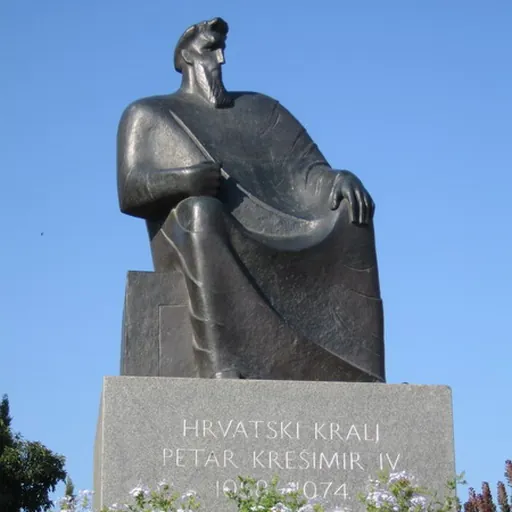
About Peter Krešimir IV of Croatia
Peter Krešimir IV of Croatia was a Croatian monarch.
Peter Krešimir IV was King of Croatia and Dalmatia from 1058 until his death in 1074. He was the last ruler of the Krešimirović branch of the Trpimirović dynasty.
Under Peter Krešimir IV, the Croatian realm reached its peak territorially. He kept his seat at Nin and Biograd na Moru; however, the city of Šibenik holds a statue of him and is sometimes called "Krešimir's city" (Croatian: "Krešimirov grad") because he is generally credited as the founder.
Biography
Early years Peter Krešimir was born as one of two children to king Stephen I (Stjepan I) and his wife Hicela, daughter of the Venetian Doge Pietro II Orseolo. Krešimir succeeded his father Stephen I upon his death in 1058 and was crowned the next year. It is not known where his coronation took place, but some historians suggest Biograd as a possibility.
From the outset, he continued the policies of his father, and was immediately requested in letter by Pope Nicholas II first in 1059 and then in 1060 to further reform the Croatian church in accordance with the Roman rite. This was especially significant to the papacy in the aftermath of the Great Schism of 1054, when a papal ally in the Balkans was a necessity. Upon a visit of the papal legate Mainardius in 1060, at Church sabor in Split in 1061, Krešimir and the upper nobility lent their support to the pope and the church of Rome. To his time period, and possibly rulership over Bosnia as well, dates the foundation of the Roman Catholic Diocese of Bosnia (somewhere between 1060 and 1074).
Ruins of Monastery of Saint John the Evangelist in Biograd na Moru. Church conclusions were made also against the Croatian Glagolitic priesthood and other having long beards and hair style, marriages, and that the secular government does not interfere in the affairs of the church, in aim to distance them from Byzantine orientalism. More so, the ecclesiastical service was likely practiced in the native Slavonic (Glagolitic), whereas the pope demanded practice in Latin. This caused a rebellion of the clergy led by a bishop of Krk Cededa and a certain priest named Vuk (Ulfus), They protested against celibacy and the Roman Rite in 1063, but they were proclaimed heretical at a synod of 1064 and excommunicated, a decision which Krešimir supported. Krešimir harshly quelled all opposition and sustained a firm alignment towards western Romanism, with the intent of more fully integrating the Dalmatian populace into his realm.
In turn, he could then use them to balance the power caused by the growing feudal class. By the end of Krešimir's reign, feudalism had made permanent inroads into Croatian society and Dalmatia had been permanently associated with the Croatian state, and the last Byzantine protospatharios and katepano of Dalmatia, named Leo, is mentioned in 1067 and 1069.
The income from the cities further strengthened Krešimir's power, and he subsequently fostered the development of more cities, such as Biograd, Nin, Šibenik, Karin, and Skradin. He also had several monasteries constructed, like the Benedictine monasteries of St John the Evangelist (1060) and St Thomas (c. 1066) in Biograd, and donated much land to the Church. In 1066, he granted a charter to the new monastery of St. Mary in Zadar, where the founder and first nun was his cousin, the abbess Čika. This remains the oldest Croatian monument in the city of Zadar, and became a spearhead for the reform movement. During the same year, he gave his nephew Stephen Trpimirović the office of Duke of Croatia, which designated him as his co-ruler and successor.
In 1067, the northern part of the kingdom was invaded by Ulric I, Margrave of Carniola, who occupied a part of Kvarner and the eastern coast of Istria, the "March of Dalmatia". As the king was at that time preoccupied with the liturgical issues and reforms in Dalmatia, these parts were eventually liberated by his ban Demetrius Zvonimir.
Territorial policy
It was during his rule that, for the first time, the high-ranking office of ban started to branch, as multiple bans were first mentioned in 1067. Older generation of historians like Ferdo Šišić and Miho Barada assumed, apart from the ban of Croatia, that the banate of Slavonia existed during this period, and that was held by Krešimir's successor Demetrius Zvonimir. However, other historians like Nada Klaić and Neven Budak reject or doubt such a thesis because there is lack of historical evidence.
The city of Šibenik is for the first time mentioned during his rule in 1066, which was his seat for some time and is for these reasons referred to as "Krešimir's city" in modern times. In 1069, he gave the island of Maun, near Nin, to the monastery of St. Krševan in Zadar, in thanks for the "expansion of the kingdom on land and on sea, by the grace of the omnipotent God" (quia Deus omnipotens terra marique nostrum prolungavit regnum). In his surviving document, Krešimir nevertheless did not fail to point out that it was "our own island that lies on our Dalmatian sea" (nostram propriam insulam in nostro Dalmatico mari sitam, que vocatur Mauni).
Around 1070, Krešimir was rumored to have previously murdered his brother Gojslav (some historians identify with Gojčo, Ban of Croatia who served until 1069). Eventually, when the rumors reached abroad, Pope Alexander II sent one of his legates, Mainardius, to inquire about the death of Gojslav. Only after the monarch and 12 Croatian župans had taken an oath that he did not kill his brother, the Pope symbolically restored the royal power to Krešimir. According to Neven Budak, these events happened at the very beginning of Krešimir's reign because was titled only as princeps and it happened before Mainardius calling of Church sabor in 1060. Krešimir in turn made Demetrius Zvonimir the new Ban of Croatia, and subsequently elevated him as his principal adviser with the title Duke of Croatia. However in 1074, at the invitation of the Dalmatian coastal cities and Byzantium, the Normans invaded the Dalmatian possessions of Croatia from southern Italy, ruling since 19 March the towns of Split, Trogir, Biograd na Moru and Zadar for almost a year. During the invasion, the Norman count Amico of Giovinazzo, who was in Byzantine service and Byzantines instigated the attack on Krešimir because he abandoned emperor's sovereignty, Several centuries later the Ottoman Turks destroyed the church, banished the monks who had preserved it, and destroyed the graves.
Legacy
Krešimir is, by some historians, regarded as one of the greatest Croatian rulers. The RTOP-11 of the Croatian navy was named after Krešimir. The city of Šibenik holds a statue of him and some schools in the vicinity are named after Krešimir.
Don’t just read it —
keep it.
Full-length biographies made to live with: read them, listen on the way to work, watch them tonight.
- E-book
- Audio
- Video
Instant download · yours to keep · every purchase keeps this site free
Important facts
Related people
Same field, nearest in time



Frequently asked questions
Who was Peter Krešimir IV of Croatia?
King of Croatia
When was Peter Krešimir IV of Croatia born?
Peter Krešimir IV of Croatia was born in Venice.
When did Peter Krešimir IV of Croatia die?
Peter Krešimir IV of Croatia died in 1074.
What was Peter Krešimir IV of Croatia's occupation?
Peter Krešimir IV of Croatia was a monarch.
What nationality was Peter Krešimir IV of Croatia?
Peter Krešimir IV of Croatia was Croatian.
Sources & further reading
· Wikipedia: Peter Krešimir IV of Croatia
Cite this page
APA: Biography.guide. (2026). Peter Krešimir IV of Croatia. https://biography.guide/peter-kresimir-iv-of-croatia/
MLA: "Peter Krešimir IV of Croatia." Biography.guide, https://biography.guide/peter-kresimir-iv-of-croatia/.
Chicago: "Peter Krešimir IV of Croatia." Biography.guide. https://biography.guide/peter-kresimir-iv-of-croatia/.
Data last updated: 2026-09-23 · Spot an error? Report a correction.
Portrait: Wikimedia Commons · author & licence
Page generated 2026-09-27 05:08 UTC