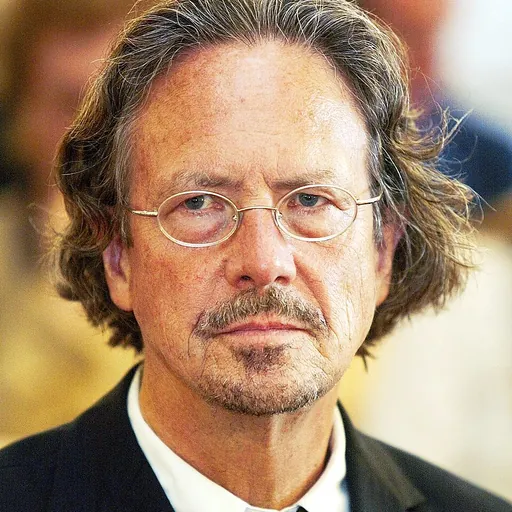
Peter Handke
Austrian writer, playwright and film director (born 1942)
About Peter Handke
Born 1942. Peter Handke is an Austrian writer, film director, screenwriter, translator, playwright and prose writer.
Peter Handke (; born 6 December 1942) is an Austrian novelist, playwright, translator, poet, film director, and screenwriter. He was awarded the 2019 Nobel Prize in Literature "for an influential work that with linguistic ingenuity has explored the periphery and the specificity of human experience." Handke is considered to be one of the most influential and original German-language writers in the second half of the 20th century.
In the late 1960s, he earned his reputation as a member of the avant-garde with such plays as Offending the Audience (1966) in which actors analyze the nature of theatre and alternately insult the audience and praise its "performance", and Kaspar (1967). His novels, mostly ultra objective, deadpan accounts of characters in extreme states of mind, include The Goalie's Anxiety at the Penalty Kick (1970) and The Left-Handed Woman (1976). Prompted by his mother's suicide in 1971, he reflected her life in the novella A Sorrow Beyond Dreams (1972).
A dominant theme of his works is the deadening effects and underlying irrationality of ordinary language, everyday reality, and rational order. Handke has drawn significant controversy for his public support of Serbian nationalism in the wake of the Yugoslav Wars.
Life Early life and family Handke was born in Griffen, in Carinthia, Austria
After leaving Graz, Handke lived in Düsseldorf, Berlin, Kronberg, Paris, the U.S. (1978–1979) and Salzburg (1979–1988). He is the subject of the documentary film Peter Handke: In the Woods, Might Be Late (2016), directed by Corinna Belz. Since 2012, Handke has been a member of the Serbian Academy of Sciences and Arts. He is a member of the Serbian Orthodox Church.
In November 2019, Austrian authorities investigated reports that Handke had obtained a Yugoslav passport and possibly Yugoslav nationality during the 1990s, which could have triggered automatic loss of his Austrian citizenship. The investigation was closed in 2021.
Career While studying, Handke established himself as a writer, linking up with the Grazer Gruppe (the Graz Authors' Assembly), an association of young writers.
Handke abandoned his studies in 1965, He co-founded the Grazer Autorenversammlung in 1973 and was a member until 1977.
In 2019, Handke was awarded the Nobel Prize in Literature "for an influential work that with linguistic ingenuity has explored the periphery and the specificity of human experience." John Updike reviewed the same novel in The New Yorker and was equally impressed, noting that "there is no denying his [Handke's] willful intensity and knifelike clarity of evocation. He writes from an area beyond psychology, where feelings acquire the adamancy of randomly encountered, geologically analyzed pebbles." The Frankfurter Allgemeine Zeitung described him as "the darling of the West German critics." Hugo Hamilton stated that, since his debut, Handke "has tested, inspired and shocked audiences." Joshua Cohen noted that Handke "commands one of the great German-language prose styles of the post-war period, a riverine rhetoric deep and swift and contrary of current," while Gabriel Josipovici described him, "despite reservations about some of his recent work," as one of the most significant German-language writers of the post-war era. W. G. Sebald was inspired by Handke's intricate prose. In an essay on Repetition, he wrote about "a great and, as I have since learned, lasting impression" the book made on him. "I don’t know," he lauded, "if the forced relation between hard drudgery and airy magic, particularly significant for the literary art, has ever been more beautifully documented than in the pages of Repetition." Karl Ove Knausgård described A Sorrow Beyond Dreams as one of the "most important books written in German in our time." The book and its author were also praised in Knausgård's My Struggle.
Controversies
In 1996, Handke's travelogue Eine winterliche Reise zu den Flüssen Donau, Save, Morawa und Drina oder Gerechtigkeit für Serbien (published in English as A Journey to the Rivers: Justice for Serbia) created controversy, as Handke portrayed Serbia as being among the victims of the Yugoslav Wars. In the same essay, Handke also criticised Western media for misrepresenting the causes and consequences of the war. The American translator Scott Abbott, who travelled with Handke through Yugoslavia after which numerous essays were published, stated that Handke considered Yugoslavia as the "incredible, rich multicultural state that lacked the kind of nationalisms that he saw in Germany and Austria". Tanjil Rashid noted that "Handke’s novels, plays and memoirs demonstrate the evil of banality". Salman Rushdie declared him as a candidate for "International Moron of the Year" due to his "idiocies", while Alain Finkielkraut said that he was an "ideological monster", and Slavoj Žižek stated that his "glorification of the Serbs is cynicism".
However, disputing such interpretations of his work as listed above as misinterpreted by the English press, Handke has described the Srebrenica massacre as an "infernal vengeance, eternal shame for the Bosnian Serbs responsible." This concern about the imprecision and political nature of language, carries through Handke's view. In a 2006 interview, Handke commented on concerns about the stereotyped language of the media that "knew everything", endlessly recycling words like "the butcher of Belgrade".
Handke’s literary fame was overshadowed in 2006 by his politics. The writer’s public support of Slobodan Milošević, the former president of Yugoslavia who died that year while on trial for genocide and war crimes, caused controversy after Handke spoke at his funeral. This event once again drew both supportive and critical voices. Renaud Donnedieu de Vabres, the French minister of culture, implicitly criticized Bozonnet's action in a letter addressed to him, and by deciding to invite Handke to the ministry. A petition against the censorship of his work was signed by Emir Kusturica, Patrick Modiano (winner of the Nobel Prize for Literature in 2014), Paul Nizon, Bulle Ogier, Luc Bondy and Handke’s compatriot Elfriede Jelinek (winner of the Nobel Prize for Literature in 2004). Handke was subsequently selected to receive that year’s Heinrich Heine Prize, though he refused it before it was to be revoked from him.
In 2019, The Intercept published a number of articles by Peter Maass criticizing Peter Handke's Nobel Prize in Literature reception. In another article by Intercept, Maass went to great lengths accusing Handke of being an "exponent of white nationalism". Subsequently in an interview conducted by Maass in December 2019, asking Handke whether the 1995 Srebrenica massacre had happened, Handke responded: “I prefer waste paper, an anonymous letter with waste paper inside, to your empty and ignorant questions.” Maass also claims that two Nobel prize jurors were adhering to "conspiracy theories" with regard to American involvement in the Yugoslav conflicts, and that the jurors were "misinformed" about Handke's literary achievements. Peter Handke received countless mails that included threats, or unsanitary content. Germany's Eugen Ruge also protested against the scale of the criticism. In November, around 120 authors, literary scholars, translators and artists expressed their unease in an open letter. They felt that the criticism against Handke was no longer rational.
In February 2020, Handke was decorated with the Order of Karađorđe's Star for "special merits in representing Serbia and its citizens" as he "wholeheartedly defended the Serbian truth". The current President of Serbia Aleksandar Vučić presented recipients on the occasion of the Serbian Statehood Day.
Reactions to the Nobel Prize
Awards 1973: Georg Büchner Prize 1987: Vilenica International Literary Prize 2000: 2002: America Award 2002: Honorary Doctor, University of Klagenfurt 2003: Honorary Doctor, University of Salzburg 2008: Thomas-Mann-Preis 2009: Franz Kafka Prize 2012: Mülheimer Dramatikerpreis 2014: International Ibsen Award 2018: Nestroy Theatre Prize for Lifetime Achievement 2019: Nobel Prize in Literature 2020: Order of Karađorđe's Star 2021: Order of the Republika Srpska 2024: Grand Decoration of Honour in Gold with Sash for Services to the Republic of Austria
Works
Handke has written novels, plays, screenplays, essays and poems, often published by Suhrkamp.
Prose fiction 1966 (The Hornets), novel 1970 Die Angst des Tormanns beim Elfmeter (The Goalie's Anxiety at the Penalty Kick), novel and screenplay of the film The Goalkeeper's Fear of the Penalty (1972) 1972 Der kurze Brief zum langen Abschied (Short Letter, Long Farewell), novel 1972 Wunschloses Unglück (A Sorrow Beyond Dreams: A Life Story), memoir 1975 Die Stunde der wahren Empfindung (A Moment of True Feeling), novel 1976 Die linkshändige Frau (The Left-Handed Woman) 1979 Langsame Heimkehr (Slow Homecoming), start of a tetralogy of stories, including Die Lehre der Sainte-Victoire (1980), Über die Dörfer and (1981) 1983 (Across), story 1986 Die Wiederholung (Repetition), novel 1987 Nachmittag eines Schriftstellers (The Afternoon of a Writer) 1987 Die Abswesenhait (The Absence) 1994 Mein Jahr in der Niemandsbucht. Ein Märchen aus den neuen Zeiten (My Year in the No-Man's-Bay), novel 1997 In einer dunklen Nacht ging ich aus meinem stillen Haus (On a Dark Night I Left My Silent House) 2002 Der Bildverlust oder Durch die Sierra de Gredos (Crossing the Sierra de Gredos), novel 2004 Don Juan (erzählt von ihm selbst) (Don Juan: His Own Version) 2008 Die morawische Nacht (The Moravian Night), novel 2009 Bis dass der Tag euch scheidet oder Eine Frage des Lichts: ein Monolog (Till Day You Do Part or A Question of Light) 2010 Immer noch Sturm (Storm Still) 2011 Der Große Fall (The Great Fall) 2017 Die Obstdiebin oder Einfache Fahrt ins Landesinnere (The Fruit Thief or One-Way Journey into the Interior) 2020 Das zweite Schwert (The Second Sword) 2021 Mein Tag im anderen Land (My Day in the Other Land) 2023 Die Ballade des letzten Gastes (The Ballad of the Last Guest)
Plays 1966 Publikumsbeschimpfung und andere Sprechstücke (Offending the Audience and Other Spoken Plays), play, English version as Offending the Audience and Self-accusation 1967 Kaspar, play, English version also as Kaspar and Other Plays 1973 , play 1990 Das Wintermärchen, William Shakespeare, German translation by Peter Handke. Première Schaubühne Berlin (1990) 1992 Die Stunde, da wir nichts voneinander wußten (The Hour We Knew Nothing of Each Other), play 2010 Immer noch Sturm (Storm Still), a play about the Slovenian uprising against Hitler in 1945, ; first performance: Salzburg Festival 2011 2018 Peter Handke Bibliothek. I. Prose, Poetry, Plays (Vol. 1–9), ; II. Essays (Vol. 10–11), ; III Diaries (Vol. 13–14), 2021
Poetry 1969 Die Innenwelt der Aussenwelt der Innerwelt (The Innerworld of the Outerworld of the Innerworld) 1974 Als das Wünschen noch geholfen hat (Nonsense and Happiness)
Films
1971 Chronik der laufenden Ereignisse (Chronicle of Current Events) 1977 Die linkshändige Frau (The Left-Handed Woman), after his 1976 novel 1985 Das Mal des Todes (The Malady of Death), after Marguerite Duras' 1982 novella
1992 L'Absence (The Absence)
Screenplays 1969 3 amerikanische LP's (3 American LPs), film by Wim Wenders 1972 Die Angst des Tormanns beim Elfmeter (The Goalie's Anxiety at the Penalty Kick), film by Wim Wenders 1975 Falsche Bewegung (Wrong Move), film by Wim Wenders 1987 Der Himmel über Berlin (Wings of Desire), film by Wim Wenders
Don’t just read it —
keep it.
Full-length biographies made to live with: read them, listen on the way to work, watch them tonight.
- E-book
- Audio
- Video
Instant download · yours to keep · every purchase keeps this site free
Important facts
People in Peter Handke's life
Named in this biography and alive at the same time





Related people
Same field, nearest in time

Contemporaries
People whose lives overlapped Peter Handke's


Frequently asked questions
Who is Peter Handke?
Austrian writer, playwright and film director (born 1942)
When was Peter Handke born?
Peter Handke was born on 6 December 1942 in Griffen.
What is Peter Handke's occupation?
Peter Handke is a writer, film director, screenwriter, translator, playwright and prose writer.
What nationality is Peter Handke?
Peter Handke is Austrian.
Sources & further reading
Cite this page
APA: Biography.guide. (2026). Peter Handke. https://biography.guide/peter-handke/
MLA: "Peter Handke." Biography.guide, https://biography.guide/peter-handke/.
Chicago: "Peter Handke." Biography.guide. https://biography.guide/peter-handke/.
Data last updated: 2026-09-22 · Spot an error? Report a correction.
Portrait: Wikimedia Commons · author & licence
Page generated 2026-09-27 05:02 UTC