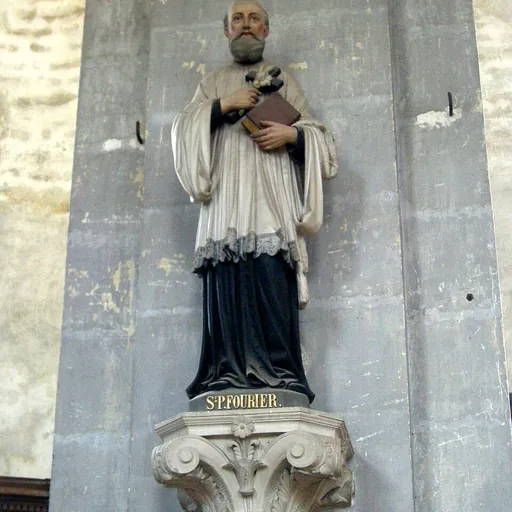
Peter Fourier
French canon regular
About Peter Fourier
Lived 1565 – 1640 (aged 75). Peter Fourier was a French writer, catholic priest, founder of Catholic religious community, catholic theologian and theologian.
Peter Fourier (, ; 30 November 15659 December 1640) was a French canon regular who is honored as a saint in the Roman Catholic Church. Foregoing offers of high office, he served for many years as a pastor in the village of Mattaincourt in the Vosges. He was a strong proponent of free education and also helped to found a religious congregation of canonesses regular dedicated to the care of poor children, developing a new pedagogy for this.
Early life Fourier was born on 30 November 1565 in the village of Mirecourt, in what was then the Duchy of Lorraine, a part of the Holy Roman Empire (now the French department of Vosges), which was a bulwark of the Catholic Counter-Reformation. He was the eldest of the three sons of a cloth merchant and his wife, who were faithful Catholics. At the age of 15, his father enrolled him in the new Jesuit University of Pont-à-Mousson (eventually merged into the University of Lorraine).
In 1585 Fourier was admitted to the novitiate of the canons regular of the Abbey of Chaumousey, where he made his profession of vows two years later. He was ordained a priest at Trier, at the age of 23, on 24 February 1589. His abbot then sent him back to the University of Pont-à-Mousson to further his studies. He became a scholastic theologian who knew the Summa Theologica by heart, who were committed to the free education of children, taking a fourth vow to that goal. Soon there were six schools run by his spiritual daughters. He played an active role in their education, being credited with the invention of the blackboard and its use in the classroom, as well as the division of students into classes of a similar level of instruction. By the time of his death, the number of schools run by the canonesses had grown to forty. They went on to spread their work throughout France, Germany and England.
Fourier's vision also extended to the life of his own Order. He sought to revive a spirit of fervor and discipline in the communities of the canons regular. In 1621 the bishop of Toul, Jean des Porcellets, chose him to organize the canonical communities in his diocese. He therefore entrusted the ancient Abbey of St. Remy in that city to Fourier and six companions, where they could lead the way of life he envisioned. Within four years, eight houses of the Order had embraced his reform. In 1625 they were formed into a new congregation of all the priories of canons in the duchy. To reinforce the reform, any canons who wished to join had to undergo a new novitiate and profession of vows. Otherwise they could retire with a pension from the canonical life. On 11 February 1628 they were officially established as the Congregation of Our Savior by the Holy See, as a reformed congregation of the Regular Canons of Lorraine.
The method of reform established by Fourier served as a model for the reform of the canons regular in the Kingdom of France, where, with the support of Cardinal Rochefoucauld, the Congregation of France was established with these same conditions. In 1625 Fourier was charged with preaching to the people of the Principality of Salm-Salm, which had embraced Calvinism. and canonized by Pope Leo XIII in 1897. His feast day is celebrated in the Roman Catholic Church on 9 December, the anniversary of his death.
Fourier is honored by a statue of him in St. Peter's Basilica among the founders of religious orders.
Legacy
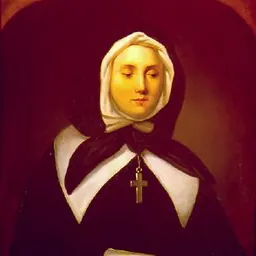
The vision of Fourier was exported to Canada in 1654 by Marguerite Bourgeoys, who was the president of a sodality of volunteers associated with the work of the cloistered canonesses. Moving to New France at the invitation of its governor, she became one of the early founders of the new colony. There she established the Congregation of Notre Dame of Montreal, which was the first to provide education to the children of the colonists, as well as to the Native American children. Her work has been highly successful both there and in the United States of America.
Don’t just read it —
keep it.
Full-length biographies made to live with: read them, listen on the way to work, watch them tonight.
- E-book
- Audio
- Video
Instant download · yours to keep · every purchase keeps this site free
Important facts
People in Peter Fourier's life
Named in this biography and alive at the same time
Related people
Same field, nearest in time

Contemporaries
People whose lives overlapped Peter Fourier's




Frequently asked questions
Who was Peter Fourier?
French canon regular
When was Peter Fourier born?
Peter Fourier was born on 30 November 1565 in Mirecourt.
When did Peter Fourier die?
Peter Fourier died on 9 December 1640 in Gray.
What was Peter Fourier's occupation?
Peter Fourier was a writer, catholic priest, founder of Catholic religious community, catholic theologian and theologian.
What nationality was Peter Fourier?
Peter Fourier was French.
Sources & further reading
Cite this page
APA: Biography.guide. (2026). Peter Fourier. https://biography.guide/peter-fourier/
MLA: "Peter Fourier." Biography.guide, https://biography.guide/peter-fourier/.
Chicago: "Peter Fourier." Biography.guide. https://biography.guide/peter-fourier/.
Data last updated: 2026-09-23 · Spot an error? Report a correction.
Portrait: Wikimedia Commons · author & licence
Page generated 2026-09-27 05:05 UTC