
About Peter Behrens
Lived 1868 – 1940 (aged 71). Peter Behrens was a German poster artist, architect, typographer, painter, designer and graphic designer.
Peter Behrens (14 April 1868 – 27 February 1940) was a leading German architect, graphic and industrial designer, best known for his early pioneering AEG Turbine Hall in Berlin in 1909. He had a long career, designing objects, typefaces, and important buildings in a range of styles from the 1900s to the 1930s. He was a founding member of the German Werkbund in 1907, when he also began designing for AEG, pioneered corporate design, graphic design, producing typefaces, objects, and buildings for the company. In the next few years, he became a successful architect, a leader of the rationalist / classical German Reform Movement of the 1910s. After the First World War, he turned to Brick Expressionism, designing the remarkable Hoechst Administration Building outside Frankfurt, and from the mid-1920s increasingly to New Objectivity. He was also an educator, heading the architecture school at Academy of Fine Arts Vienna from 1922 to 1936. As a well known architect he produced design across Germany, in other European countries, Russia and England. Several of the leading names of European modernism worked for him when they were starting out in the 1910s, including Ludwig Mies van der Rohe, Le Corbusier and Walter Gropius.
Career
Behrens attended the Christianeum Hamburg from September 1877 until Easter 1882. He studied painting in his native Hamburg, as well as in Düsseldorf and Karlsruhe, from 1886 to 1889. In 1890, he married Lilly Kramer and moved to Munich. At first, he worked as a painter, illustrator and bookbinder in an artisanal fashion. He frequented circles that engaged in bohemianism and was interested in subjects related to the reform of lifestyles. During the 1890s Behrens was, alongside Fritz Erler and Wilhelm von Debschitz, among those applied artists who managed to find work in Munich. In the Munich Secession young artists called for art that reflected modern German life.
In 1899 Behrens accepted the invitation of the Grand Duke Ernst-Ludwig of Hesse to be the second member of his recently inaugurated Darmstadt Artists' Colony, where Behrens built his own Jugendstil style house in 1901, and fully conceived everything, from furniture to towels, paintings, pottery, etc. The building of this house is considered to be the turning point in his life, when he left the artistic circles of Munich and showed himself to be a talented architect in his very first project. Untitled aka Der Kuss (The Kiss), circa 1898, by Peter Behrens.
In 1903, Behrens was named director of the Kunstgewerbeschule in Düsseldorf, where he implemented successful reforms, developing new ways of teaching design.
AEG AEG Turbine Factory, 1908–1909, in the Moabit district of Berlin. An early example of industrial classicism. In 1907, AEG (Allgemeine Elektrizitäts-Gesellschaft) retained Behrens as artistic consultant, and his AEG’s Turbine factory was the first large-scale demonstration of the viability and vitality of the Werkbund's initiatives and objectives. He designed the entire corporate identity (logotype, product design, publicity, etc.) and for that he is considered the first industrial designer in history. He also designed a series of factory buildings for them at their two Berlin factory sites, most famously the 1909 AEG Turbine Factory, at the Moabit site, considered an early example of Modernism. He then went on to design four new buildings at the Humboldthain site, which showed that he was as much interested in massive, bold, classical and picturesque effects depending on the context, as expressing modernity. Since Peter Behrens was a consultant rather than an employee of AEG, he was free to work on other projects, and developed a highly successful architectural practice. In this period his growing office had many students and assistants, some who would go on become leading Modernists, including Ludwig Mies van der Rohe, Le Corbusier, Adolf Meyer, Jean Kramer and Walter Gropius (later to become the first director of the Bauhaus).
Immediately after the AEG Turbine Hall, he designed a series of large office buildings in a bold monumental stripped classical form, part of the German Reform Architecture movement. His 1912 German Embassy in St Petersburg, and the Administration Building for Continental AG in Hannover, built 1912–1914 are examples of this period.
Brick Expressionism
After WW1 his work changed again, and like many German architects, he explored the themes and styles of Brick Expressionism. Between 1920 and 1924, he was responsible for the design and construction of the Technical Administration Building of Hoechst AG in Höchst, outside Frankfurt. With its soaring atrium clad in coloured bricks representing the factory's dye products, and an exterior in dark clinker bricks with clocktower and dramatic arch, it is one of the most representative examples of the style in Germany. In 1922, he accepted an invitation to teach at the Academy of Fine Arts Vienna, becoming head of the architecture school, a post he kept until 1936, whilst also designing for a range of clients across Europe.
In 1926, Behrens was commissioned by Wenman Joseph Bassett-Lowke to design a family home in Northampton UK. The house named 'New Ways', a stark white walled rectangular volume (with jagged parapets), is often regarded as probably the first modernist house in Britain, and marks Behrens' turn towards the Modernism of New Objectivity.
Weissenhof Estate In 1925 he was invited by his former student Mies van der Rohe, along with many of the leading German architects working in the new style, to design a residential building in Stuttgart, in the development now known as the Weissenhof. His contribution was a set of apartments in stacked cubic volumes, allowing many apartments to open to large terraces.
Commissions and competitions In 1928 Behrens won an international competition for the construction of the New Synagogue, in Zilina, Slovakia, which was restored in 2012–17 as a cultural centre. The same year he designed a renovation of the Feller-Stern department store in central Zagreb, Croatia, transforming it from Art Nouveau to a complex almost De Stijl Modernist composition. His 1931 hillside villa for the Clara Gans, daughter of Frankfurt industrialist Adolf Gans, was a similarly complex interplay of rectangular volumes, clad in stone, a fine example of New Objectivity.
In 1929, Behrens was invited to the competition for the design of buildings around a proposed radical redesign of Alexanderplatz in Berlin, and though he came second, his designs for the buildings on the south west side of the new square was preferred by the subsequent developer, and the Alexanderhaus and the Berolinahaus were built by 1932.
In 1929, Behrens, in partnership with former student Alexander Popp, was commissioned to design a new factory for the state-run Austria Tabak in Linz, which was built over a long period, due to the economic conditions, finally completed in 1935. The main building has a very long completely horizontal slightly curved facade, Behrens' most striking design in the style of New Objectivity.
Rebuilding Berlin In 1936 Behrens left Vienna to teach architecture at the Prussian Academy of Arts (now the Akademie der Künste) in Berlin, reportedly with the specific approval of Hitler. Behrens participated in Hitler's plans for the rebuilding of Berlin with the commission for the new headquarters of the AEG on Albert Speer's famous planned north–south axis. Speer reported that his selection of Behrens for this commission was rejected by the powerful Alfred Rosenberg, but that his decision was supported by Hitler who admired Behrens's Saint Petersburg Embassy. Behrens died in the Hotel Bristol in Berlin on 27 February 1940, while seeking refuge there from his country estate.
List of projects
1905–1907: Villa Obenauer in Saarbrücken 1905–1908: Eduard Müller Crematorium in Hagen-Delstern 1906: Interior design of the state and city library in the extension of the Kunstgewerbemuseum Düsseldorf 1908–1909: AEG Turbine hall, Berlin-Moabit 1908–1909: Schröder house in Hagen (destroyed in World War II) 1909–1910: Catholic Fellowship House in Neuss 1909–1910: Villa Cuno in Hagen 1909–10: High Voltage Factory, AEG, Berlin – Humboldthain 1910: Boathouse "Elektra" for the Berlin rowing company "Elektra" in Berlin-Oberschöneweide, founded in 1908 as a rowing club for employees and civil servants of the AEG 1910: Exhibition hall (temporary wooden structure, named Hetzerhalle) for the German Railways with a span of 43 meters for the Brussels World Exhibition in 1910, built by the entrepreneur Otto Hetzer from Weimar 1911: Gasworks Ost in Frankfurt am Main, Osthafen 1911: AEG factory settlement in Hennigsdorf 1911–1912: Mannesmann House in Düsseldorf 1911–1912: German Embassy in Saint Petersburg 1911–1912: House for government architect C. H. Goedecke in Hagen 1911–1912: Wiegand house, home for the archaeologist and museum director Theodor Wiegand in Berlin-Dahlem, today the seat of the German Archaeological Institute 1912: AEG Large Motors Factory, Berlin – Humboldthain 1912–1914: Administration building of Continental AG in Hanover (extension 1919–1920), today the House of Economic Development 1913: AEG Small Motors Factory, Berlin – Humboldthain
1914–1917: Factory for the National Automobile Society (NAG) in Berlin-Oberschöneweide (later the factory for television electronics, called Peter-Behrens-Bau) 1915: Wuhlheide forest settlement in Berlin-Karlshorst, Hegemeisterweg 1918: Oberschöneweide settlement in Berlin (built 1919–21 to plans by others, Behrens only designed some single family houses ) 1919: Workers' and master craftsmen's settlement for Deutsche Werft AG in Hamburg-Finkenwerder 1921–1925: Technical administration building of Hoechst AG in Frankfurt-Höchst 1921–1925: Administration building of the Gutehoffnungshütte in Oberhausen 1925: Tomb for Friedrich Ebert in Heidelberg, in the mountain cemetery 1925–1926: College of St. Benedict in Salzburg 1926: 'New Ways', Northampton, UK
1928: Reconstruction of Feller-Stern department store, Ban Jelačić Square in Zagreb, Croatia 1928–1929: U-Bahn stations, line U 8 in Berlin (Moritzplatz, Bernauer Straße, Voltastraße, designed 1912) 1928–1930: Franz-Domes-Hof in Vienna – Margareten 1929: Residence for Kurt Lewin in Berlin- Nikolassee, Waldsängerpfad 3 1929–1930: Group of apartment buildings in Berlin- Westend, Bolivarallee 9 1929–1931: Villa Gans in Kronberg im Taunus, Falkensteiner Straße 19, Hesse 1929–1931: Synagogue in Žilina, Kuzmányho 1 1929–1935: (with Alexander Popp) 1930–1932: Alexanderhaus and Berolinahaus at Alexanderplatz in Berlin 1931: “Ring der Frauen” house at the German Building Exhibition in 1931 in Berlin-Charlottenburg (demolished) 1932–1933: Hohenlanke house near Neustrelitz (planned as a separate retirement home, partially completed) 1933–1951: Christ the King Church in Linz (with Alexander Popp, Hans Feichtlbauer and Hans Foschum)
Typefaces designed by Behrens All faces cast by the Klingspor Type Foundry. Behrens-Schrift (1901–07) Behrens-Antiqua (1907–09) Behrens Mediaeval (1914) 1901 Ein Dokument Deutscher Kunst, Darmstadt Mathildenhöhe and 1904 Amtlicher Katalog Weltausstellung St. Louis
Gallery
Don’t just read it —
keep it.
Full-length biographies made to live with: read them, listen on the way to work, watch them tonight.
- E-book
- Audio
- Video
Instant download · yours to keep · every purchase keeps this site free
Important facts
People in Peter Behrens's life
Named in this biography and alive at the same time




Related people
Same field, nearest in time
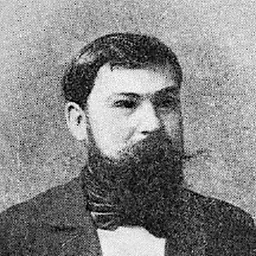

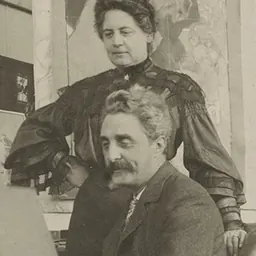
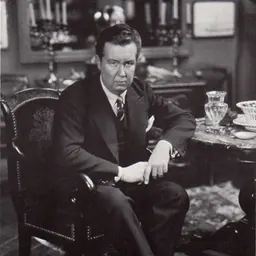
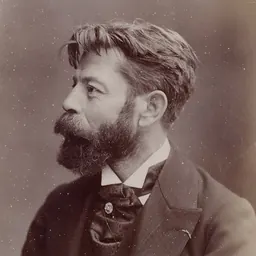
Contemporaries
People whose lives overlapped Peter Behrens's





Frequently asked questions
Who was Peter Behrens?
German architect and designer (1868-1940)
When was Peter Behrens born?
Peter Behrens was born on 14 April 1868 in Hamburg.
When did Peter Behrens die?
Peter Behrens died on 27 February 1940 in Berlin.
What was Peter Behrens's occupation?
Peter Behrens was a poster artist, architect, typographer, painter, designer and graphic designer.
What nationality was Peter Behrens?
Peter Behrens was German.
Sources & further reading
Cite this page
APA: Biography.guide. (2026). Peter Behrens. https://biography.guide/peter-behrens-poster-artist/
MLA: "Peter Behrens." Biography.guide, https://biography.guide/peter-behrens-poster-artist/.
Chicago: "Peter Behrens." Biography.guide. https://biography.guide/peter-behrens-poster-artist/.
Data last updated: 2026-09-20 · Spot an error? Report a correction.
Page generated 2026-09-27 05:32 UTC