Penthesilea Painter
Greek vase painter (c. 5. century BCE)
About Penthesilea Painter
Penthesilea Painter was a Greek red-figure vase painter and attic vase-painter.
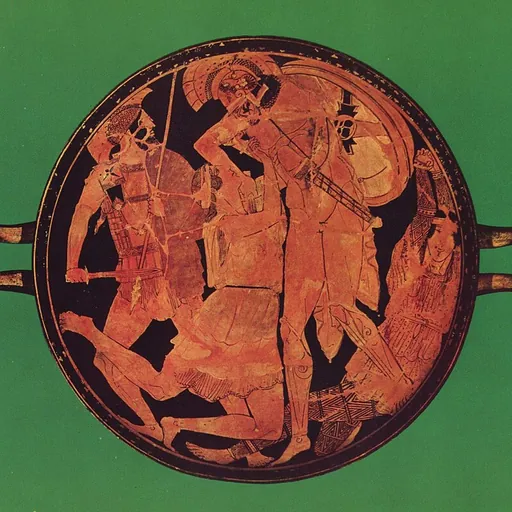
Depiction of Penthesilea, on a bowl from Vulci; circa 470/460 BC. Munich, Staatliche Antikensammlungen.
The Penthesilea Painter (active between 470 and 450 BC at Athens) was a Greek vase painter of the Attic red-figure style. His true name is unknown. His conventional name is derived from his name vase, "bowl 2688" in Munich, the inside of which depicts the slaying of Penthesilea by Achilles. On the basis of that work, John Beazley attributed 177 known vases to the painter, about 100 of which only survive fragmentarily. Bowls, 149 in number, represent the bulk of his work. The rest is distributed among small shapes like skyphoi, kantharoi and bobbins.
Satyr and maenad on a skyphos, Paris, Bibliothèque Nationale, Cabinet des Médailles. His work is characterised by large, space-filling figures whose posture is often bent so as to permit them to fit on a vessel. For the same reason, ornamental decoration around the edges is often very narrow. His works are also characterised by being very colourful, permitting several intermediate shades. Apart from dark coral red and the usual light red, he also used tones of brown, yellow, yellow-white and gold. His figures are painted remarkably meticulously in every detail. Unlike many of his contemporaries, he appears to have painted the subsidiary or exterior images on his vases himself. An exception is his very early "bowl T 212" at the Museo Archeologico Nazionale in Ferrara, with exterior images by the Splanchnoptes Painter. The Penthesilea Painter's works are dominated by depictions of boys and youths engaged in athletic activity, teaching scenes, weaponry and armour, as well as scenes of people talking to horses. While he painted the occasional mythological motif, they are so rare that they should be considered an exception among his work. Throughout his career, scenes from everyday life gain an increasingly dominant share of his paintings.
In his later works, his love of detail is lost and replaced with stencil-like motifs, their basic compositions indistinguishable from typical mass-produced wares. His lines become more casual, but don't lose their certainty, so that even these works preserve a distinctive charm, marking him as one of the great masters of Greek vase painting. His true mastery is increasingly found in the subsidiary images of boys, on which he appears to have concentrated more and more.
His major importance for Classical vase painting lies in the fact that he moved away from the usual motifs and replaced them with typical motifs from everyday life. His emphasis on human aspects represented a new departure and was to be an important influence on the further development of vase painting.
Apart from the Penthesilea bowl, "bowl 2689", also in Munich, is considered his other masterpiece. Its interior shows the slaying of Tityos by Apollo.
Selected works
Name Images Dimensions Type Date Description Museum record Berlin, Antikensammlung bowl skyphos F 2591 fragment of a skyphos 31573, V. 162 Bologna, Museo Civico fragment of a krater 289 Image ---- Calyx krater c.450 Amazonomachy bowl PU 272 Boston, Museum of Fine Arts skyphos 01.8032 H. 23 cm; D. 23 cm Red-figure skyphos c.450 BC Maenads and Pans Record bowl 03.815 H. 15.5 cm red-figure kylix c.460 BC Int: Nymph with scepter and vase; Ext: Two women and four youths Record bowl 13.84 H. 27 cm; D. 27 cm red-figure kylix c.450 BC Int: Youth talking to woman; Ext: Satyrs and Maenads Record bowl 28.48 H. 9.8 cm; D. 23.8 cm red-figure kylix c.460 BC Int: Two boys talking; Ext: Boys at the gymnasium Record Cambridge, Massachusetts, Harvard University Art Museums kylix 1925.30.130 H. 11.3 cm.; D. 27.3 cm Attic Red Figure kylix 470-460 BC Int: Satyr and maenad; ExtA: Warrior presented to Zeus by Iris; ExtB: Departing warrior, with Iris.Chicago, IL, Art Institute of ChicagoKylix 1889.27Attic Red-figure kylix460 BCInt: Youth with woman.Record Ferrara, Museo Archeologico Nazionale bowl T 18 C 150px 150px ---- Attic Red-figure kylix 460-450 BC Int: Apotheosis of Theseus, Ext: Combat bowl T 212 Hamburg, Museum für Kunst und Gewerbe bowl 1900.164 Images ---- Red-figure kylix c.450 BC Int: boy seated with lyre, and youth; Ext: youths and horses London, British Museum bowl E 72 Madison, Wisconsin, Chazen Museum of ArtKylix 1976.31 H. 15.25 cm; D. 45.56 cm Red-figure kylix c.455 BC Int: Theseus fighting the bull of MarathonRecord Munich, Glyptothek and Antikensammlung kantharos 2565 Penthesilea bowl (2688) 150px H. 7 cm; D. 43 cm Attic red-figure kylix 470–460 BC Achilles killing Penthesilea bowl 2689 H. 7 cm; D. 40 cmAttic red-figure kylix 460–450 BCApollo, Tityos and a goddess (probably Gaia defending her son, or Leto). New York, Metropolitan Museum of Art skyphos 06.1079 H. 16.2 cm; D. 30.2 cm Red-figure skyphos c.460 BC A & B: A young man goes to warRecord pyxis 07.286.36150px 150px H. 12.1 cm D. 17.2 cm Attic white-ground pyxis with lid 460-450 The Judgement of Paris Record bobin 28.167150px 150px D. 12.8 cm Attic white-ground bobbin 460-450 BC A: Nike & a youth; B: Eros and a youth Record bowl 41.162.9 H. 16.4 cm; D. 36.7 cm Red-figure kylix c.460 BC Int: Man hunting boar; Ext: Athletes Record Oxford, Ashmolean Museumbowl 1931.12 Image Red-figure kylix c.450 Int: Nike dressing a bull for sacrifice Paris, Bibliothèque Nationale (Cabinet des Médailles)De Ridder 814 150px 150px H. 12.6 cm, L. 41.9 cm, D. 33.7 cm Red-figure kylix 480 - 450 BC Int: Horseman; Ext: Arming scene RecordDe Ridder 849 150px H. 28.9 cm, L. 28.2 cm, D. 20.6 cm Red-figure kantharos c.460 BC Satyrs and Maenads Record Paris, Musée National du Louvre bowl G 382 bowl G 448 150px H. 16.50 cm; L. 44.80 cm; D. 36.10 cm Attic red-figure kylix 460–450 BC Int: Silenus and maenad Philadelphia, University Museum hydria L-64-41 Image dimensions Red-figure hydria 460-450 BC Three women in a domestic scene kylix L-637-1a Image H. 12.5 cm; D. 45.7 cm Red-figure kylix 520-420 BC Int: Boy propositioning a girl; Ext: Departure of young horsemen kylix MS 2495 Image H. 9 cm; D. 24 cm Red-figure kylix 475-450 BC Int: Two boys facing; Ext: Nike and young citizens kylix MS 5693 Image H. 7.8 cm; D. 29 cm Red-figure kylix 460-450 BC Int: Two boys at the gymnasium; Ext: Nike parts a boy and a man Vienna, Kunsthistorisches Museum bowl 3700
Don’t just read it —
keep it.
Full-length biographies made to live with: read them, listen on the way to work, watch them tonight.
- E-book
- Audio
- Video
Instant download · yours to keep · every purchase keeps this site free
Important facts
Related people
Same field, nearest in time



Frequently asked questions
Who was Penthesilea Painter?
Greek vase painter (c. 5. century BCE)
What was Penthesilea Painter's occupation?
Penthesilea Painter was a red-figure vase painter and attic vase-painter.
What nationality was Penthesilea Painter?
Penthesilea Painter was Greek.
Sources & further reading
· Wikipedia: Penthesilea Painter
· DBpedia: Penthesilea Painter
Cite this page
APA: Biography.guide. (2026). Penthesilea Painter. https://biography.guide/penthesilea-painter/
MLA: "Penthesilea Painter." Biography.guide, https://biography.guide/penthesilea-painter/.
Chicago: "Penthesilea Painter." Biography.guide. https://biography.guide/penthesilea-painter/.
Data last updated: 2026-09-22 · Spot an error? Report a correction.
Portrait: Wikimedia Commons · author & licence
Page generated 2026-09-27 05:03 UTC