
About Penny Tweedie
Lived 1940 – 2011 (aged 70). Penny Tweedie was a British photojournalist and photographer.
Penelope "Penny" Anne Tweedie (30 April 1940 – 14 January 2011) was an English photojournalist who is noted for her work with the Aboriginal peoples in Arnhem Land in the late 1970s. Born into a farming family she went to the Guildford School of Art in spite of her parents’ opposition. Tweedie's first job came with Queen in 1961 after it asked her college to send their best performing student to them. She left two years later to go freelance and set herself assignments in which she covered various newsworthy stories.
She and others travelled to East Bengal during the 1971 East Pakistan crisis but were arrested by the Indian Army after they were mistaken for spies. Tweedie was embroiled in controversy when she refused to photograph prisoners accused to being collaborators when she noticed they were to be bayoneted to death for the assembled foreign media.
She was asked by the BBC to photograph the filming of a programme called Explorers: The Story of Burke and Wills in Alice Springs in 1975 and later became fascinated by the lives and work of the Aboriginal people. Her work was widely exhibited and she won the Walkley Award for photojournalism in 1999. Tweedie regularly returned to the United Kingdom and continued to be kept busy until she took her own life in early 2011.
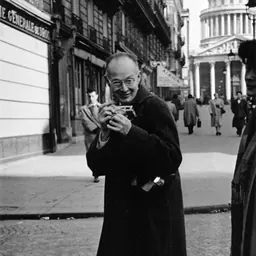
Biography Early life Penelope Anne Tweedie was born on 30 April 1940 at the Fowlers nursing home in Hawkhurst in Kent. She was the oldest of three children and the sole daughter to the farmer John Lawrence Tweedie, who was serving as an aircraftman in the Royal Air Force Volunteer Reserve, and his first wife Anne Ellinor née Wilson. At the time of the registration of Tweedie's birth, Anne was living in Tuckness with her parents. Tweedie was educated at Benenden School. She wanted to become a photographer as she was impressed by the work of Henri Cartier-Bresson but her parents voiced their opposition to her career choice but nevertheless went to Guildford School of Art to study the subject from 1958 to 1961.
Career
Upon graduating from art school, Tweedie found employment at Queen in 1961, a magazine covering London's young smart set, after it asked the Guildford School of Art to send their best performing student to them. Among her subjects during this time was about the painter David Hockney while he was in his final year at the Royal College of Art.
By the late 1960s Tweedie became known as a "swinging London’" photographer as she was seen walking a black Pekingese dog and drove a MGB convertible. She set herself further assignments and this was funded by cover portraits of celebrities for the Radio Times and the Reader's Digest magazines and technically demanding work including the Embassy cigarettes gift catalogue. She and Scollay were two of the five creative artists fellows of 1978 at the Australian National University. In collaboration with the composer Martin Wesley-Smith, Tweedie produced five multi-projector audio-visuals on ‘Kdadalak’ (about Timor in 1977) and ‘Music today '78’ (in Japan). Her work on the Aboriginal people published in the National Geographic. Tweedie wrote her first book This My Country in 1985. A second book, Spirit of Arnhem Land, was published in 1998, and a third called Australia Standing Strong followed three years later.
Tweedie's work was widely exhibited and was awarded the Walkley Award for photojournalism in 1999. She chose not to publish her work before taking the book proofs back to Arnhem Land to ensure that the people were satisfied with their portrayal. Tweedie regularly flew to the United Kingdom where she kept her residence and continued to volunteer with various charities and campaigns. She also kept travelling which saw her work with non-governmental organisations on the effects of landmine victims in Cambodia. At the same time, Tweedie built up a large portfolio of portraits of well-known people and contributed an entire chapter to a book concerning photojournalists and war correspondents. She took stills for the BBC to later Australian productions including the 2002 film Rabbit-Proof Fence. Tweedie returned to Arnhem Land in late 2005 on behalf of Australian Geographic, and made an acclaimed presentation at the 2009 National Union of Journalists' Photographers' conference in London.
During the last years of her life, she cared for her ailing mother in Kent. Tweedie's final work came by the National Trust, and her last publication came in 2010 which contained photographs of Kent and Sussex celebrating thirty years of Hospice in the Weald. She was supposedly despondent at the lack of opportunities in her occupation, she hanged herself in the woods close to her home, called Foxhole Farm, in Hawkhurst, on 14 January 2011. Tweedie was survived by her son, her mother and two brothers. At the urging of the former director of the Victorian College of the Arts Andrea Hall in 2013, the National Library of Australia accepted her whole archive consisting of 160,000 slides, negatives, prints and documents, the library's first acquisition of the lifetime works of a woman photographer.
Don’t just read it —
keep it.
Full-length biographies made to live with: read them, listen on the way to work, watch them tonight.
- E-book
- Audio
- Video
Instant download · yours to keep · every purchase keeps this site free
Important facts
People in Penny Tweedie's life
Named in this biography and alive at the same time





Related people
Same field, nearest in time

Contemporaries
People whose lives overlapped Penny Tweedie's


Frequently asked questions
Who was Penny Tweedie?
British photojournalist
When was Penny Tweedie born?
Penny Tweedie was born on 30 April 1940 in Hawkhurst.
When did Penny Tweedie die?
Penny Tweedie died on 14 January 2011 in Kent.
What was Penny Tweedie's occupation?
Penny Tweedie was a photojournalist and photographer.
What nationality was Penny Tweedie?
Penny Tweedie was British.
Sources & further reading
Cite this page
APA: Biography.guide. (2026). Penny Tweedie. https://biography.guide/penny-tweedie/
MLA: "Penny Tweedie." Biography.guide, https://biography.guide/penny-tweedie/.
Chicago: "Penny Tweedie." Biography.guide. https://biography.guide/penny-tweedie/.
Data last updated: 2026-09-22 · Spot an error? Report a correction.
Page generated 2026-09-27 05:26 UTC