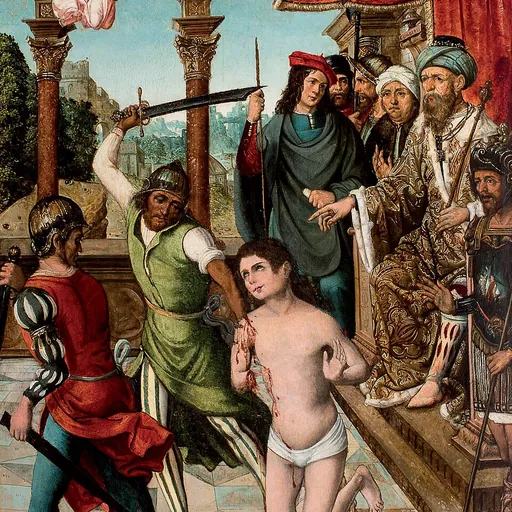
Pelagius of Cordova
10th-century Spanish saint
About Pelagius of Cordova
Lived 912 – 926 (aged 13–14). Pelagius of Cordova was a Spanish.
Pelagius of Córdoba (c. 912–926) (in Spanish San Pelayo Mártir) was a Christian boy who died as a martyr in Córdoba in southern Spain around 926 AD.
Narrative There are three accounts of Pelagius. The earliest, The Martyrdom/Passion of St Pelagius was written by one Raguel, a priest of Córdoba. Other accounts have him being shot from a catapult over the city walls, with the Caliph expecting his body to be dashed on the rocks of the river. When Pelagius emerged from this harsh sentence unharmed, he was then decapitated. The various accounts uphold his refusal to fulfil the Caliph's wishes.
Pelagius was later enshrined as a Christian martyr and canonized as "Saint Pelagius." His commemoration is celebrated on 26 June. The cult of Saint Pelagius is thought to have provided spiritual energy for centuries to the Reconquista (the Christian reconquest of Spain), and is seen by some modern scholars as part of a pattern of portraying Islamic morality as inferior to other moral codes.
Interpretation Jeffrey A. Bowman says that The Martyrdom of St. Pelagius not only demonstrates a conventual attack on Muslim morals, but also depicts a hero who refuses to assimilate. At a time when the Christian minority was attempting to maintain its identity and traditions, its members were increasingly enticed by the more dominant culture. Cordoba was a rich, sophisticated city with many fine houses, libraries, and bath houses. "As Raguel wrote, Christians in Al-Andalus were converting to Islam in increasing numbers. Christian leaders complained that young Christians were more interested in learning Arabic than Latin."
Lisa Weston finds a similar theme in Hrotsvitha's poem. "Produced within and serving the needs of a cultic community, [the] hagiographic narrative enacts this negotiation of licit and illicit desires, and the subsequent formation of boundaries between "us" (the saint's community) and "them" (the persecutors and other non-believers) upon the textual body of the saint." The poet deplores the dissolution of the one into the other. Pelagius spurns Abd-ar-Rahman's touch saying, "It is not right that a man cleansed by the baptism of Christ should submit his chaste neck to a barbaric embrace, nor should a worshipper of Christ, anointed with the sacred chrism, accept the kiss of such a lewd slave of demons".
Don’t just read it —
keep it.
Full-length biographies made to live with: read them, listen on the way to work, watch them tonight.
- E-book
- Audio
- Video
Instant download · yours to keep · every purchase keeps this site free
Important facts
Frequently asked questions
Who was Pelagius of Cordova?
10th-century Spanish saint
When was Pelagius of Cordova born?
Pelagius of Cordova was born in 912 in Albeos (parroquia).
When did Pelagius of Cordova die?
Pelagius of Cordova died in 926 in Córdoba.
What nationality was Pelagius of Cordova?
Pelagius of Cordova was Spanish.
Sources & further reading
· Wikipedia: Pelagius of Cordova
· DBpedia: Pelagius of Córdoba
Cite this page
APA: Biography.guide. (2026). Pelagius of Cordova. https://biography.guide/pelagius-of-cordova/
MLA: "Pelagius of Cordova." Biography.guide, https://biography.guide/pelagius-of-cordova/.
Chicago: "Pelagius of Cordova." Biography.guide. https://biography.guide/pelagius-of-cordova/.
Data last updated: 2026-09-21 · Spot an error? Report a correction.
Portrait: Wikimedia Commons · author & licence
Page generated 2026-09-27 05:01 UTC