
About Pedro Eugenio Aramburu
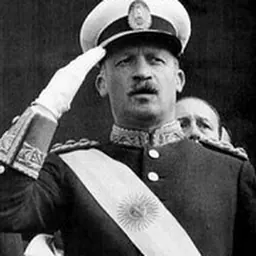
Lived 1903 – 1970 (aged 67). Pedro Eugenio Aramburu was an Argentine dictator and military personnel.
Pedro Eugenio Aramburu Silveti (May 21, 1903 – June 1, 1970) was an Argentine Army general and the President of Argentina from 1955 to 1958. He was a major figure behind the Revolución Libertadora, the military coup against Juan Perón in 1955. He was kidnapped by the left-wing organization Montoneros on May 29, 1970, and then murdered as part of retaliation. He had been involved in the June 1956 execution of Army General Juan José Valleassociated with the Peronist movement and 26 Peronist militants, after a botched attempt to overthrow his regime.
Family Pedro Eugenio Aramburu Silveti was born on May 21, 1903, in Río Cuarto. Both of his parents were born in Spain. His father, Carlos Pantaleón Aramburu, was born in Zestoa, Basque Country, while his mother, Leocadia Silveti, was born in Zuriáin, Navarre. He had eight siblings.
Military career He studied at the National Military College 1922: Sub-lieutenant 1939: Major 1943: War School Teacher 1951: Brigadier War School Headmaster 1955: Commander in Chief of the Army 1958: Lieutenant general.
President of Argentina He served as president of Argentina from November 13, 1955, to May 1, 1958.
The Revolución Libertadora which overthrew Juan Perón was triggered in part by his actions towards the press, as well as the imprisonment of opposition leaders and economic instability. For example, Perón incited his followers to wreck the offices and printing presses of newspapers who criticized him and he jailed the leader of the opposition, Ricardo Balbin, of the Radical Civic Union party. The military Revolución Libertadora against Perón for these actions led to three years of military rule under Aramburu, who allowed elections to be held in 1958.
Aramburu's military government forced Perón into exile and barred the Peronist Party from further elections. Perón lived in exile in Spain until 1973.
He repealed the reelectionist and statist Constitution of 1949 and restored the validity of the historical text of 1853/60, a decision that was later validated by a constituent convention. He promised to hand over power as soon as possible to a president elected by the people. He made a public commitment that none of the military who held positions in his government would accept candidacies when elections were called.
Anti-Peronist political power After the end of his presidential term in 1958, Aramburu retired from the military career and devoted himself entirely to politics.
He ran for president in 1963 as leader of the Union of the Argentine People (Unión del Pueblo Argentino, UDELPA), with the slogan "Vote UDELPA and HE won't return" ("Vote UDELPA y no vuelve"), referring to Perón.
With the Peronists banned, the Presidential elections resulted in Arturo Umberto Illia becoming president, with Aramburu coming in third.
Yet the military retained much real power, censoring both Peronism and its leader. The fragility of Argentine democracy was shown when Illia was overthrown in 1966 by a military coup led by General Juan Carlos Onganía.
In 1970, Aramburu was mentioned as a possible presidential candidate.
Kidnapping and death
On May 29, 1970, at noon, Aramburu was snatched from his apartment in Buenos Aires by two members of Montoneros posing as young army officers. Montoneros dubbed the kidnapping Operación Pindapoy, after a company that produced citrus in the 1960s. Aramburu's disappearance kept Argentinian society on tenterhooks for a month before it was discovered that Aramburu had been assassinated three days after his abduction, following a mock trial and his corpse hidden inside a farmhouse near Timote, Carlos Tejedor, in Buenos Aires Province. He had been shot twice in the chest with two different pistols. Mario Firmenich took credit for the kidnapping and assassination with his partner Esther Norma Arrostito.
In the following weeks, statements from Montoneros flooded the media. Their actions were a response to the executions of twenty-seven Peronist militants who took part in an unsuccessful coup d'état in 1956 (a retaliation).
Don’t just read it —
keep it.
Full-length biographies made to live with: read them, listen on the way to work, watch them tonight.
- E-book
- Audio
- Video
Instant download · yours to keep · every purchase keeps this site free
Important facts
People in Pedro Eugenio Aramburu's life
Named in this biography and alive at the same time




Contemporaries
People whose lives overlapped Pedro Eugenio Aramburu's
Frequently asked questions
Who was Pedro Eugenio Aramburu?
president of Argentina
When was Pedro Eugenio Aramburu born?
Pedro Eugenio Aramburu was born on 21 May 1903 in Río Cuarto.
When did Pedro Eugenio Aramburu die?
Pedro Eugenio Aramburu died on 1 June 1970 in Carlos Tejedor.
What was Pedro Eugenio Aramburu's occupation?
Pedro Eugenio Aramburu was a dictator and military personnel.
What nationality was Pedro Eugenio Aramburu?
Pedro Eugenio Aramburu was Argentine.
Sources & further reading
· Wikipedia: Pedro Eugenio Aramburu
· DBpedia: Pedro Eugenio Aramburu
Cite this page
APA: Biography.guide. (2026). Pedro Eugenio Aramburu. https://biography.guide/pedro-eugenio-aramburu/
MLA: "Pedro Eugenio Aramburu." Biography.guide, https://biography.guide/pedro-eugenio-aramburu/.
Chicago: "Pedro Eugenio Aramburu." Biography.guide. https://biography.guide/pedro-eugenio-aramburu/.
Data last updated: 2026-09-20 · Spot an error? Report a correction.
Page generated 2026-09-27 05:27 UTC