
About Pedro de Medina
Lived 1493 – 1567 (aged 73–74). Pedro de Medina was a Spanish cartographer, astronomer, mathematician, geographer, historian and polygraph.
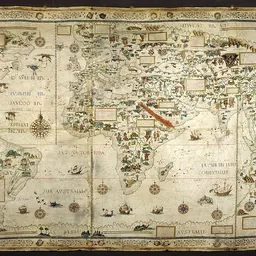
Cross-staff in Regimento de Navegación by Pedro de Medina, 1552. A goniometric instrument used to measure the altitude of stars. Medina's Suma de cosmographia ("Compendium of Cosmography"). The folio-size manuscript on parchment includes 11 beautiful astronomical figures with accompanying text. The illustrations are carefully drawn and illuminated in gold and in bright colors, with the initial letters of text pages in highlighted golden insets. A fine mappa mundi on a double-page spread, illuminated in red, blue, green, sienna, and gold, represents the known world and reflects the state of geographic knowledge in Spain and Portugal at that time. Prominently shown on the map is the line of demarcation, established in the 1494 Treaty of Tordesillas, between the domains of Spain and Portugal. Mappa mundi by Pedro de Medina & G.B. Pedrazano, Venice, 1554
Pedro de Medina (1493 – Seville, 1567) was a Spanish cartographer and author of navigational texts. His well-known Arte de navegar ("The Art of Navigation", 1545) was the first work published in Europe dealing exclusively with navigational techniques (Martín Fernández de Enciso's Suma de Geographia, 1519, which gave ample geographical information already contained solar declination tables with explanations and the corrections for finding the latitude by measuring the height of Polaris).
Early life Medina is believed to have been born in Seville, although based on his name and the protection afforded to him by the Dukes of Medina Sidonia he may instead have been born in Medina-Sidonia. In 1520 he became tutor to Juan Claros Pérez de Guzmán y Aragón, the Count of Niebla and heir to Juan Alfonso Pérez de Guzmán, 6th Duke of Medina Sidonia.
Navigational science and cosmography Earlier career After having amicably parted from the House of Medina Sidonia, he sought recognition as a cosmographer and brought out a text titled Libro de Cosmografía ("Book of Cosmography", 1538). He received official permission to compile navigation maps, to write books about pilotage, and to manufacture navigational devices necessary for voyages to the Indies. In February 1539, he was appointed in Seville as examiner of the navigators and ship's captains who would take part in the conquest of the Indies. His work was closely associated with the "House of Trade" (Casa de Contratación), the Spanish government agency overseeing the exploration and colonization of the New World, although he never succeeded in gaining employment in that agency.
Arte de navegar In 1545 Medina published his most important work, Arte de navegar ("The Art of Navigation") in eight volumes. It was dedicated to the future Philip II, in support of his quest to be appointed royal cosmographer.
Medina acted as royal adviser during the two assemblies convened by the Council of the Indies in 1554 and 1556 to determine the precise position of the Philippines and the Moluccas, and to define the demarcation between Spanish and Portuguese control in that part of the world. Mount Medina in Antarctica is named in his honour.
Other works Medina also wrote historical and philosophical books. In 1548 he published a work titled Libro de las grandezas y cosas memorables de España ("Book of the great deeds and memorable things of Spain"). This dealt with historical acts and important towns in Spain, with engravings and transcriptions of key documents. It was later (1595) revised and expanded by Diego Pérez de Mesa, professor of mathematics at the University of Alcalá. Other works included Libro de la verdad ("Book of truth", 1555), written in furtherance of disputes with the Casa de Contratación, and his last work, (Crónica de los excelentes señores duques Medina Sidonia ("Chronicle of the excellent ducal lords of Medina Sidonia", 1561).
List of works
Obras. Libro de las grandezas y cosas memorables de España. Libro de la verdad, published by Ángel González Palencia, Madrid: CSIC, 1944. Libro de Cosmografía (1538). . First published Valladolid, Francisco Fernández de Córdoba, 1545, many times reprinted and translated. Facsimile copy in Madrid: Patronato del Inst. Nacional del Libro Español, 1945, and an electronic version in Obras clásicas de Náutica y Navegación, Madrid, Fundación Histórica Tavera, 1998, CD-Rom. . First published Seville, Dominico de Robertis, 1548. Facsimile copies: Instituto de España y Biblioteca Nacional, Madrid 1994, with an introduction by Pilar Cuesta Domingo; Maxtor, 1666 edition by Pedro de Robles and Juan de Villanueva. Expanded and republished in 1595 by Diego Pérez de Mesa: Primera y segunda parte de las Grandezas y cosas notables de España, Juan Gracián, 1595. Crónica de España (Sevilla, 1548) . First published Seville, 1549. Included in the Obras edition of 1944. Regimiento de navegación, en que se contienen las reglas, declaraciones y avisos del libro dArte de navegar, Sevilla: Juan Canella, 1 December 1552. Suma de Cosmographia, unpublished manuscript, 1561. Modern editions: facsimile, Seville, Excma Diputación Provincial Patronato de Cultura, 1947; Valencia: Albatros, 1980, in the care of J. Fernández Jiménez; de-luxe edition on two volumes, Madrid: Grial, 1999 with an introduction by Ana García Herráez. Hispaniae Tabula Geographica (Sevilla, 1560). Crónica de los excelentes señores duques Medina Sidonia (1561). Regimiento de navegación compuesto por el maestro Pedro de Medina. Contiene las cosas que los pilotos han de saber para bien navegar: y los remedios y avisos que han de tener para los peligros que navegando les pueden suceder, Sevilla: Simón Carpintero, 1563. Modern edition: Regimiento de navegación. Compuesto por el Maestro Pedro de Medina (1563). Republished by Instituto de España as a facsimile edition. 2 volumes: Original and Transcription. Madrid, Instituto de España, 1964.
Don’t just read it —
keep it.
Full-length biographies made to live with: read them, listen on the way to work, watch them tonight.
- E-book
- Audio
- Video
Instant download · yours to keep · every purchase keeps this site free
Important facts
People in Pedro de Medina's life
Named in this biography and alive at the same time

Related people
Same field, nearest in time


Contemporaries
People whose lives overlapped Pedro de Medina's





Frequently asked questions
Who was Pedro de Medina?
Spanish cartographer
When was Pedro de Medina born?
Pedro de Medina was born in 1493.
When did Pedro de Medina die?
Pedro de Medina died in 1567 in Seville.
What was Pedro de Medina's occupation?
Pedro de Medina was a cartographer, astronomer, mathematician, geographer, historian and polygraph.
What nationality was Pedro de Medina?
Pedro de Medina was Spanish.
Sources & further reading
Cite this page
APA: Biography.guide. (2026). Pedro de Medina. https://biography.guide/pedro-de-medina/
MLA: "Pedro de Medina." Biography.guide, https://biography.guide/pedro-de-medina/.
Chicago: "Pedro de Medina." Biography.guide. https://biography.guide/pedro-de-medina/.
Data last updated: 2026-09-20 · Spot an error? Report a correction.
Page generated 2026-09-27 05:33 UTC