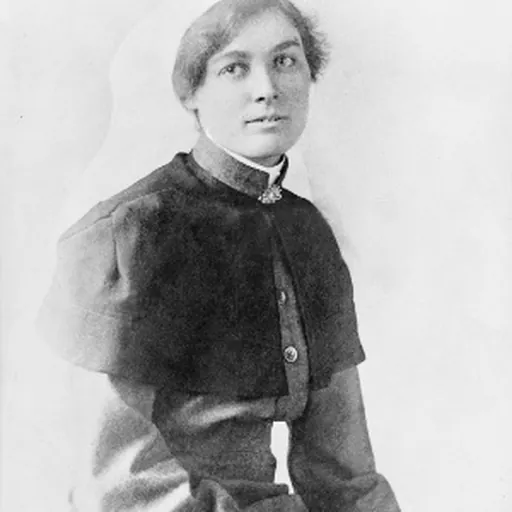
About Pearl Corkhill
Lived 1887 – 1985 (aged 98). Pearl Corkhill was an Australian nurse.
Elizabeth Pearl Corkhill, MM (11 March 1887 – 4 December 1985) was an Australian military nurse of the First World War. Trained as a nurse in Sydney, Corkhill enlisted in the Australian Imperial Force on 4 June 1915. After serving in France at the 1st and 3rd Australian General Hospitals, Corkhill was assigned to the 38th British Casualty Clearing Station near Abbeville on 21 August 1918. On 23 August, while the camp was being heavily bombed by enemy aircraft, Corkhill remained calm and continued to tend to her patients, despite the danger. For her bravery, she was awarded the Military Medal, one of only seven Australian nurses to be so decorated in the First World War. Following the Armistice, she went on to work as a nurse at various public hospitals, and donated a large collection of her father's photographs to the National Library of Australia.
Early life A photograph of Pearl (right) and her sister, Edith (left), taken by their father in 1894. Corkhill was born on 11 March 1887, the second child of William Henry Corkhill, a grazier and photographer, and Francis Hawtrey née Bate. Growing up on the family ranch, "Marengo", near Tilba Tilba in southern New South Wales, Corkhill, her sister Edith and brother Norman's lives were extensively recorded by their father, who by 1890 had become a professional photographer. She was first educated by a governess before attending the public school in town. She left Fremantle aboard the A62 Wandila on 25 June 1915, and arrived in Egypt in July that year. She was assigned to the 1st Australian General Hospital, and assisted in the treatment of soldiers involved with the Gallipoli Campaign. On 24 March 1916, Corkhill was among a group of nurses sent to Marseille aboard the Braemar Castle, a hospital ship. Arriving in early April, she was then sent aboard a train destined for the 2nd British General Hospital in Le Havre. The train was poorly equipped and was missing many amenities, such as toilets or water, so the women were forced to improvise by washing with cologne. As a result of its proximity to the front, the station would often come under enemy attack, as was the case of the 38th British Casualty Station on 23 August. The Casualty Station suffered a heavy air raid by German forces, with the sterilisation room being destroyed and the camp being hit by numerous bombs. Despite the heavy attack, Corkhill, who was attending to the wounded at the time, remained calm and continued to aid the patients.
War Office, 23rd August, 1918 His Majesty the KING has been pleased to approve of the award of the Military Medal to the undermentioned Lady for distinguished service in the Field, as recorded: — Staff Nurse Pearl Elizabeth Corkhill, Aust. A.N.S. For courage and devotion on the occasion of an enemy air-raid. She continued to attend to the wounded without any regard to her own safety, though enemy aircraft were overhead. Her example was of the greatest value in allaying the alarm of the patients. as she described in a letter to her mother:
Later service A group portrait of the sisters at the 1st Australian Auxiliary Hospital in 1918. The day following the action, 24 August, Corkhill was posted to the 1st Australian General Hospital, and went on leave in the United Kingdom. She was retained for service at the 1st Australian Auxiliary Hospital in Harefield, London on 27 August 1918. Following the war, Corkhill went on to pursue a nursing career. After serving as a nurse in various hospitals both in Australia and overseas, Corkhill became the senior sister at the District Hospital in Bega, New South Wales in 1951. Amongst the one thousand piece collection were personal photographs along with pictures of the Tilba area, which were later used to create a book, Taken at Tilba, and an engagement calendar. Corkhill was a skilled horsewoman, and was the lead in the centenary Cooma Show. Corkhill died on 4 December 1985 in Dalmeny, New South Wales. She was unmarried.
Don’t just read it —
keep it.
Full-length biographies made to live with: read them, listen on the way to work, watch them tonight.
- E-book
- Audio
- Video
Instant download · yours to keep · every purchase keeps this site free
Important facts
People in Pearl Corkhill's life
Named in this biography and alive at the same time
Related people
Same field, nearest in time



Contemporaries
People whose lives overlapped Pearl Corkhill's





Frequently asked questions
Who was Pearl Corkhill?
Australian Military Nurse of First World War (1887-1985)
When was Pearl Corkhill born?
Pearl Corkhill was born on 11 March 1887 in Tilba.
When did Pearl Corkhill die?
Pearl Corkhill died on 4 December 1985 in Dalmeny.
What was Pearl Corkhill's occupation?
Pearl Corkhill was a nurse.
What nationality was Pearl Corkhill?
Pearl Corkhill was Australian.
Sources & further reading
Cite this page
APA: Biography.guide. (2026). Pearl Corkhill. https://biography.guide/pearl-corkhill/
MLA: "Pearl Corkhill." Biography.guide, https://biography.guide/pearl-corkhill/.
Chicago: "Pearl Corkhill." Biography.guide. https://biography.guide/pearl-corkhill/.
Data last updated: 2026-09-21 · Spot an error? Report a correction.
Portrait: Wikimedia Commons · author & licence
Page generated 2026-09-27 05:00 UTC