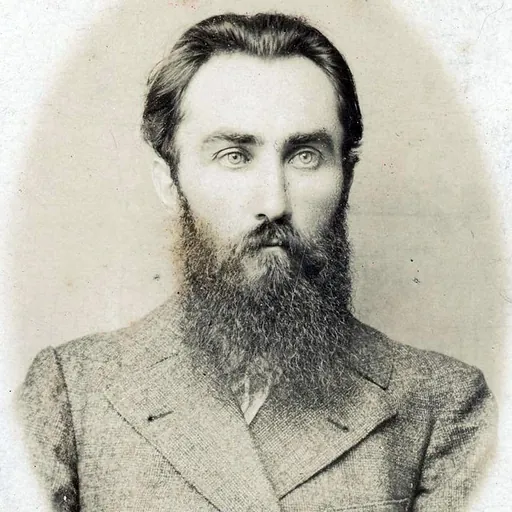
About Pavlo Hrabovskyi
Lived 1864 – 1902 (aged 38). Pavlo Hrabovskyi was a Russian poet, translator, opinion journalist and writer.
Pavlo Arsenovych Hrabovsky (Ukrainian: Павло Арсенович Грабовський; 11 September [ O.S. 30 August] 1864 – 12 December [O.S. 29 November] 1902) was a Ukrainian poet, journalist, translator and revolutionary.
Biography Hrabovsky was in to the family of a village sexton. His father died while he was at a young age and was raised by his mother. He was educated at the church school in Okhtyrka and at the theological seminary in Kharkov, in the third year he was expelled for participating in the Narodnik movement (in the organization of Black Repartition) and distributing banned literature, then arrested and exiled to his native village under police supervision.
In 1885 he went to Kharkov, where he worked as a proofreader in the newspaper "Yuzhny Krai", in the autumn of the same year he was mobilized into the army and sent to serve in the Turkestan Military District. In 1886 in Orenburg he was arrested again for distribution of illegal literature, later he was imprisoned in Izium and Kharkov. In 1888 he was sentenced to 5 years of exile in the Irkutsk Governorate. In 1889, he took part in the drafting and distribution of the "Statement to the Russian Government" against the brutal massacre of prisoners on March 22, 1889. After the text of the statement appeared in the foreign press, he was arrested and accused of drafting a political appeal. In 1889 he was arrested again and imprisoned in Irkutsk for 3.5 years.
Later he was in exile in Vilyuysk and Yakutsk, and then in Tobolsk, where he died of tuberculosis and was buried at the Zavalnoye Cemetery.
Hrabovsky is also the author of numerous translations into Ukrainian of works of world classics, such as Lord Byron, Goethe, Sándor Petőfi, Robert Burns, etc, and Russian poets (Pushkin, Lermontov, Derzhavin etc.) as well as Scandinavian and Georgian writers. He also translated Ukrainian literature into Russian.
Personal life In 1888, Hrabovsky, in the Moscow transit prison (Butyrka), met a former teacher and a member of the Narodnaya Volya, Nadezhda Malaksiano (Sigida), who was also convicted of revolutionary activity. Many of his lyrical poems are imbued with love for her; the poet dedicated his first poetry collection, Snowdrop, to her. Nadezhda Sigida died in 1889 in the Kara tragedy. Two years before his death in Tobolsk, Hrabovsky married a student of the paramedic-midwife school, Anastasia Nikolaevna Butkovskaya. In 1901, they had a son, Boris, who would later become one of the inventors of television in the Soviet Union.
Don’t just read it —
keep it.
Full-length biographies made to live with: read them, listen on the way to work, watch them tonight.
- E-book
- Audio
- Video
Instant download · yours to keep · every purchase keeps this site free
Important facts
People in Pavlo Hrabovskyi's life
Named in this biography and alive at the same time



Related people
Same field, nearest in time

Contemporaries
People whose lives overlapped Pavlo Hrabovskyi's




Frequently asked questions
Who was Pavlo Hrabovskyi?
Ukrainian poet and translator (1864-1902)
When was Pavlo Hrabovskyi born?
Pavlo Hrabovskyi was born on 30 August 1864 in Grabovs'ke.
When did Pavlo Hrabovskyi die?
Pavlo Hrabovskyi died on 29 November 1902 in Tobolsk.
What was Pavlo Hrabovskyi's occupation?
Pavlo Hrabovskyi was a poet, translator, opinion journalist and writer.
What nationality was Pavlo Hrabovskyi?
Pavlo Hrabovskyi was Russian.
Sources & further reading
Cite this page
APA: Biography.guide. (2026). Pavlo Hrabovskyi. https://biography.guide/pavlo-hrabovskyi/
MLA: "Pavlo Hrabovskyi." Biography.guide, https://biography.guide/pavlo-hrabovskyi/.
Chicago: "Pavlo Hrabovskyi." Biography.guide. https://biography.guide/pavlo-hrabovskyi/.
Data last updated: 2026-09-21 · Spot an error? Report a correction.
Portrait: Wikimedia Commons · author & licence
Page generated 2026-09-27 04:59 UTC