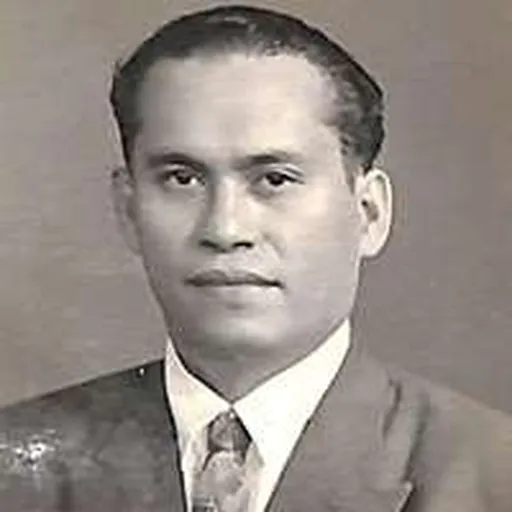
Paulus Samador da Cunha
Indonesian politician
About Paulus Samador da Cunha
Paulus Samador da Cunha was an Indonesian.
Paulus Samador da Cunha (13 January 1924 – 19 September 1970) was an Indonesian politician and civil servant. He served as a member of the Constitutional Assembly of Indonesia between 1956 and 1959, and as the first regent of Sikka from 1960 to 1967. A member of the Catholic Party, da Cunha's tenure in Sikka saw the construction of a new sports stadium, agricultural expansion, and anti-communist mass killings in 1966.
Early life Paulus Samador da Cunha was born on 13 January 1924 in Sikka village (the old capital of the Kingdom of Sikka) in present-day Sikka Regency, on the island of Flores. He was educated at a Catholic seminary in Todabelu (present-day Ngada Regency), graduating in 1941. He later studied government administration at a law high school in Makassar, graduating in 1953. While there, he became a good friend to Laurentius Say, a fellow Sikkan and a distant relative.
Early in his tenure, Sikka ordered the construction of a sports stadium in Maumereat that time the largest stadium in East Nusa Tenggara. It was constructed in expectation of a Flores-wide sports festival, and was inaugurated on 20 April 1961, one day before the event's start.
Not long after his election, Da Cunha's political alliance with Say began to fracture over access to financial proceeds of a municipally-owned copra company. Say enlisted the support of Djong (now a member of Sikka's legislature) to press da Cunha on official appointments. By 1963, Djong had been reassigned as a district head directly under da Cunha, and Say had been dispatched to Manila by the central government, solidifying da Cunha's political influence in Sikka. In July 1963, da Cunha was appointed chairman of the Catholic Party's branch in Sikka and the party soon extensively began to recruit members throughout the regency. This led to another conflict with Djong, which lasted until his removal by the Ministry of Home Affairs in June 1965. Anti-communist mass killings occurred in Sikka late in his term, with between 800 and 1,500 people (including Djong) killed.
Da Cunha was replaced by Say on 6 September 1967 and was reassigned to the provincial government's office in Kupang. The Maumere stadium constructed during his tenure was renamed the Stadion Gelora Samador (Samador Sports Arena Stadium) after him.
Don’t just read it —
keep it.
Full-length biographies made to live with: read them, listen on the way to work, watch them tonight.
- E-book
- Audio
- Video
Instant download · yours to keep · every purchase keeps this site free
Important facts
Frequently asked questions
Who was Paulus Samador da Cunha?
Indonesian politician (1924–1970)
When did Paulus Samador da Cunha die?
Paulus Samador da Cunha died on 19 September 1970.
What nationality was Paulus Samador da Cunha?
Paulus Samador da Cunha was Indonesian.
Sources & further reading
· Wikipedia: Paulus Samador da Cunha
· DBpedia: Paulus Samador da Cunha
Cite this page
APA: Biography.guide. (2026). Paulus Samador da Cunha. https://biography.guide/paulus-samador-da-cunha/
MLA: "Paulus Samador da Cunha." Biography.guide, https://biography.guide/paulus-samador-da-cunha/.
Chicago: "Paulus Samador da Cunha." Biography.guide. https://biography.guide/paulus-samador-da-cunha/.
Data last updated: 2026-09-20 · Spot an error? Report a correction.
Page generated 2026-09-27 05:10 UTC