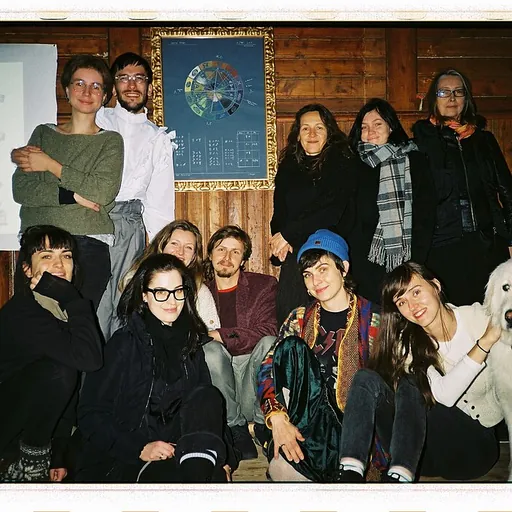
About Paulina Olowska
Born 1976. Paulina Olowska is a Polish painter, draftsperson, photographer, conceptual artist, video artist and fashion designer.
Paulina Olowska (born 1976, Gdańsk) is a Polish painter and photographer, who also works in the field of performance and video-art, social action and applied art. The areas of her artistic explorations are modernist utopias and research on the work of 20th century artists, which she combines with her own creative practice to bring unjustly forgotten ideas back to life. A characteristic thread in Olowska's work is her interest in female attitudes in art and her search for "protoplasts"; such as Alina Szapocznikow and Zofia Stryjeńska. The artist lives and works in Rabka-Zdrój.
Oeuvre
Paulina Olowska's work is characterized by a synthesis of arts. In her works she willingly uses various media, such as painting, collage, installation, performance, fashion and music, which allows her to obtain an exceptionally rich range of artistic impressions. Olowska's work is the product of her current experiences and fascinations. A common feature of her works is the romantic vision of art as a carrier of positive utopias and the belief that "art can change the world". Olowska's main interests include the artistic utopias of modernism found in the foundations of the early Bauhaus (the Bauhaus Yoga project, 2001), the circles of Russian constructivists (Abstraction in Process, 2000) and the explorations of the European avant-garde of the early 20th century.
Olowska also does not shy away from performance. Presented at Tate Modern in 2015, The Mother An Unsavoury Play in Two Acts and an Epilogue is an adaptation of avant-garde playwright Stanislaw Ignacy Witkiewicz's 1924 play. The story takes place in a bourgeois setting where hallucinations, schizophrenia, alcoholism, madness and drug addiction escalate into surreal madness.
The artist often returns to the work of Zofia Stryjeńska (1891–1976), exploring the visionary imagery of the Polish artist of the interwar period. In Slavic Goddesses, the artist explores Stryjeńska's notion of ballet as a "wreath of ceremony" by designing costumes based on her 1918 painting series under the same title. The actors, dressed in surreal costumes with huge headdresses adorned with peacock feathers and wheat stalks, portray imaginative characters from Slavic mythology and folklore: goddesses of mischief, fortune, fate, spring, winter, and heaven. The original score by American artist Sergei Tcherepnin combines cosmic sounds with traditional mazurkas, polkas and obereks, as well as "spiritual disco" and the local musical tradition of Val Gardena.
Another key performance in Paulina Olowska oeuvre was the Alphabet, which was inspired by the book ABECEDA by Karel Teige, a key figure in the Czech avant-garde who in 1926, in collaboration with Milca Mayerova, created an experimental "mobile alphabet". Referring to Teige's project, Olowska combines rhythmicity with a constructivist fascination with typography and points to the rhetorical function of dance: three performers arrange their bodies into 26 letters, from A to Z, confronting the alphabet of written language with the "alphabet" of gestures and movements, creating a new system for expressing meaning. Alphabet was first shown in Berlin in 2005 (Galerie Meerrettich). In 2012 it was exhibited at the Museum of Modern Art in New York, and in early 2014 it was presented at the Museum of Modern Art in Warsaw.
In 2004, Olowska began a project to refabricate the neon signs that illuminated Warsaw in the 1960s and 1970s. Many of the neon signs were designed by artists for state-run monopolies and promoted general activities such as hairdressing, sports, and reading books. Olowska organized an exhibition at the Foksal Gallery Foundation, Painting – Exchange – Neon (2006), to raise money for the restoration and reinstallation of the 1961 neon sign Volleyball Player by Jan Mucharski, which originally advertised a sports store on Constitution Square.
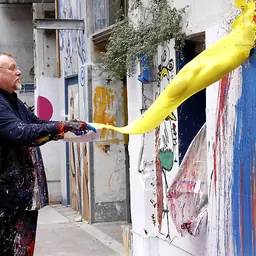
Her approach to conservation has developed performatically and over time, as a result of researching and responding to numerous local modernisms - from regional constructivism to magazine designs. In 2010, the artist undertook a social and artistic initiative which involved covering the facade of the Rabcio theater building in a mountainous village near Krakow with large-scale paintings inspired by the designs of stage designer and painter Jerzy Kolecki. By making a kind of collage of works she had found in the theater's archives, she transferred them onto the building, making them visible again in the public space. While on a scholarship in Portugal she painted a series of paintings that referred to fashion photographs from the magazine Ty i Ja / You and Me, a cult magazine for young Polish intellectuals of the 1960s.
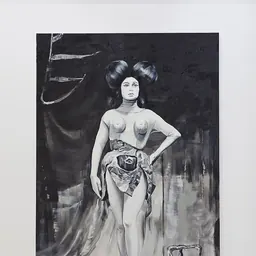
The painting entitled Ewa Wawrzoń (2013) in costume from the play Rhinoceros (1961) represents the characteristic motif of forgotten heroines or artists in Paulina Olowska's work. Olowska seeks to excavate their stories and reinterpret them, inserting them into a broader narrative, thus contributing to the tradition of women's art. Olowska holds provincial stage artists in particular in high esteem (e.g., the series devoted to actresses at the Rabcio Puppet Theatre in Rabka) - women who are risky, committed and ambiguous. Their complex condition serves as an inspiration to define the artist's contemporary identity.
Currently the artist runs Kadenówka Creative House in Rabka-Zdrój where she invites artists to collaborate in creative projects.
In addition, Olowska publishes the Pavilionesque magazine, devoted to various aspects of contemporary art and theater. The magazine is also a form of active archive, which seeks and recovers unpublished archival materials related to theater, performance and puppetry.
Awards and Prizes 2014 Aachen Art Prize
2017 Bessie Awards Nomination for Outstanding Visual Design
Selected solo exhibitions and performances
Works in collections Her paintings and installations can be found in the collections of the Pompidou Centre in Paris, the MoMA in New York and the Tate Modern in London.
Don’t just read it —
keep it.
Full-length biographies made to live with: read them, listen on the way to work, watch them tonight.
- E-book
- Audio
- Video
Instant download · yours to keep · every purchase keeps this site free
Important facts
People in Paulina Olowska's life
Named in this biography and alive at the same time
Related people
Same field, nearest in time



Contemporaries
People whose lives overlapped Paulina Olowska's




Frequently asked questions
Who is Paulina Olowska?
Polish artist (born 1976)
When was Paulina Olowska born?
Paulina Olowska was born in 1976 in Gdańsk.
What is Paulina Olowska's occupation?
Paulina Olowska is a painter, draftsperson, photographer, conceptual artist, video artist and fashion designer.
What nationality is Paulina Olowska?
Paulina Olowska is Polish.
Sources & further reading
Cite this page
APA: Biography.guide. (2026). Paulina Olowska. https://biography.guide/paulina-olowska/
MLA: "Paulina Olowska." Biography.guide, https://biography.guide/paulina-olowska/.
Chicago: "Paulina Olowska." Biography.guide. https://biography.guide/paulina-olowska/.
Data last updated: 2026-09-20 · Spot an error? Report a correction.
Portrait: Wikimedia Commons · author & licence
Page generated 2026-09-27 04:57 UTC