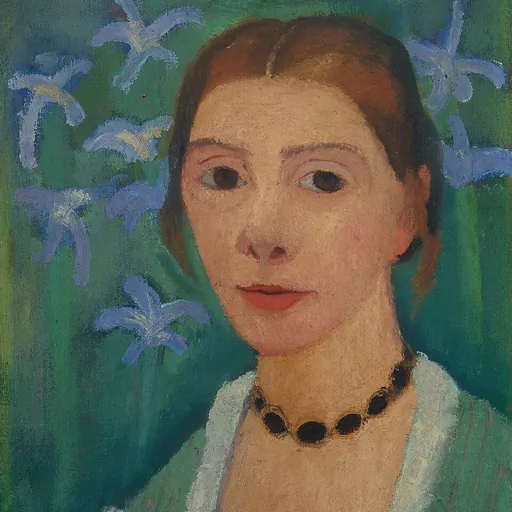
About Paula Modersohn-Becker
Lived 1876 – 1907 (aged 31). Paula Modersohn-Becker was a German painter, printmaker, draftsperson, artist and painting, known for Expressionism.
Paula Modersohn-Becker (8 February 1876 – 20 November 1907) was a German Expressionist painter and draftswoman of the late 19th and early 20th centuries. She is noted for the many self-portraits, including nudes. She is considered one of the most important representatives of early expressionism, producing more than 700 paintings and over 1000 drawings during her active painting life. She is recognized both as the first known woman painter to paint nude self-portraits, and the first woman to have a museum devoted exclusively to her art (the Paula Modersohn-Becker Museum, founded 1927). Additionally, she is believed to be the first woman artist to depict herself pregnant. at the age of 31.
Biography
Dresden-Friedrichstadt: After Paula's birth, the Becker family moved into a house in "Friedrichstraße 29" (today "Friedrichstraße 46"). thumb
Early life Schwachhauser Heerstr. 23, Bremen. Becker family home and residence of Paula Becker (1888–1899) Paula Modersohn-Becker, Child with Goldfish (1907)Becker was born and grew up in Dresden, in the Friedrichstadt area. She was the third of seven children in her family. Her father, Carl Woldemar Becker (1841–1901), the Odessa-born son of a Russian university professor of French, was employed as an engineer with the German railway. Her mother, Mathilde (1852–1926), was from the aristocratic von Bültzingslöwen family, and her parents provided their children a cultured and intellectual household environment.
Despite these advantages of family, the Beckers found themselves in socially constrained circumstances. In 1861, Oskar Becker, Carl's brother, in an unsuccessful assassination attempt, had shot King Wilhelm of Prussia in the neck. The King was not severely injured, and Oskar was pardoned five years later for the crime (on condition that he permanently leave the country), but the constraints of opportunity for Carl Becker's family would linger.
In 1888 the family moved from Dresden to Bremen, where Carl Becker had obtained a position on the building board of the Prussian Railway Administration. The family interacted with Bremen's local artistic and intellectual circles, and Paula began to learn to draw. In the summer of 1892, her parents sent her to relatives in England to learn English. While living with a maternal aunt in London, Becker received her first instruction in drawing at St John's Wood Art School.
After returning to Bremen, she studied at a teachers' training school from 1893 to 1895, as her father wished (two sisters also attended this program). Concurrently she received private painting lessons from local German painter Bernhard Wiegandt. but it was clear that she had little intention of pursuing a career in that profession.
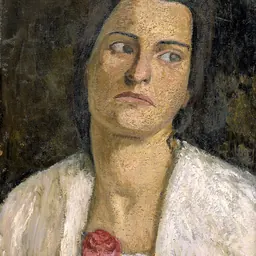
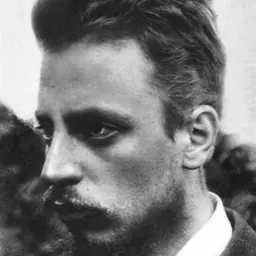
In the spring of 1896, Paula was able to travel to Berlin to take part in a six-week drawing and painting course organized by the Berlin Artists' Association (Verein der Berliner Künstlerinnen), staying with members of her mother's family while completing her course. After graduating, she stayed on in Berlin, and in February 1897 was admitted to the first class of painting at the Women's Academy. Paula additionally used her Berlin time to visit its art museums, studying the works of German and Italian artists. At this time she began close friendships with the sculptor Clara Westhoff (1875–1954), the painter Ottilie Reylaender (1882–1965), and the poet Rainer Maria Rilke (1875–1926). It became quickly evident, however, that Worpswede was not suited to Becker's rapidly developing artistic style. In her journal, Becker wrote: "the way Mackensen portrays people is not broad enough, too genre-like for me."
Two paintings she exhibited at the Bremen Kunsthalle in December 1899 were sharply criticized and had to be removed during the exhibition,
In April 1900, the great World's Fair Centennial Exhibition opened in Paris. Otto Modersohn, a Worpswede painter who had been an on-and-off resident of the colony since 1897, arrived in town with mutual friends to attend. His sick wife Helene had remained behind in Worpswede, and she died during Modersohn's short time in Paris. Modersohn hurried back to Germany. Shortly thereafter, Becker returned to Worpswede herself. It was clear to Becker's parents that the two had become romantically involved, but their disapproval was of little impact. The historian Katja Haustein argues that Becker's works depicting motherhood were inspired by contemporary ideas of "natural motherhood", against increased German state intervention into the private lives of women and the maternal relationship with their children.
She had complained of pain in her legs after the delivery, and was advised to remain in bed. When the physician returned on 20 November, he advised her to rise. She walked a few steps, then sat down, called for the infant to be placed in her arms, complained of leg pain, and died, saying only "What a pity".
Paula's death was likely due to deep venous thrombosis (DVT), a complication of pregnancy that is relatively common when women are set to bed for a long time after delivery, as was customary practice at that time. Apparently, a thrombus had formed in her leg, and with her mobility, broke off and then caused her death within hours.
She was buried in the Worpswede Cemetery.
Self-portraits Paula Modersohn-Becker. Self-Portrait at 6th Wedding Anniversary (1906) Until the years when Becker began the practice, women painters had not widely used nude females as subjects for their work.
Notable exceptions are the works by Artemisia Gentileschi, three centuries earlier; however, art historians have asserted that Gentileschi made use of her own body as a reference for her work out of necessity and lack of access to any other models (in, for example, Gentileschi's 1610 Susanna and the Elders), as opposed to creating an intentional, purposeful, self-portrait (an assertion that continues to be debated).
These arguments aside, Becker is generally accepted as the first known woman painter to paint nude self-portraits, and the first woman painter known to have painted herself pregnant and pregnant and nude.
Becker's work on the female nude is unconventional and expresses an ambivalence to both her subject matter and the method of its representation.
Painting technique Becker was trained in the methods of realism and naturalism, along with a recognizable simplicity of form.
She was able to achieve a distinct texture to her work by scratching into the wet paint. Modersohn-Becker employed the same technique throughout her short career as a painter. She worked in tempera and oil with a limited palette range of pigments such as zinc white, cadmium yellow, viridian, and synthetic ultramarine. She later abandoned those techniques to move into Fauvism. Fauvist influences appear in her works such as Poorhouse Woman with a Glass Bottle.
Influences
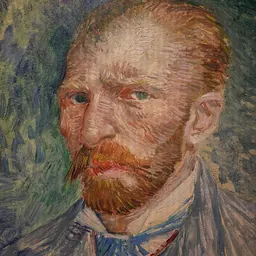
There is evidence to suggest that a number of Paula Modersohn-Becker's self-portraits were influenced by the Pre-Raphaelite painter Dante Rossetti, including Self-portrait with a bowl and a glass (c. 1904; Sander Collection), Self-portrait nude with amber necklace (1906; Private collection), and Self-Portrait on 6th Wedding Anniversary (1906; Museen Böttcherstrasse, Paula Modersohn- Becker Museum, Bremen). She visited contemporary exhibitions often, and was particularly intrigued with the work of Paul Cézanne. Other post-impressionists were especially influential, including Vincent van Gogh and Paul Gauguin.
Influence Becker may have influenced some of Picasso's paintings, as Diane Radycki posits in her 2013 monograph on the artist.
Legacy By 1899 Clara Westhoff had made a bust of Modersohn-Becker, saying that it was a symbol of their friendship and shared passion for art. In 1908, on the first anniversary of her death, Rainer Maria Rilke wrote the renowned poem "Requiem for a Friend" in Modersohn-Becker's memory.
Becker was not widely known at her untimely death, and had sold few paintings during her lifetime. It was only thanks to exhibitions organized in the first years after her death that some collectors learned about her and began to acquire her paintings.
First woman to have a museum devoted exclusively to her art
In 1927 businessman Ludwig Roselius opened the Paula Modersohn-Becker Museum in Bremen. It was designed by Bernhard Hoetger, who had known Becker from Worpswede.
"Degenerate Art" Local Nazis denounced the museum's art and architecture in 1935, but Roselius ignored this until Hitler denounced his entire Böttcherstraße in September 1936. After Roselius's secretary Barbara Goette intervened on his behalf with Hitler, the street's buildings were allowed to remain as a monument of "degenerate art".
But despite the survival of the architectural fabric of her museum, Becker's work did not escape the Nazis attention undamaged. In 1937, "70 of her paintings were purged from German museums, either destroyed or exhibited as 'degenerate art. The Nazi critique derided the lack of "femininity" in Becker's paintings: "A revolting mixture of colours, of idiotic figures, of sick children, degenerates, the dregs of humanity."
The Paula Modersohn-Becker Foundation Mathilde Modersohn (1907–1998) founded the Paula Modersohn-Becker Foundation (Paula Modersohn-Becker-Stiftung) in 1978. To form the core of the foundation, Mathilde Modersohn donated more than 50 paintings and 500 drawings from her personal collection, which she had inherited through her mother's estate. The purpose of the foundation is to "enhance the knowledge of the artist by researching and cataloguing her complete works," and to protect the integrity of her corpus.
Paula Becker House leftModersohn-Becker's house in Bremen, where she spent much of her life, opened in October 2007 as a private art museum and gallery. The Becker family had moved from Dresden to Bremen in 1888 and lived in this house. Becker lived in the house until 1899 when she was 23 years old and set up her first studio here. There was an active artist community in Bremen and via Becker's mother's friendships in the art world, Paula grew to be part of this community.
In 2003, Heinz and Betty Thies bought the then-rundown house and had it restored in time for the 100th anniversary of the artist's death. At that time (November 2007), it was turned into a public museum.
Art market The best selling painting by the artist in the art market was Self-Portrait Looking Slightly Left (1906), which sold in Berlin for €1,270,000 ($1,159,872) on 1 December 2025, well above the estimate of €250,000-350,000.
In popular culture In 1988 a stamp with the portrait of Paula Modersohn-Becker was issued in the series Women in German history by the German post-office authority Deutsche Bundespost. On 8 February 2018, Becker's birthday was celebrated in a Google Doodle. The life of Paula Modersohn-Becker is fictionalized in Sue Hubbard's 2012 novel, Girl in White. She was the subject of a 2016 German bio-pic film, Paula. In 2025, ARTE produced a documentary about her.
21st century exhibitions Making Modernism: Paula Modersohn-Becker, Käthe Kollwitz, Gabriele Münter and Marianne Werefkin (12 November 2022 – 12 February 2023) Royal Academy of Arts, London These are my modern women: Trading Monet for Modersohn-Becker (20 February 2022 – 4 September 2022) Arp Museum Bahnhof Rolandseck Paula Modersohn-Becker (8 October 2021 – 6 February 2022) Schirn Kunsthalle, Frankfurt Paula Modersohn-Becker: An Intensely Artistic Eye (8 April 2016 – 21 August 2016) Musée d'Art moderne, Paris Paula Modersohn-Becker: Art and Life (February 2016 – 12 March 2016) Galerie St. Etienne, New York, New York Rebels and Martyrs: the image of the artist in the 19th century (opened 28 June 2006) National Gallery, London (first UK exhibition of Self-Portrait at 6th Wedding Anniversary) Paula Modersohn-Becker: Ich bin ich / I Am Me (6 June 2024 – 9 September 2024) Neue Galerie New York and (12 October 2024 – 12 January 2025) Art Institute of Chicago
Gallery Landscapes
Self-portraits
Still lifes
Portraits
Don’t just read it —
keep it.
Full-length biographies made to live with: read them, listen on the way to work, watch them tonight.
- E-book
- Audio
- Video
Instant download · yours to keep · every purchase keeps this site free
Important facts
more
Paula Modersohn-Becker (pseudonym), Paula (pseudonym) Modersohn-BeckerFamily & relationships
People in Paula Modersohn-Becker's life
Named in this biography and alive at the same time




Related people
Same field, nearest in time

Contemporaries
People whose lives overlapped Paula Modersohn-Becker's
Frequently asked questions
Who was Paula Modersohn-Becker?
German expressionist painter (1876–1907)
When was Paula Modersohn-Becker born?
Paula Modersohn-Becker was born on 8 February 1876 in Dresden.
When did Paula Modersohn-Becker die?
Paula Modersohn-Becker died on 20 November 1907 in Worpswede.
What was Paula Modersohn-Becker's occupation?
Paula Modersohn-Becker was a painter, printmaker, draftsperson, artist and painting.
What was Paula Modersohn-Becker known for?
Paula Modersohn-Becker was known for Expressionism.
What nationality was Paula Modersohn-Becker?
Paula Modersohn-Becker was German.
Sources & further reading
· Wikipedia: Paula Modersohn-Becker
· DBpedia: Paula Modersohn-Becker
Cite this page
APA: Biography.guide. (2026). Paula Modersohn-Becker. https://biography.guide/paula-modersohn-becker/
MLA: "Paula Modersohn-Becker." Biography.guide, https://biography.guide/paula-modersohn-becker/.
Chicago: "Paula Modersohn-Becker." Biography.guide. https://biography.guide/paula-modersohn-becker/.
Data last updated: 2026-09-23 · Spot an error? Report a correction.
Portrait: Wikimedia Commons · author & licence
Page generated 2026-09-27 05:06 UTC