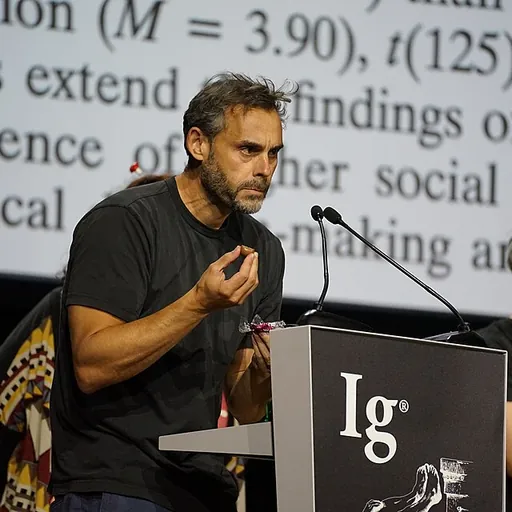
About Paul Piff
Paul Piff was a scientist.
Paul Kayhan Piff (born c. 1981) is an American social psychologist and Associate Professor of Psychology at the University of California, Irvine. His research focuses on social class, economic inequality, moral behavior, prosocial tendencies, and the social functions of emotions such as awe.
His work has been the subject of national media coverage, including a cover profile in New York magazine. In 2013 he delivered a TEDx talk titled “Does Money Make You Mean?”, presenting research on inequality to a public audience. The talk has received several million views online. He has also appeared in documentary films including Park Avenue: Money, Power and the American Dream and Capital in the Twenty-First Century.
Education and early career
Piff grew up in Seattle, Washington, before moving at age four with his family to Haifa, Israel, where his father worked as an archivist, and his mother was a translator for the Baha'i World Center.
He received a B.A in psychology from Reed College in 2004.
Research
Piff's work focuses on three areas: social class and ethics, the psychology of awe, and theoretical accounts of social class as a cultural system.
His most widely discussed work, published in 2012 in the Proceedings of the National Academy of Sciences, is titled “Higher social class predicts increased unethical behavior.” Across seven studies, the paper reported that individuals from higher social classes were more likely to break traffic laws, engage in unethical decision-making in hypothetical scenarios, take valued goods from others, lie in negotiations, and endorse unethical behavior at work. The research suggested that favorable attitudes toward greed may contribute to these differences. The paper received widespread media coverage and has been widely cited in the academic literature.
The PNAS paper also attracted scholarly criticism and subsequent replication efforts. Statistician Greg Francis published a response arguing that the probability of all seven studies reaching statistical significance was unusually low, suggesting possible publication bias. Piff and his team published a reply in the same journal, critiquing Francis’s statistical approach; others have raised similar concerns. In 2017, researchers at the University of Western Ontario identified a mathematical error in the original paper; Piff’s team acknowledged it as minor and not affecting the overall conclusions, and in turn noted an inversion error in the replication team’s analysis. Corrections were issued, described by Retraction Watch as a collaborative exchange. Regarding the original field studies on driver behavior, Coughenour and colleagues replicated the patterns, finding that drivers of higher-cost cars were less likely to yield for pedestrians. However, Jung et al. (2023) published two preregistered direct replications and found no evidence of a relationship between vehicle status and unethical driving behavior.
In subsequent research, Piff reported in 2014 that wealthier individuals scored higher on measures of narcissism and entitlement, and that experimentally inducing feelings of egalitarianism was associated with reductions in these tendencies. A 2020 study published in Nature Human Behaviour found that shifting people's explanations for poverty from individual failings to situational and structural factors increased their opposition to inequality and support for egalitarian policies.
Awe and prosocial behavior
Piff's second major research area examines the psychological and social effects of awe. In a 2015 paper published in the Journal of Personality and Social Psychology, Piff and colleagues presented five studies demonstrating that experiences of awe diminish the emphasis on the individual self, what the authors termed "the small self" effect, which was associated with prosocial behavior such as generosity, helping, and ethical decision-making. In one field experiment, participants who spent a minute looking up at a grove of towering eucalyptus trees subsequently helped a researcher pick up more dropped pens than participants who looked up at a tall building.
Subsequent research has extended these findings to large-scale natural events. A 2022 study published in Psychological Science examined the 2017 total solar eclipse and found that communities in the path of totality showed increases in prosocial behavior and social cohesion compared with communities that experienced only a partial eclipse. Piff has also published research on how engagement with nature, particularly awe-inspiring natural environments such as giant sequoia groves, is associated with social connection and well-being, with support from the United States Forest Service. A more comprehensive review of this framework was published in 2012 in Psychological Review.
Media and public engagement
TEDx talks
In 2013, Piff delivered a TEDx Marin talk titled “Does Money Make You Mean?”, in which he described a rigged Monopoly game experiment illustrating the effects of structural advantages on behavior. In September 2022, he returned to TEDx Marin with a talk on “The Science of Awe,” reflecting his research on the social functions of awe.
Media coverage
Piff has been profiled in New York magazine and his research has been covered in The New York Times, Scientific American, NPR, CBC Radio, and the World Economic Forum. In 2012, New York magazine published a cover story by Lisa Miller titled "The Money-Empathy Gap," profiling Piff as "one of a new generation of scientists...who are exploiting this moment of unprecedented income inequality to explore behaviors." On March 19, 2026, Piff appeared on the Outside Podcast episode "The Anti-Asshole Effect: The Surprising Science of Awe in Nature," discussing the science of awe, his field studies measuring the effects of awe at Lake Tahoe, and the documentary Beyond Awestruck: The Scientific Search for Connection, which followed that research.
Documentary appearances
Piff has appeared as an expert in several documentary films:
Park Avenue: Money, Power and the American Dream (2012), directed by Alex Gibney, which aired on PBS Independent Lens and examines the wealth gap between Park Avenue's billionaires and the South Bronx. Capital in the Twenty-First Century (2019), directed by Justin Pemberton and based on Thomas Piketty's bestselling book, in which Piff discusses the rigged Monopoly experiment alongside economists and public intellectuals. 12th Hour (2021), directed by Susan Kucera, a documentary examining humanity's capacity to respond to climate change. Giants Rising (2024), written and directed by Lisa Landers, in which Piff discusses the impacts of experiencing awe. Beyond Awestruck: The Scientific Search for Connection (2026), directed by Richard Yelland, which followed Piff and his research team from the University of California, Irvine as they measured the effects of awe at Lake Tahoe.
Awards and honors
2020 – Dean's Award for Inclusionary Excellence, School of Social Ecology, UC Irvine 2017 – Fellow, Society of Experimental Social Psychology 2015 – Emerging Leadership in Psychology, American Psychological Association Committee on Socioeconomic Status 2012 – First Prize, Social Issues Dissertation Award, Society for the Psychological Study of Social Issues (Division 9 of the APA) 2008–2011 – National Science Foundation Graduate Research Fellowship 2004 – Phi Beta Kappa, Reed College
Selected publications
Don’t just read it —
keep it.
Full-length biographies made to live with: read them, listen on the way to work, watch them tonight.
- E-book
- Audio
- Video
Instant download · yours to keep · every purchase keeps this site free
Important facts
Related people
Same field, nearest in time


Frequently asked questions
Who was Paul Piff?
social psychologist
What was Paul Piff's occupation?
Paul Piff was a scientist.
Sources & further reading
Cite this page
APA: Biography.guide. (2026). Paul Piff. https://biography.guide/paul-piff/
MLA: "Paul Piff." Biography.guide, https://biography.guide/paul-piff/.
Chicago: "Paul Piff." Biography.guide. https://biography.guide/paul-piff/.
Data last updated: 2026-09-20 · Spot an error? Report a correction.
Portrait: Wikimedia Commons · author & licence
Page generated 2026-09-27 04:57 UTC