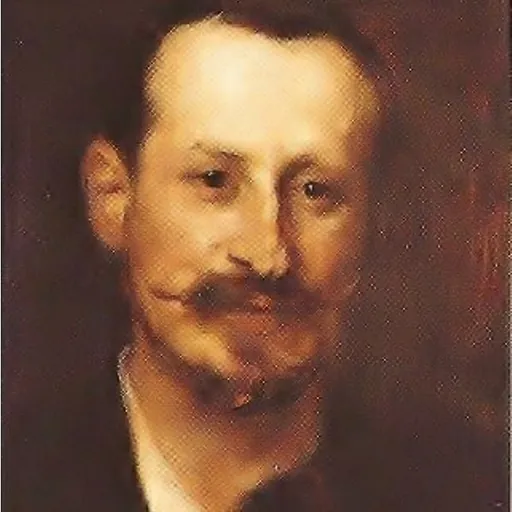
About Paul Gallimard
Lived 1850 – 1929 (aged 78). Paul Gallimard was a French translator, art collector and bibliophile.
Paul Sébastien Gallimard (; 20 July 1850 – 9 March 1929) was a French art collector, bibliophile and theatre owner. He was the father of publisher Gaston Gallimard.
Life and work Paul Gallimard was born in 1850 to businessman Gustave Gallimard and his wife Henriette ( Chabrier). His parents both belonged to wealthy families. His grandfather Sébastien André Gallimard, a trained coppersmith, made his fortune in Paris during the July Monarchy by producing gaslamps for outdoor street lighting. His mother's family owned several Parisian theatres. Gallimard developed an appreciation for art collecting at an early age through his father's painting collection, which collected together works from the Barbizon school. After completing his education at the Lycée Condorcet, Gallimard studied painting at the École des Beaux-Arts. It is now used as a hotel under the name "Manoir de Benerville".
On 12 April 1880, Gallimard married Lucie Duché, Gallimard's marriage to Lucie Duché, the granddaughter of editor-printer Amédée Guyot. Their union resulted in three sons: Jacques, Gaston and Raymond. In 1888, he commissioned a group portrait painting of the children made by Eugène Carrière. In the same year, Carrière also created a portrait of Paul Gallimard with the dedication "À mon bon ami Paul Gallimard" . Carrière also completed a portrait of Gallimard's wife Lucie, who also sat as a model for Pierre-Auguste Renoir in 1892.
Gallimard's mistress was the actress and opera singer Amélie Diéterle, who was twenty-one years his junior. Gallimard was compromised with Diéterle in a scandal which involved fake Rodin sculptures. He was charged with counterfeiting and aiding and abetting by Judge Bonin in 1919. Absent from court at the time of the trial for health reasons, an arrangement took place in 1923 with the donation of a painting by Eugène Carrière to the French State.
Gallimard died on 9 March 1929 in his Rue Saint-Lazare residence. His wife Lucie died at the same location on 2 March 1942.
Art collection Gallimard's art collection contained a total of 16 works by his friend Pierre-Auguste Renoir. Gallimard supported the painter financially and in 1892 invited him to travel together to Madrid for a month. Berthe Morisot, Claude Monet and Édouard Manet (Suzette Lemaire en face) were part of the collection. Gallimard collected other works, including oil paintings and works on paper, from artists such as Rembrandt van Rijn, El Greco, Jean-Honoré Fragonard, Francisco Goya, Honoré Daumier (Sortie du bateau à lessive), Jean-Baptiste-Camille Corot, Jean-Auguste-Dominique Ingres, Eugène Delacroix and Jean-François Millet. He also collected works by modern artists such as Henri de Toulouse-Lautrec (M. de Lauradour), Édouard Vuillard, Pierre Bonnard, Henri Matisse and Pablo Picasso. The importance of the Gallimard Collection was recognized in 1908 in an article written by the influential art critic Louis Vauxcelles in the magazine Les Arts. After Gallimard's death, the collection was sold by its inheritors.
Library In addition to the art collection, Gallimard devoted himself to building an extensive library. He brought together numerous first editions, mostly by French authors of the 19th century. His library also produced expensive limited-edition books, including a limited edition of Germinie Lacerteux (1865) by the Goncourt brothers, which appeared in an edition of only three copies. The book contains original illustrations by Jean-François Raffaëlli and its cover was designed by Eugène Carrière. Other book projects included an elaborately designed edition of Charles Baudelaire's Les Fleurs du mal, which he had adorned with pen drawings Auguste Rodin. Gallimard's library was also sold after his death. He is described as a "bibliophile" by journalist Eléonore Sulser. His passion for books was passed on to his son Gaston Gallimard, who, in 1911, founded the publishing house Éditions Gallimard, which still exists today.
Publications
Les Étreintes du passé Poèmes et Poésies (Translation of John Keats, 1910)
Don’t just read it —
keep it.
Full-length biographies made to live with: read them, listen on the way to work, watch them tonight.
- E-book
- Audio
- Video
Instant download · yours to keep · every purchase keeps this site free
Important facts
Family & relationships
People in Paul Gallimard's life
Named in this biography and alive at the same time




Related people
Same field, nearest in time

Contemporaries
People whose lives overlapped Paul Gallimard's


Frequently asked questions
Who was Paul Gallimard?
French art collector and bibliophile (1850-1929)
When was Paul Gallimard born?
Paul Gallimard was born on 20 July 1850 in Suresnes.
When did Paul Gallimard die?
Paul Gallimard died on 9 March 1929 in 9th arrondissement of Paris.
What was Paul Gallimard's occupation?
Paul Gallimard was a translator, art collector and bibliophile.
What nationality was Paul Gallimard?
Paul Gallimard was French.
Sources & further reading
Cite this page
APA: Biography.guide. (2026). Paul Gallimard. https://biography.guide/paul-gallimard/
MLA: "Paul Gallimard." Biography.guide, https://biography.guide/paul-gallimard/.
Chicago: "Paul Gallimard." Biography.guide. https://biography.guide/paul-gallimard/.
Data last updated: 2026-09-24 · Spot an error? Report a correction.
Portrait: Wikimedia Commons · author & licence
Page generated 2026-09-27 05:08 UTC