
About Patrick V, Earl of March
Lived 1285 – 1369 (aged 83–84). Patrick V, Earl of March was a Scottish politician.
Patrick de Dunbar, 9th Earl of March, (c. 1285–1369) was a prominent Scottish magnate during the reigns of Robert the Bruce and David II.
Early years The earldom, located in East Lothian, and known interchangeably by the names Dunbar and March (so-called Northumbrian or Scottish March), was one of the successor fiefs of Northumbria, an Anglo-Saxon kingdom and later earldom. The Dunbar family descended from one branch of ancient earls of Northumbria, specifically from a branch which also had Scottish royal blood.
He is said to have been aged 24 in 1309 at the death of his father, Patrick, 8th Earl of March, who had been one of the Competitors for the Crown of Scotland in 1291. The 8th Earl's purported wife, Marjory, daughter of Alexander Comyn, Earl of Buchan, was also descended from King Donald III.
Bannockburn to Durham
After the Battle of Bannockburn, Patrick de Dunbar gave sanctuary and quarter to the English King Edward II at the fortress of Dunbar Castle, on the east coast of Scotland between Edinburgh and Berwick-upon-Tweed, and managed to effect the king's escape by means of a fishing boat whereby that monarch was transported back to England. The earl afterwards made his peace with his cousin Robert the Bruce, and was present at the parliament held at Ayr on 26 April 1315, when the succession to the Crown of Scotland was settled.
In 1318 he assisted in retaking Berwick-upon-Tweed from the English, at which time he is noted as Sheriff of Lothian. In 1320 he was one of those nobles who signed the Declaration of Arbroath sent to Pope John XXII asserting the independence of Scotland.
Laing relates a charter of a Precept originally written in Norman French by Patrick de Dunbar, Earl of March, to Sir Robert Lauder of Quarrelwood, for heritable sasine of the reversion of the lands of Whitelaw within the Earldom of Dunbar, plus 10 livres yearly from the mill of Dunbar, and the farms and issues of the granter's said town (ville) of Dunbar, according to the terms of charters to the grantee. Dated at Berwick-upon-Tweed, 20 October 1324.
Sometime after 1331 the Bishop of Durham complained to the Regency in Scotland that the village of Upsettlington, on the Scottish side of the River Tweed west of Norham, belonged to the See of Durham and not the Earl of Dunbar, who had seized it. The King of England now became involved also and it appears the lands were restored to the Bishop.
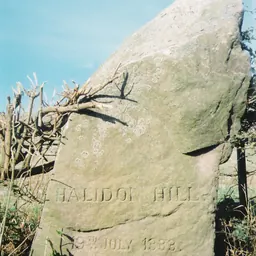
In 1332, the Earl of Dunbar was appointed by the assembly of the estates (Parliament) at Perth, joint Guardian of the Crown, upon the death of the Regent, Thomas Randolph, 1st Earl of Moray. He opposed Edward Balliol in several battles and skirmishes following the Battle of Dupplin Moor. In January 1333 he was appointed Governor of Berwick Castle but was forced to surrender it following the Battle of Halidon Hill in July 1333. The Earl of Dunbar and several others of the nobility paid fealty to King Edward. It is unlikely that Dunbar remained to fight after the first arrows reached them.
In 1355, with William, Lord of Douglas and Sir William Ramsay of Dalhousie, the Earl of Dunbar again invaded Northumberland, and subsequently recovered Berwick-upon-Tweed, although not the castle. In 1357 he was one of the Scottish ambassadors who met at Berwick to discuss the liberation of King David, who had been taken prisoner at Neville's Cross. He was subsequently one of the hostages for David until the ransom was paid, although it would appear from Safe-Conducts that he was out and about thereafter. Following this his town of Dunbar was erected into a Royal Burgh.
In 1366, he made a pilgrimage to the shrine of St. Thomas Becket at Canterbury. In May 1367 he confirmed to the monks of Coldingham Priory by charter to the Prior and Convent of Durham, the church and manor of Edrom, and Nisbet, with the agreement of his wife.
In June 1368, the King was advised by parliament at Scone to consult with the Earls of Dunbar and Douglas on the security of the Eastern marches. He was not present at the Coronation of King Robert II in 1371 so it is assumed that he died before then. Brown gives a year of death as 1368. If that is so it would probably be 1368/9.
Marriage Patrick Dunbar is not as well remembered as his second wife Agnes Randolph, also known as Black Agnes of Dunbar who died just a few months before him. From her brothers she obtained by inheritance the Isle of Man, the Lordship of Annandale (which she brought to her marriage), and the feudal baronies of Morton and Tibbers in Nithsdale, Mordington (where she is buried), Longformacus, and Duns, in Berwickshire; Mochrum in Galloway, Cumnock in Ayrshire, and Blantyre in Clydesdale.
Don’t just read it —
keep it.
Full-length biographies made to live with: read them, listen on the way to work, watch them tonight.
- E-book
- Audio
- Video
Instant download · yours to keep · every purchase keeps this site free
Important facts
People in Patrick V, Earl of March's life
Named in this biography and alive at the same time


Related people
Same field, nearest in time
Contemporaries
People whose lives overlapped Patrick V, Earl of March's

Frequently asked questions
Who was Patrick V, Earl of March?
Scottish noble
When was Patrick V, Earl of March born?
Patrick V, Earl of March was born in 1285 in East Lothian.
When did Patrick V, Earl of March die?
Patrick V, Earl of March died in 1369.
What was Patrick V, Earl of March's occupation?
Patrick V, Earl of March was a politician.
What nationality was Patrick V, Earl of March?
Patrick V, Earl of March was Scottish.
Sources & further reading
· Wikipedia: Patrick V, Earl of March
· DBpedia: Patrick V, Earl of March
Cite this page
APA: Biography.guide. (2026). Patrick V, Earl of March. https://biography.guide/patrick-v-earl-of-march/
MLA: "Patrick V, Earl of March." Biography.guide, https://biography.guide/patrick-v-earl-of-march/.
Chicago: "Patrick V, Earl of March." Biography.guide. https://biography.guide/patrick-v-earl-of-march/.
Data last updated: 2026-09-20 · Spot an error? Report a correction.
Page generated 2026-09-27 05:25 UTC