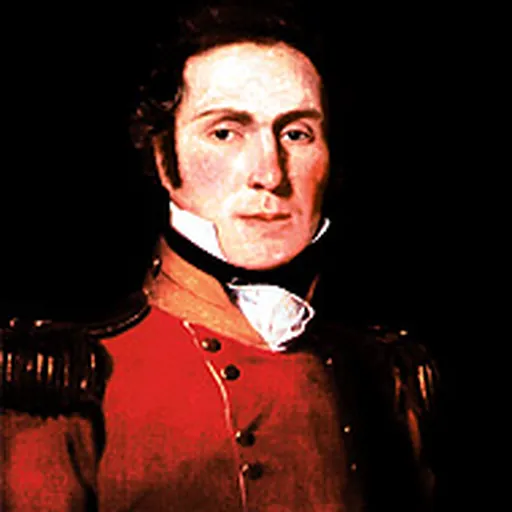
About Patrick Logan
Lived 1791 – 1830 (aged 38–39). Patrick Logan was a British explorer.
Captain Patrick Logan (baptised 15 November 1791 – 17 October 1830) was a Scottish army officer who was the commandant of the Moreton Bay Penal Settlement from 1826 until his death in 1830 at the hands of Aboriginal Australians. As he had been despised by convicts who were brutalised at his say-so, there were rumours that convicts who had managed to escape and were camping in the bush, had attacked him as an act of revenge, but there is no evidence of this.
Logan had a distinguished military career. He was infamous as the strict commandant of the penal colony, to the point of viscous cruelty and the inhumane treatment of convict prisoners. Logan made significant explorations of what was to become known as South East Queensland. He was the first European to discover the area which became Ipswich, Queensland and some consider him to be the founder of Queensland. He took part in the battles of Salamanca with the retreat from Salamanca; Vittoria; Nivelle and Toulouse. Logan's regiment was sent to Canada in 1814 where he stayed for a year before joining the Duke of Wellington's Army of Occupation in Paris.
He designed and oversaw the construction of a hospital, a jail and a windmill. He administered crops of wheat and maize at various locations. He believed that the settlement was a place to punish the convicts, forcing them to work by hand from sunrise to sunset. justifying the extreme criticism bestowed on him in the contemporary ballad Moreton Bay.
Explorations He also systematically explored the outer part of south-east Queensland. He discovered the southern entrance to Moreton Bay, now known as the Gold Coast Broadwater. He named the McPherson Range, Birnam Range, Teviot Brook and Wilsons Peak.
Logan was the first European explorer to visit the upper reaches of the Brisbane River and other places in the vicinity including the areas now known as Esk and the mountain rainforests of Lamington National Park and Mount Barney National Park. He was the first European to explore the Bremer River, where he discovered deposits of limestone at a point later to become known as Ipswich.
Captain Logan unsuccessfully attempted to climb Mount Barney on 13 and 14 June 1827. On a return journey, Logan, Allan Cunningham, Charles Fraser and a small party attempted to ascend the peak, believing they were climbing Mount Warning, which was first identified by James Cook. A determined Logan carried on while the rest were too fearful of the hazardous and difficult climb. From atop the summit, which was at the time the highest point reached in Australia,
As the horse had evidently failed to leap over the creek resulting in its death, it has been conjectured that the injuries and death of Captain Logan may have been accidental. However, contemporary news reports are emphatic that he was murdered with native weapons, as proved by the settlement's surgeon, Mr Cowper, at an inquest.
In November 1830, Logan was buried in the Protestant burial ground in Surry Hills, Sydney. Moreton Bay convicts "manifested insane joy at the news of his murder, and sang and hoorayed all night, in defiance of the warders." The ballad Moreton Bay represents Logan as a bloody tyrant. "Captain Logan, he had us mangled, on the triangles of Moreton Bay", attributes his death to "a native black", and concludes "my fellow prisoners, be exhilarated, that all such monsters such a death may find". In the long poem A Convict's Tour to Hell, written in 1839 by the convict Francis MacNamara, also thought to have composed the Moreton Bay lyrics, the convict sees Captain Logan suffering in hell.
Many geographic features in South East Queensland bear his name. These include Logan City, the Logan Motorway and Logan Road, Logan River, Logan Central, Logan Village, Logan Reserve, Loganholme, Loganlea and Logans Ridge. A commemorative plaque to one of Logan's expeditions can be found in Tully Memorial Park by the Logan River at North Maclean. The Queensland state electorate of Logan is also named for him.
The Commandant (1975) is a historical fiction novel by Jessica Anderson which describes the Moreton Bay penal settlement under Logan's command and the events surrounding his death from the viewpoint of his wife's sister Frances (a fictional character), who lives with the Logan family at the penal colony.
Don’t just read it —
keep it.
Full-length biographies made to live with: read them, listen on the way to work, watch them tonight.
- E-book
- Audio
- Video
Instant download · yours to keep · every purchase keeps this site free
Important facts
People in Patrick Logan's life
Named in this biography and alive at the same time

Related people
Same field, nearest in time

Contemporaries
People whose lives overlapped Patrick Logan's



Frequently asked questions
Who was Patrick Logan?
British Army officer
When was Patrick Logan born?
Patrick Logan was born in 1791 in Berwickshire.
When did Patrick Logan die?
Patrick Logan died on 1 October 1830 in Queensland.
What was Patrick Logan's occupation?
Patrick Logan was an explorer.
What nationality was Patrick Logan?
Patrick Logan was British.
Sources & further reading
Cite this page
APA: Biography.guide. (2026). Patrick Logan. https://biography.guide/patrick-logan/
MLA: "Patrick Logan." Biography.guide, https://biography.guide/patrick-logan/.
Chicago: "Patrick Logan." Biography.guide. https://biography.guide/patrick-logan/.
Data last updated: 2026-09-22 · Spot an error? Report a correction.
Portrait: Wikimedia Commons · author & licence
Page generated 2026-09-27 05:02 UTC