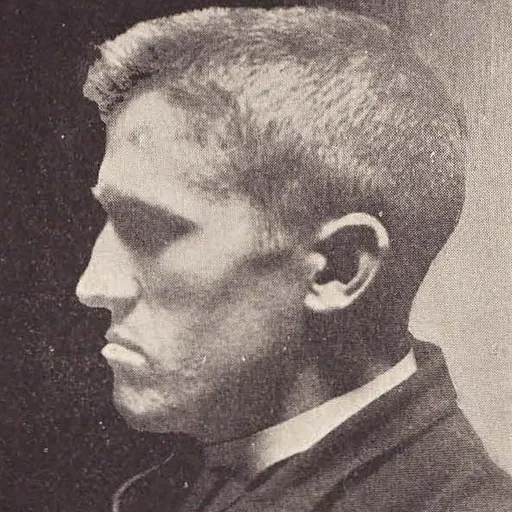
Patrick Eugene Prendergast
American assassin
About Patrick Eugene Prendergast
Lived 1868 – 1894 (aged 26).
Patrick Eugene Joseph Prendergast (6 April 1868 – 13 July 1894) was an Irish-born American newspaper distributor who assassinated Chicago Mayor Carter Harrison III, fatally shooting the five-term mayor on October 28, 1893. Following a murder trial and a subsequent proceeding in which the defense tried unsuccessfully to have him acquitted by reason of insanity, Prendergast was ultimately found guilty and sentenced to death for the assassination. He was executed by hanging on July 13, 1894, the only client of famed attorney Clarence Darrow to ever receive the death penalty.
Early life Prendergast was born on 6 April 1868 in Cloonamore townland, Inishbofin, an island off the west coast of Ireland. He was baptised in St Colman's Church on 12 April 1868. His parents were Ellen King (1837–1914) and Patrick Prendergast (1840–1886), both of whom were described as teachers at their marriage in Inishbofin on 2 July 1865. His grandfather, William Prendergast, who lost an arm in Pamplona, was an army pensioner who was reported to have died insane. His mother had "repeated attacks of hysterics" and his father died of consumption.
Prendergast was reported to have suffered a severe head injury from a fall at the age of four, from which he was unconscious for a long period of time and suffered vomiting for four weeks after. He left home at the age of 16 because of imaginary persecution. Prendergast had a fixation with writing postcards. In order to support Carter Harrison's pursuit to regain the mayoralty, Prendergast sent rambling postcards to prominent Chicagoans urging them to vote for Harrison. Among those who received such a postcard was prominent lawyer A. S. Trude, who would later prosecute the case against Prendergast in the murder trial that followed the assassination. Prendergast sent these postcards in support of Harrison for more than two years before Harrison was successful in winning the 1893 Chicago mayoral election. Prendergast believed that his letters had been responsible for Harrison's success in the election.
From some time in 1893 until July of that year, Prendergast disappeared for an extended time without notice, possibly in a dissociative fugue. He offered little account of where he had been, other than a vague statement about having been in Wisconsin.
In approximately mid-1893, Prendergast visited Chicago City Hall under the delusion that he had been appointed corporation counsel by Harrison. After Prendergast was insistent to a clerk that he held the position, he was brought to meet Adolph Kraus, the incumbent corporation counsel, who showed Prendergast his office and teased him by facetiously asking if he wanted the job. After Harrison had spent six months in office without appointing him corporation counsel or granting him any recognition, Prendergast began to desire revenge against Harrison for the perceived slight.
Assassination of Mayor Harrison
When the appointment did not come, Prendergast visited Harrison at his home on October 28, 1893, ringing the doorbell at 7:50 p.m. He was admitted by a maid who went to wake the mayor, who was taking a nap on a sofa in the parlor. As Harrison stepped into the hallway from the parlor, Prendergast approached and shot the mayor three times with a .38 revolver, hitting him first in the abdomen above the navel, a second time under the left arm with a shot that pierced his heart, and a third time at point-blank range through the left hand.
Harrison's coachman, hearing the gunfire, ran towards the site of the shooting with a pistol of his own, firing three times at the escaping Prendergast without hitting him, while avoiding being hit when Prendergast returned fire. Mortally wounded, Harrison died in his home at 8:25 p.m.
Prendergast was taken from the Des Plaines Street station to the Central Station, located downtown, where the building was quickly surrounded by a crowd of 5,000 people. Fearing potential mob violence, at 11:15 p.m., Prendergast was stealthily hurried into a wagon and taken to another station located on the North Side of the city, where he was lodged in the county jail pending trial. Several doctors testified that while Prendergast was paranoid, he knew right from wrong and was capable of standing trial for the murder.
A gallows had been constructed in the north corridor of the jail and seats placed between the row of cells along the north side and the high building wall of the Criminal Courts Building.
About 500 ticketed witnesses assembled to watch the execution, which included the members of the jury which convicted Prendergast. Prisoners whose cells faced the corridor where the gallows were erected were removed from their cells at 11:00 AM and brought to a location where the execution would not be visible to them.
When he got to the top of the platform, Prendergast briefly raised his hands, recognizing the crowd that gathered to view his execution. Prendergast walked to the edge of the trap without assistance, where his hands were fastened. Although having previously planned to make a last statement to the crowd, he had been dissuaded by Father Berry, to whom he quietly delivered his last words, "I had no malice against anyone."
The Chicago Daily News reported,
Prendergast's feet, knees, and chest were bound with straps and a white shroud placed over him and he was taken onto the trap, where the noose was placed around his neck. A white muslin hood was placed over his head and the noose, obscuring both from view.
A signal was given and at 11:48 the rope holding the heavy trap in place was cut. Prendergast's neck was broken by the six-foot drop and his body did not move after the fall. His pulse was taken several times. Before the hanging, his pulse stood at 120 beats per minute (BPM). Prendergast's heart continued to beat for about ten minutes after the trap was released. It decreased to 58 BPM within a minute after the trap was released, but rose to 100 the second minute, 148 the third minute, 160 the fourth minute, before declining gradually thereafter to 100 BPM in the eighth minute. It stopped some time before the twelfth minute. Five minutes later his body was taken down and placed in an awaiting coffin for burial.
The Chicago Daily News reported,
At 12:30 PM, Prendergast's hearse containing the coffin departed from the jail. He was buried at Calvary Cemetery in Evanston, Illinois in an unmarked grave located next to his father's grave.
Media depictions On occasion, Prendergast has been represented in film or fiction. In the 1991 made-for-TV movie Darrow, he was portrayed by New York-born actor Paul Klementowicz. Prendergast's story is one of the subplots in Erik Larson's 2003 best-selling non-fiction book The Devil in the White City. Patrick was also referenced in Watch Dogs during a city hotspot checkin in which you can visit the police station and briefly read about it.
Don’t just read it —
keep it.
Full-length biographies made to live with: read them, listen on the way to work, watch them tonight.
- E-book
- Audio
- Video
Instant download · yours to keep · every purchase keeps this site free
Important facts
People in Patrick Eugene Prendergast's life
Named in this biography and alive at the same time

Contemporaries
People whose lives overlapped Patrick Eugene Prendergast's


Frequently asked questions
Who was Patrick Eugene Prendergast?
American assassin (1868-1894)
When was Patrick Eugene Prendergast born?
Patrick Eugene Prendergast was born on 18 April 1868 in Ireland.
When did Patrick Eugene Prendergast die?
Patrick Eugene Prendergast died on 13 July 1894 in Chicago.
Sources & further reading
· Wikipedia: Patrick Eugene Prendergast
· DBpedia: Patrick Eugene Prendergast
Cite this page
APA: Biography.guide. (2026). Patrick Eugene Prendergast. https://biography.guide/patrick-eugene-prendergast/
MLA: "Patrick Eugene Prendergast." Biography.guide, https://biography.guide/patrick-eugene-prendergast/.
Chicago: "Patrick Eugene Prendergast." Biography.guide. https://biography.guide/patrick-eugene-prendergast/.
Data last updated: 2026-09-23 · Spot an error? Report a correction.
Portrait: Wikimedia Commons · author & licence
Page generated 2026-09-27 05:07 UTC