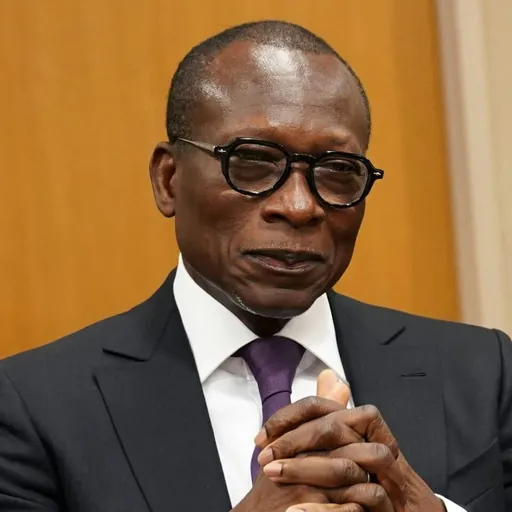
Patrice Talon
President of Benin between 2016 and 2026
About Patrice Talon
Born 1958. Patrice Talon is a Beninese politician, businessperson and president of the Republic of Benin.
Patrice Guillaume Athanase Talon (born 1 May 1958) is a Beninese politician and businessman who serves as the first president of the Senate since 2026. He previously served as the eighth president of Benin from 2016 to 2026. Early life and career Patrice Guillaume Athanase Talon was born in Ouidah on 1 May 1958, and is of Fon origin. His father was from Ouidah while his mother came from a Guédégbé family in Abomey. After completing secondary school with a baccalauréat, Talon had ambitions of becoming a pilot in his early years. Following his second year at university, he passed an Air Afrique pilot exam and transferred to the École nationale de l'aviation civile in Paris,
In 1983, Talon became involved in trading packaging and agricultural inputs. In 1985, he returned to Benin and established the Intercontinental Distribution Company (Société Distribution Intercontinentale; SDI), supplying agricultural inputs to cotton producers. In 1990, after recommendations by the World Bank to liberalize economies in West African countries, Benin was called upon to withdraw from the cotton production chain. Talon then won the chance to establish three cotton ginning factories in Benin. He was also known as the "King of Cotton" for his involvement in the cotton industry. He built his empire due to connections with the Beninese political class.
Talon was one of President Thomas Boni Yayi's chief financial backers, financing his campaigns in the 2006 and 2011 elections. His company, Benin Control, acquired two nationally owned enterprises, Sodeco in 2009 and PVI in 2011. In 2011, Talon received management of Cotonou's imports at the Port of Cotonou. In 2012, he fled to France after he was accused of embezzling more than 18 million euros in taxes.
Presidency (2016–2026)
Talon ran as an independent candidate in the March 2016 presidential election. He finished second to Prime Minister Lionel Zinsou of the Cowry Forces for an Emerging Benin in the first round of voting, but won the second round with 65% of the vote. Zinsou conceded on election night. On 25 March 2016, Talon said that he would "first and foremost tackle constitutional reform", discussing his plan to limit presidents to a single term of five years in order to combat "complacency". He also said that he planned to reduce the cabinet from 28 to 16 members.
Talon was inaugurated as the eighth president of Benin on 6 April 2016. The composition of his government was announced later that day. There was no prime minister, and two defeated presidential candidates who had backed Talon in the second round, Pascal Koupaki and Abdoulaye Bio-Tchane, were appointed to key posts, Secretary-General of the Presidency and Minister of State for Planning and Development, respectively. Talon pledged to increase Benin's fortunes in five years and improve its relationship with France. Some of his policy goals are to reduce the power of the executive and limit presidents to single terms of five years.
On 4 April 2017, the National Assembly failed to pass a bill that would have led to a referendum on Talon's proposal to limit presidents to a single five-year term. 63 votes in the 83-member National Assembly were required for passage, and the bill received 60 votes. Talon said a few days later that he would not pursue the matter any further. He said he was saddened by the outcome of the vote but respected it because of his commitment to democracy. He declined to say whether he would stand for reelection in 2021, Ultimately, he was reelected with 86% of the vote.
In 2018, Sébastien Ajavon, an opponent who came third in the 2016 presidential election, was sentenced to 25 years in prison for "drug trafficking" and "forgery and fraud". Several opposition figures were sentenced to heavy prison terms in December 2021. Former Minister of Justice Rekaya Madougou was sentenced to twenty years in prison for "terrorism", and the law professor Joël Aïvo to ten years for "money laundering" and "undermining state security". According to journalist and teacher Francis Kpatindé, Talon's policies have led to a decline in human rights and the right to strike. In July 2023, after the coup d'état in neighboring Niger and the ensuing Nigerien crisis, Talon expressed support for ousted president Mohamed Bazoum and condemned the coup. In September 2024, authorities announced the discovery of a coup plot against Talon, scheduled for 27 September and led by the businessman and Talon ally Olivier Boko. Former sports minister Oswald Homéky and the commander of the Republican Guard were named as co-conspirators, leading to the arrest of Boko and Homéky. Both were convicted and sentenced in January 2025 to 20 years' imprisonment and a fine of 60 billion CFA francs ($95 million).
On 23 January 2025, Talon announced that he would not seek a third presidential term and that he would not amend the constitution (which imposes an absolute two-term limit on the presidency) to do so. On 14 March 2025, Talon reaffirmed that he would not run in the 2026 Beninese presidential election. On 7 December 2025, Talon's residence in Cotonou was attacked, after which a group of soldiers led by Lieutenant Colonel Pascal Tigri announced Talon's overthrow over national television; however, the coup was largely suppressed by government forces later in the day with military assistance from Nigeria and other ECOWAS member-states, and Talon pledged to punish those responsible and other participants.
According to NPR, Talon oversaw a modest economic transformation of Benin following a major investment in infrastructure.
Post-presidency The Senate was established under a constitutional reform adopted on 18 November 2025 passed by a 90-19 vote in the National Assembly. The then government of Talon said the reform was aimed at strengthening political stability, national unity and the functioning of state institutions, leading to Benin’s transition to a bicameral parliament. The senate was sworn in on 30 July 2026. Talon was elected as the president of Senate in its first inaugural session on 6 august 2026, securing 24 out of 25 votes, and marking a return to the centre of national politics only months after leaving the presidency.
Personal life Talon is married to Claudine Gbènagnon from Porto-Novo and has two children.
Don’t just read it —
keep it.
Full-length biographies made to live with: read them, listen on the way to work, watch them tonight.
- E-book
- Audio
- Video
Instant download · yours to keep · every purchase keeps this site free
Important facts
Family & relationships
People in Patrice Talon's life
Named in this biography and alive at the same time



Related people
Same field, nearest in time



Contemporaries
People whose lives overlapped Patrice Talon's



Frequently asked questions
Who is Patrice Talon?
President of Benin between 2016 and 2026
When was Patrice Talon born?
Patrice Talon was born on 1 May 1958 in Ouidah.
What is Patrice Talon's occupation?
Patrice Talon is a politician, businessperson and president of the Republic of Benin.
What nationality is Patrice Talon?
Patrice Talon is Beninese.
Sources & further reading
Cite this page
APA: Biography.guide. (2026). Patrice Talon. https://biography.guide/patrice-talon/
MLA: "Patrice Talon." Biography.guide, https://biography.guide/patrice-talon/.
Chicago: "Patrice Talon." Biography.guide. https://biography.guide/patrice-talon/.
Data last updated: 2026-09-22 · Spot an error? Report a correction.
Portrait: Wikimedia Commons · author & licence
Page generated 2026-09-27 05:02 UTC