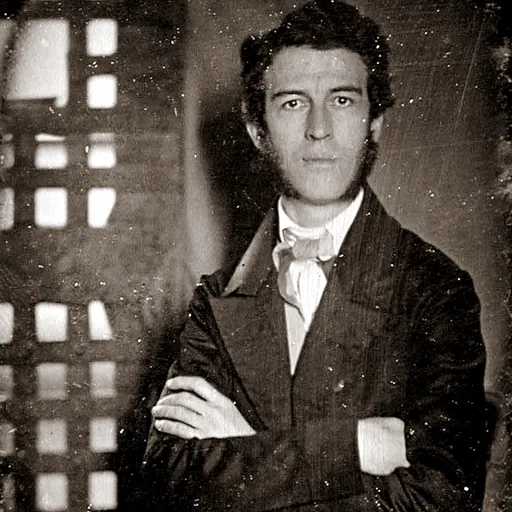
About Passmore Williamson
Lived 1822 – 1895 (aged 72). Passmore Williamson was an American suffragist.
Passmore Williamson (February 23, 1822 – February 1, 1895) was an American abolitionist and businessman in Philadelphia, Pennsylvania, a free state in the antebellum years. As secretary of the Pennsylvania Anti-Slavery Society and a member of its Vigilance Committee, Williamson is best known for helping Jane Johnson and her two sons gain freedom from slavery on July 18, 1855.
In a case that established legal precedent, he was served with a writ of habeas corpus by federal US District Court John K. Kane under the Fugitive Slave Law of 1850 to produce Johnson and her two sons in court. He did not know where they were held, so could not respond; Judge Kane charged him with contempt of court and sentenced him to 90 days.
The jailing of Williamson dramatically expanded news coverage of the case and generated debate about the extension of "Slave Power" over state law, as Pennsylvania did not recognize slavery. It held that slaveowners gave up their property rights in slaves if they brought them into the state; if the slave chose freedom, the state would support that decision and not compensate the owner. Thus, Johnson was not literally a fugitive, as she had gained freedom in the state according to state law, after John Hill Wheeler voluntarily took her there in the course of his travel.
Early life and education
Passmore Williamson was born in 1822 as the son of Thomas and Elizabeth (Pyle) Williamson, a Quaker family in Westtown Township, Pennsylvania. He also had two sisters.
Judge John K. Kane charged Williamson with contempt of court for not revealing the location of Johnson and her children, but he literally did not know it, as Still had not told him. (This was common practice among the Vigilance Committee, to protect members and fugitives.) Williamson responded, noting that Johnson was not legally a fugitive under the circumstances of the case, as Wheeler had voluntarily brought her into the state, where she had the freedom to decide if she wanted to leave slavery. Lithographs of Williamson in prison were sold to raise money for the abolitionist cause. Kane judged Williamson in violation of the Fugitive Slave Law of 1850, which required even citizens of free states to cooperate in returning fugitive slaves to their owners. He had dismissed an affidavit from Jane Johnson, attesting that she had not been forcibly abducted but chose to go, as "immaterial and irrelevant." While imprisoned, he received numerous letters and several hundred visitors, including African-American abolitionists Frederick Douglass and Harriet Tubman, both former slaves who had escaped from the South. These are attested in his visitor book, which is held by the Chester County History Center.
Protected by state and local officials, Jane Johnson was quickly taken out of the city, eluding federal marshals. She and her children remained free; they moved to Boston, where they settled. Johnson soon married there and worked as a seamstress. Several years later after being widowed, she married again. Her son Isaiah Johnson served in a Massachusetts Regiment of the United States Colored Troops during the American Civil War.
Claiming that he was illegally imprisoned, Williamson had filed his own writ of habeas corpus with the State Supreme Court, but it was denied. He was finally freed on November 3, suffering some health effects from jail. He sued Judge Kane for illegal imprisonment, but the case was still unsettled at the time of Kane's death in 1858.
Other activities Williamson continued to be involved in abolitionism and public service. For instance, he supported voting rights for women from an early stage.
After his father's death in 1871, Williamson invested some of his estate in speculative ventures that did not do well. His family divided over the issue, and his sisters sued him. The outcome of this case is not known.
His wife Mercie died in 1878. After his death years later, Williamson was buried next to her and his father in a Quaker cemetery in Upper Darby Township, Pennsylvania.
Don’t just read it —
keep it.
Full-length biographies made to live with: read them, listen on the way to work, watch them tonight.
- E-book
- Audio
- Video
Instant download · yours to keep · every purchase keeps this site free
Important facts
People in Passmore Williamson's life
Named in this biography and alive at the same time



Related people
Same field, nearest in time



Contemporaries
People whose lives overlapped Passmore Williamson's



Frequently asked questions
Who was Passmore Williamson?
American abolitionist
When was Passmore Williamson born?
Passmore Williamson was born on 23 February 1822 in Chester County.
When did Passmore Williamson die?
Passmore Williamson died on 1 February 1895 in Upper Darby Township.
What was Passmore Williamson's occupation?
Passmore Williamson was a suffragist.
What nationality was Passmore Williamson?
Passmore Williamson was American.
Sources & further reading
· Wikipedia: Passmore Williamson
· DBpedia: Passmore Williamson
Cite this page
APA: Biography.guide. (2026). Passmore Williamson. https://biography.guide/passmore-williamson/
MLA: "Passmore Williamson." Biography.guide, https://biography.guide/passmore-williamson/.
Chicago: "Passmore Williamson." Biography.guide. https://biography.guide/passmore-williamson/.
Data last updated: 2026-09-23 · Spot an error? Report a correction.
Portrait: Wikimedia Commons · author & licence
Page generated 2026-09-27 05:05 UTC