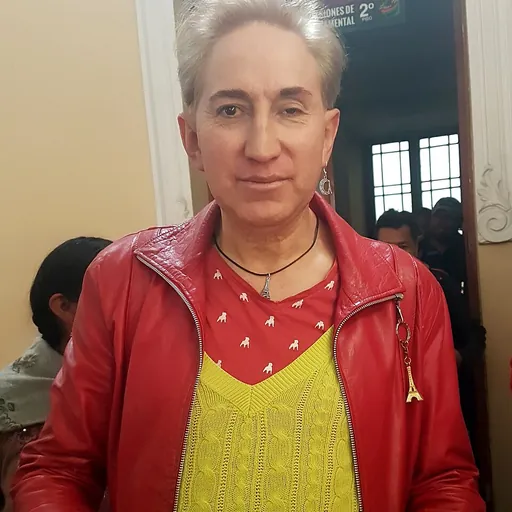
París Galán
Bolivian drag queen and politician
About París Galán
Lived 1968 – 2026 (aged 58). París Galán was a Bolivian politician, lGBTQ rights activist and drag queen.
Carlos Felipe Parra Heredia (5 February 1968 – 30 May 2026), known professionally as París Galán , was a Bolivian drag queen, LGBT rights activist and politician. A member of Galan Family (Familia Galán), a collective of LGBT drag performers, Parra was the country's best-known drag queen. Heefn-lg|Parra was indifferent to the pronouns used to refer to him, stating, as one example, that the masculine article el and the feminine la had both been used to address him, as in "el París or la París". where he was introduced to (Marco Salguero), a drag performance artist who introduced him to the art of transformismo femenino.
Together with other artists, Parra and Salguero began performing drag shows as a group, with the troupe coming to be known as Las Galán by La Paz's queer community. La Familia Galán backed the formation of the National Network of LGBT Communities of Bolivia, but the body gradually dissolved as member groups, including Las Galán, began dissociating themselves from it.
In 2005, the Rainbow Movement was formed, composed of La Familia Galán and other LGBT organizations opposed to the national network. The group sought to apply more overtly political overtones to the various pride events that had been held until then, promoting the idea that rather than simple aesthetic displays, LGBT marches could be used as platforms to demand civil rights. "This is not just a parade; this is a march to end homophobia", Parra stated at one demonstration. In June, the Rainbow Movement constituted La Paz's delegation to the IV LGBT National Congress, where it voiced its criticisms of the national network's failings. The group voted against the network's annual report and against its continuation as a body but was outvoted by delegations from the six other participating departments. Its members abandoned the congress the next day, disregarding any ensuing resolutions it made.
LGBT rights and the Constituent Assembly: 2005–2006 Parra and La Familia Galán's split with other organized LGBT movements came at a critical time when broader discussions regarding potential reforms to the Constitution were in full swing. At times, the movement's internal factionalism and disunity hampered efforts to include the expansion of LGBT rights in these discussions. An example of this occurred in 2002 when the National Network of LGBT Communities presented Congress with a package of constitutional amendments that included, among other things, the right to same-sex marriage and civil unions. Aside from the expected pushback levied by the Catholic Church, the network's proposals also faced internal opposition from LGBT groups, such as Mujeres Creando and La Familia Galán, despite the fact that both had participated in drafting it. When the document was set to be debated in the Chamber of Deputies, a communication error resulted in proponents of the legislation not arriving, meaning that only Parra and another critic, María Galindo, attended. According to Alberto Moscoso, director of the national network, "at [the meeting], París said: 'I don't want to get married, and I don't know why they are asking for marriage in the law,' [but] the law was for everyone, it was not specifically for París Galán." Ultimately, such internal disagreements and contradicting viewpoints caused the project to lose momentum, and the legislation was archived by Congress.
Parra (furthest right) with other LGBT organizers in La Paz, 27 June 2022. alt=Carlos Parra and other organizers hold up a banner advertising the name of their collective, "Colectivo Edge".
Despite these setbacks, new opportunities to advance LGBT causes arose. In the leadup to 2006, with the convocation of the Constituent Assembly, the prospect of codifying LGBT rights into the newly rewritten constitution became a top priority for groups like Parra's. In the month's preceding the assembly's installation, Parra and La Familia Galán collaborated with government authorities to present their sector's proposals. In April 2005, the government's Constituent Assembly Coordination Unit, in collaboration with La Familia Galán and other LGBT organizations, convened the National Workshop on Gender and Sexual Diversities in Cochabamba. At a discursive level, the event marked a turning point for the Bolivian LGBT rights movement, as La Familia Galán managed to successfully center the discussion of queer rights around "gender and sexual diversity" rather than just the "gay community", a term that began falling out of use. "Until that moment, there had been talk of the gay, the gay, and the gay, making the trans, the lesbian, [and] the bisexual invisible", Parra later stated.
In addition to this and other policy proposals compiled at the meeting, a national commission was also formed to represent the country's sexual minorities before the Constituent Assembly Coordination Unit. Parra was elected as the commission's national representative, but internal power struggles led rival organizers to dispute his selection, generating a crisis of representation. Just a few months later, during the IV LGBT National Congress, the effectively defunct commission formed in April was dissolved, and a new Gender and Sexual Diversity Committee backed by the UCAC and other LGBT and human rights organizations was established. Having already abandoned the congress, La Familia Galán did not participate in its creation, and the committee ultimately met the same fate as its predecessor. Seeing the need to consolidate a broader coalition, Parra participated in the formation of the Strategic Alliance for the Inclusion of Diversities, a body that brought together activist organizations from a variety of minority groups. Following the formation of its directorate, Parra was elected as the alliance's national representative.
Although it was initially hoped that civil society organizations would be allowed to field their own candidates for the Constituent Assembly, the reaffirmation of political parties as the only groups authorized to compete electorally forced Parra and other organizers to seek out a front willing to sponsor them. Given his status as an activist for the party, Parra first looked to seal a deal with the ruling Movement for Socialism (MAS-IPSP). His alliance soon reached an agreement with the MAS in which the party pledged to include representatives from each sector—including three sexual minorities—on its electoral list. However, the party reneged on the agreement at the eleventh hour, forcing Parra to find a new front within hours of the registration deadline. "The MAS turned its back on us", Parra decried. His and other queer organizers' candidacies were eventually sponsored by the Free Bolivia Movement, but the hectic last-minute change weakened their electoral positions. "I was placed in a constituency where no one knew me", Parra recounted. In the end, not one LGBT candidate was elected to the Constituent Assembly. With the dissolution of the strategic alliance shortly thereafter, Parra stepped back from the political scene and did not play an active role in the constitution drafting process. While the final text included some LGBT-affirming language, it stopped short of codifying more important queer issues, and explicitly barred same-sex marriage.
Electoral politics and procedural hurdles: 2015–2021 In the years succeeding the passage of the 2009 Constitution, Parra assumed an antagonistic disposition towards the ruling MAS government, whose anti-discrimination efforts he considered lacking. In a 2016 interview with The Washington Post, Parra expressed disapproval of the way in which the government had handled a law allowing transgender citizens to legally change their gender. He concluded that it had only gone forward with the bill "to quell anger from activists" and lamented that LGBT rights groups had been asked to "keep a low profile... while the bill was in congress... to avoid generating opposition". In late 2014, responding to the public call issued by Revilla's party, Sovereignty and Liberty (SOL.bo), Parra presented himself as a pre-candidate for a seat on the La Paz Municipal Council. The party eventually nominated him for a seat in the La Paz Departmental Legislative Assembly, in which he was to serve as a substitute assemblyman. Elected in early 2015 and sworn in in May, Parra became the first-ever openly transgender individual to win elective office in Bolivian history. As of , he is one of two queer people and the second gay man to have served as a lawmaker in the country, after Manuel Canelas, who assumed a seat in the Chamber of Deputies just months prior.
In accordance with proportional representation, SOL.bo was assigned ten party list seats in the Departmental Legislative Assembly. Given that the party had only nominated seven candidates, the remaining three seats were left vacant upon the assembly's inauguration. As one of the three highest-ranking substitute assembly members, Parra sought to be authorized to hold one of the empty seats. Although the Supreme Electoral Tribunal ordered the three substitutes to be sworn in, the Departmental Electoral Tribunal refused to accredit them on technical grounds, In September 2018, the Supreme Electoral Tribunal intervened and delivered Parra and Quispe their credentials. Despite this, the pair continued to face hurdles as the MAS-controlled legislature, faced with the loss of its de facto majority, refused to swear them in. Finally, on 30 May 2019, after four years and with just ten months left in their terms, both Parra and Quispe were allowed to assume office.
As a result of the annulment of the 2019 general election and delays in holding the 2020 general election, the terms of all subnational authorities, including Parra's, were extended by one year. In the 2021 departmental elections, Parra sought reelection to his seat in the Departmental Assembly. However, SOL.bo's distant sixth-place finish at the polls left it devoid of most parliamentary representation, denying Parra a second term.
Personal life and death Parra was gay and had been in at least four committed same-sex relationships throughout his life. Regarding the prospect of marriage, Parra expressed a lack of interest in the matter, stating that he had "always been against the idea... I think that when you meet someone and want to express your love, you can do it without the need for a legal union." He also stated that he would not adopt, saying: "those who think, 'I'm gay; I want to have a partner and adopt children to validate myself' are reinforcing [the] nuclear family... and I question that." Regarding his gender identity, Parra stated that he thought that he wanted to be a woman as a teenager, but that as he "grew emotionally, matured, and had [his] first partner" he re-affirmed his position as a man, saying that he did not want to be a woman and enjoyed his body and sexuality. At the same time, Parra identified as transgender, viewing himself outside the gender binary.
Electoral history + Year Office Alliance Votes Result . Total % . 2006 Constituent Free Bolivia Movement 3,226 4.25% 5th 2015 Substitute assemblyman Sovereignty and Liberty 436,762 45.87% 1st 2021 Assemblyman Sovereignty and Liberty 27,650 2.60% 6th Source: Plurinational Electoral Organ Electoral Atlas
Don’t just read it —
keep it.
Full-length biographies made to live with: read them, listen on the way to work, watch them tonight.
- E-book
- Audio
- Video
Instant download · yours to keep · every purchase keeps this site free
Important facts
People in París Galán's life
Named in this biography and alive at the same time




Related people
Same field, nearest in time


Contemporaries
People whose lives overlapped París Galán's



Frequently asked questions
Who was París Galán?
Bolivian drag queen and politician (1968-2026)
When was París Galán born?
París Galán was born on 5 February 1968 in Oruro.
When did París Galán die?
París Galán died on 30 May 2026 in Cochabamba.
What was París Galán's occupation?
París Galán was a politician, lGBTQ rights activist and drag queen.
What nationality was París Galán?
París Galán was Bolivian.
Sources & further reading
Cite this page
APA: Biography.guide. (2026). París Galán. https://biography.guide/paris-galan/
MLA: "París Galán." Biography.guide, https://biography.guide/paris-galan/.
Chicago: "París Galán." Biography.guide. https://biography.guide/paris-galan/.
Data last updated: 2026-09-23 · Spot an error? Report a correction.
Portrait: Wikimedia Commons · author & licence
Page generated 2026-09-27 05:08 UTC