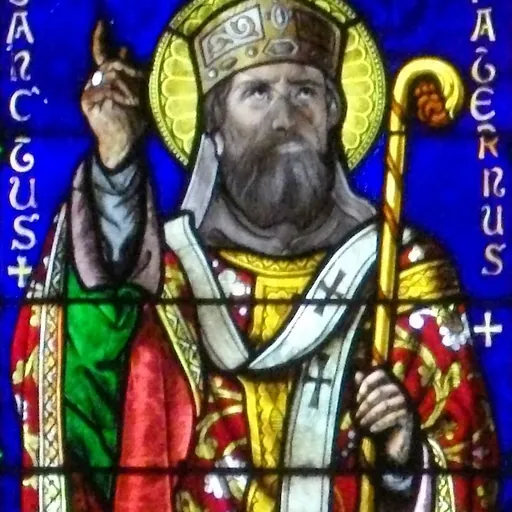
Padarn
6th‑century Welsh bishop and Christian saint active during the Age of the Saints in Wales
About Padarn
Lived 500 – 510. Padarn was a Welsh catholic priest and catholic bishop.
Padarn (; ; ; 4th century AD – 550 AD) was an early 6th century British Christian abbot-bishop who founded Saint Padarn's Church in Ceredigion, Wales. He appears to be the same individual as the first bishop of Braga and Saint Paternus of Avranches in Normandy. Padarn built a monastery in Vannes and is considered one of the seven founding saints of Brittany. His early vita is one of five insular and two Breton saints' lives that mention King Arthur independently of Geoffrey of Monmouth's Historia Regum Britanniae.
Life The Vita Sancti Paterni, a major source for biographical details of Padarn, may be an epitome of a previous and more extensive source. According to the Vita Sancti Paterni, Padarn is Armorican by race, born to "Petran, his father, and Guean, his mother".
Around the year 524 Padarn traveled to join his father in Ireland. He joined a fellowship of monks led by his cousin, St. Cadvan, who were travelling to Britannia. At this time, as in many saints' lives of the era, there appears to be an aristocratic military function in Padarn's career, for among the travellers were Padarn's cousins, who appointed him as the fourth leader of the troop, saying "you should rule over people for example of life". Padarn later founded a monastery at Llanbadarn Fawr, near Aberystwyth, which became the seat of a new diocese, with him as its first bishop.
After Padarn returned to Llanbadarn Fawr, Maelgwn Gwynedd tried to cheat him out of property belonging to the monastery. Two of Maelgwn's evil heralds were undone by the trial by ordeal of boiling water; scalded and defeated, "Their souls in raven-forms fly to the riverbed, which unto this day by the name of one of them is called, to wit, Graban." Maelgwn Gwynedd himself is first cursed and then cured of his sickness and blindness when he comes on bended knee to ask forgiveness, and to bestow lands on Padarn's community, which are laid out with the exactitude of a deed: "a quantity of land, that is, from the mouth of the river Rheidiol upwards until it touches at its head the limit of the river Clarach; and along the length of the same river as far as the sea is the limit prolonged."
In the Vita Sancti Paterni Padarn travels on a pilgrimage to Jerusalem with Saint David and Saint Teilo for all three to be ordained bishops by the patriarch. Along the way they acquired the gift of tongues so that whomever they spoke to understood them in his own language.
Padarn finally returned to Letavia, where his fame filled the region and "made peace" with the bishop Samson in Vannes, where Padarn his built a monastery and subsequently made a peace with the six bishops of Armorica, of which he now made a seventh.
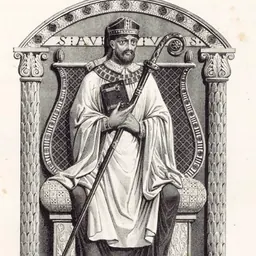
Padarn and Arthur 1878 sketch from Little Pictorial Lives of the Saints, by Benzinger Brothers. In the most celebrated episode, King Arthur tries to steal Padarn's tunic and subsequently becomes Christian. It's too late to be reliable. But the episode was probably meant to increase Padarn's prestige and credibility as a saint by being granted credit for "Christianizing" the semi-historical leader who allegedly defeated the Anglo-Saxons with the help of Jesus Christ and the Virgin Mary in the battle of Mount Badon according to the 9th century monk Nennius. The author also seemed to confuse this Padarn with Padarn Redcoat whose coat was one of the Thirteen Treasures of the Island of Britain;
Paternus of Avranches The British Padarn appears to be the same person as Saint Paternus of Avranches in Normandy. By tradition, it is said that he was born in Poitiers, became a monk at the Abbey of Saint-Jouin-de-Marnes in France, and retreated with his fellow monk, Saint Scubilion, to the in the diocese of Coutances before the Bishop of Coutances made him a priest in 512.
Veneration Feast day: April 16 Three days were kept to honour Padern in Armorica; the Armoricans celebrate three solemnities of his, namely, that day of the Kalends of November, when he formed perpetual unity with the six chief saints of Letia, the day of his obit, and the day he received the order of the episcopate, the twelfth before the Kalends of the month of July.
As well as the church at Llanbadarn Fawr, there is a second church dedicated to him, in Llanberis in Gwynedd, and three churches in Radnorshire.
St Padarn’s Institute, located at St Michael’s Conference Centre, Llandaff, handles training for ministry in the Church in Wales.
Don’t just read it —
keep it.
Full-length biographies made to live with: read them, listen on the way to work, watch them tonight.
- E-book
- Audio
- Video
Instant download · yours to keep · every purchase keeps this site free
Important facts
People in Padarn's life
Named in this biography and alive at the same time
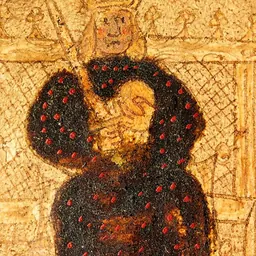
Related people
Same field, nearest in time

Frequently asked questions
Who was Padarn?
6th‑century Welsh bishop and Christian saint active during the Age of the Saints in Wales
When was Padarn born?
Padarn was born in 500 in Wales.
When did Padarn die?
Padarn died on 15 April 510 in Vannes.
What was Padarn's occupation?
Padarn was a catholic priest and catholic bishop.
What nationality was Padarn?
Padarn was Welsh.
Sources & further reading
Cite this page
APA: Biography.guide. (2026). Padarn. https://biography.guide/padarn/
MLA: "Padarn." Biography.guide, https://biography.guide/padarn/.
Chicago: "Padarn." Biography.guide. https://biography.guide/padarn/.
Data last updated: 2026-09-22 · Spot an error? Report a correction.
Portrait: Wikimedia Commons · author & licence
Page generated 2026-09-27 05:04 UTC