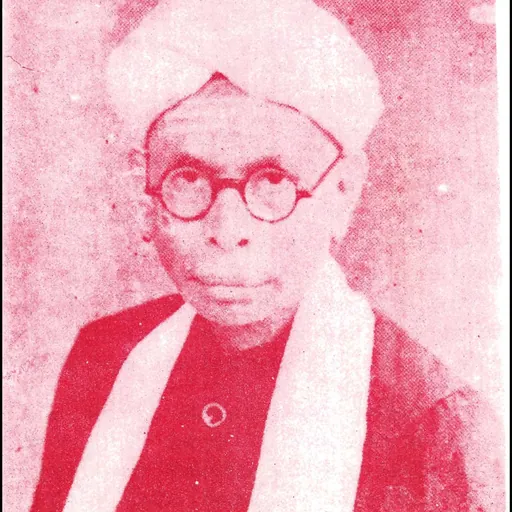
About P. S. Subrahmanya Sastri
Lived 1890 – 1978 (aged 87). P. S. Subrahmanya Sastri was an Indian translator, known for Sanskrit and Tamil language.
P. S. Subrahmanya Sastri (29 July 1890 – 20 May 1978) was a Sanskrit scholar, who also acquired mastery over Tamil language and literature. He was the first to translate Tolkāppiyam into English.
Education Subrahmanya Sastri did his S.S.L.C. at National High School, F.A. at St. Joseph's College and B.A. Mathematics at SPG (later Bishop Heber's) College – all in Tiruchirappalli. He started his professional career as a Mathematics assistant at the Central High School (now Srinivasa Rao Higher Secondary School), Thiruvaiyaru, and National High School, Tiruchi.
He studied Sanskrit under Nilakanta Sastri, a specialist in grammar and philosophy. He also learnt Nyaya (logic) and Alankara Sastra (Poetics and Literary Criticism) from Prof. S. Kuppuswami Sastri of the Madras Presidency College (professor of Sanskrit and comparative philology, and curator of the Government Oriental Manuscripts Library, Madras ) and Mimamsa (Linguistics) from Chinnaswami Sastri of the Benares Hindu University. A graduate in M.A. (Sanskrit), Subrahmanya Sastri also passed L.T. through Teachers’ Training College at Saidapet, Chennai.
While teaching Sanskrit, Subrahmanya Sastri had to teach Tamil also. This paved the way for his in-depth study in both Sanskrit and Tamil, specifically grammar. Prof. Kuppuswami Sastri also taught him the Comparative Philology of Indo Aryan languages. All these inspired Subrahmanya Sastri to take up a systematic study of Tamil literature and grammar. ), took keen interest in attending his Sanskrit classes at Annamalai University.
Research Subrahmanya Sastri worked on the Tolkappiyam, which he later translated into English. The translation of ‘Ezhuthu’ and ‘Poruladhikaram’ were published by the Kuppuswami Sastri Research Institute, while the ‘Solladhikaram part’ was published by Annamalai University.
Subrahmanya Sastri's text on Tolkappiyam in Roman transliteration and English translation received encomiums from linguists across the world.
Literary works During his tenure at Annamalai University, Subrahmanya Sastri published two volumes of lectures on Patanjali's Mahabhashya, the Thonivilakku, a Tamil translation of Dhvanyaloka (a Sanskrit rhetorical text), History of Sanskrit literature and Sanskrit Language (2 books) in Tamil and Historical Tamil Reader in English.
On his retirement, he returned to Thiruvaiyaru and completed the translation of the Mahabhashya into English (in 14 volumes running to about 4,000 pages) on the advice of the Mahaperiyava of Kanchi. He finished his translation in 1953. The Kuppuswami Sastri Research Institute has published all the 14 Vols. of Prof. P.S.S.Sastri.
Under each sutra just before taking up the bhashya, Subrahmanya Sastri had pointed out the topics that would be dealt with in the great commentary. Then giving the original in the Devanagari script, he translated each passage of the text. With a view to elucidating the obscure points, he often added notes mostly based on Kaiyata's Pradipa and Nagesabhatta's Udyota. Footnotes are also given offering further explanation and showing variance in readings. The index of words is a welcome addition.
Awards and felicitations Subrahmanya Sastri was a recipient of several titles. Vidyaratna (Benares) Vidyanidhi (Kerala) Vidyabhushana (Karnataka) Mahamahimopadhyaya (Allahabad) and Vani-Triveni-Prayaga from the Periyava of Kanchi Mutt.
In the fifth title, the Mahaswami implied that Sanskrit and Tamil represented the rivers Ganga and Yamuna and English represented Antarvahini Saraswathi since his proficiency in English was hidden in his works.
Personality Subrahmanya Sastri read and wrote in various fields. In addition to Sanskrit, Tamil, and English, he studied German, French, Telugu, Kannada, and Malayalam. During his retirement at Tiruvaiyaru, he taught Tirukkural to a manual scavenger.
Subrahmanya Sastri was extremely kind to his students that sometimes he would pay their course and examination fee. He had studied the Rg, Yajur and Sama Vedas and taught them to many students. He had also published about 40 books besides his contribution of research articles in journals.
Death Subrahmanya Sastri died on 20 May 1978 at Tiruvaiyaru. An Endowment has been created in his name in 1997 at the Kuppuswami Sastri Research Institute and every year lecture is being arranged under this Endowment.
Don’t just read it —
keep it.
Full-length biographies made to live with: read them, listen on the way to work, watch them tonight.
- E-book
- Audio
- Video
Instant download · yours to keep · every purchase keeps this site free
Important facts
Related people
Same field, nearest in time



Contemporaries
People whose lives overlapped P. S. Subrahmanya Sastri's





Frequently asked questions
Who was P. S. Subrahmanya Sastri?
Indian Sanskrit scholar (1890–1978)
When was P. S. Subrahmanya Sastri born?
P. S. Subrahmanya Sastri was born on 29 July 1890 in Tiruchirappalli.
When did P. S. Subrahmanya Sastri die?
P. S. Subrahmanya Sastri died on 20 May 1978 in Thiruvaiyaru.
What was P. S. Subrahmanya Sastri's occupation?
P. S. Subrahmanya Sastri was a translator.
What was P. S. Subrahmanya Sastri known for?
P. S. Subrahmanya Sastri was known for Sanskrit and Tamil language.
What nationality was P. S. Subrahmanya Sastri?
P. S. Subrahmanya Sastri was Indian.
Sources & further reading
· Wikipedia: P. S. Subrahmanya Sastri
· DBpedia: P. S. Subrahmanya Sastri
Cite this page
APA: Biography.guide. (2026). P. S. Subrahmanya Sastri. https://biography.guide/p-s-subrahmanya-sastri/
MLA: "P. S. Subrahmanya Sastri." Biography.guide, https://biography.guide/p-s-subrahmanya-sastri/.
Chicago: "P. S. Subrahmanya Sastri." Biography.guide. https://biography.guide/p-s-subrahmanya-sastri/.
Data last updated: 2026-09-22 · Spot an error? Report a correction.
Portrait: Wikimedia Commons · author & licence
Page generated 2026-09-27 05:03 UTC