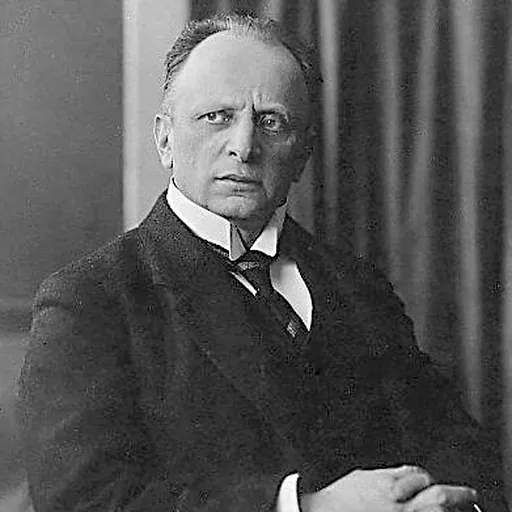
About Otto Brahm
Lived 1856 – 1912 (aged 56). Otto Brahm was a German writer, theatre critic, literary critic, literary historian and theatre manager.
Otto Brahm (born Otto Abrahamsohn; 5 February 1856 – 28 November 1912) was a German drama and literary critic, theatre manager and director. His productions were noted for being accurate and realistic. He was involved in the foundation of the progressive Die Freie Bühne (English: Free Stage) company, of which he became president and producer. He also edited the company's weekly magazine of the same name, but later changed its name to Die neue Rundschau.
Brahm also managed the Deutsches Theater in Berlin, and was responsible for modernising its output.
From Heinz Herald's memoir of Max Reinhardt entitled Bildnis eines Theater-Mannes, regarding the birth of modern theatre: In Germany, the explosion came in 1889, embodied by Otto Brahm. Her place was the newly grounded vacant stage, her occasion is the premiere of a young unknown poet. His name was Gerhart Hauptmann, his play Before Sunrise. Opinions collapsed, as the representatives of a tradition-bound art calcified with the glowing, indomitable, new style. A well-known Berlin doctor swung a symbolic and a little rude noose after the curtain had fallen. A battle raged, but soon it became clear as day that naturalism had triumphed here on the whole line.
The confirmation of this victory occurred when Brahm shortly afterwards took over the direction of the Deutsches Theater, which at that time was still considered to be the leader in Berlin and the Reich. But even Otto Brahm could not fulfill the theoretical ideal of consistent naturalism because it was and is unfulfillable. . . . Art, even naturalistic art, is a choice, omission. The verdict that was literally painted on Brahm’s stage, "art and nature are one only," could not be realized.
Brahm saw this too soon. His house-poets, led by Ibsen and Hauptmann, supplied him with pieces that one could by no means call naturalistic. They used more naturalistic means, but they also omitted and increased. . . . . [However] there was no longer a stilted language, no idealized decoration, no off-the-ground stage style. The Brahms theater was true, honest, decent, manly. One did not pretend in Brahm’s theatre, one played as lifelike as possible. A great ensemble helped Otto Brahm with this effort. Every time an elementary new stage personality appears, a keen actor seems to form itself around this center. Here were the best Rittner, Sauer, Hermann Muller, Bassermann and Else Lehmann: performers who met exactly the Brahmian style of the naturalness, truthfulness, sober behavior. Through hotly controversial Hauptmann's first performances and many pieces of the naturalistic period, Brahm and his cast rose to what they undoubtedly considered to be the pinnacle of their achievement: the peculiar and pompous cycle of Ibsen.
[However], Brahm was not a director. This position, which is unknown in our current sense, was more the role of a subaltern. Brahm sat in on the rehearsals in the dark auditorium and tried to bring his actors to where he wanted them by talking after rehearsing. He was a brilliant dramaturg. He was in close contact with his authors, selected the pieces for his playing schedule, occupied them, found and hired new ensemble members. A young actor of his theater, who had noticed him on a short visit to Salzburg and stayed with him for almost a decade, was called Max Reinhardt.” 12-14
Don’t just read it —
keep it.
Full-length biographies made to live with: read them, listen on the way to work, watch them tonight.
- E-book
- Audio
- Video
Instant download · yours to keep · every purchase keeps this site free
Important facts
People in Otto Brahm's life
Named in this biography and alive at the same time

Related people
Same field, nearest in time




Contemporaries
People whose lives overlapped Otto Brahm's





Frequently asked questions
Who was Otto Brahm?
German theatre director (1856–1912)
When was Otto Brahm born?
Otto Brahm was born on 5 February 1856 in Hamburg.
When did Otto Brahm die?
Otto Brahm died on 28 November 1912 in Berlin.
What was Otto Brahm's occupation?
Otto Brahm was a writer, theatre critic, literary critic, literary historian and theatre manager.
What nationality was Otto Brahm?
Otto Brahm was German.
Sources & further reading
Cite this page
APA: Biography.guide. (2026). Otto Brahm. https://biography.guide/otto-brahm/
MLA: "Otto Brahm." Biography.guide, https://biography.guide/otto-brahm/.
Chicago: "Otto Brahm." Biography.guide. https://biography.guide/otto-brahm/.
Data last updated: 2026-09-22 · Spot an error? Report a correction.
Portrait: Wikimedia Commons · author & licence
Page generated 2026-09-27 04:59 UTC