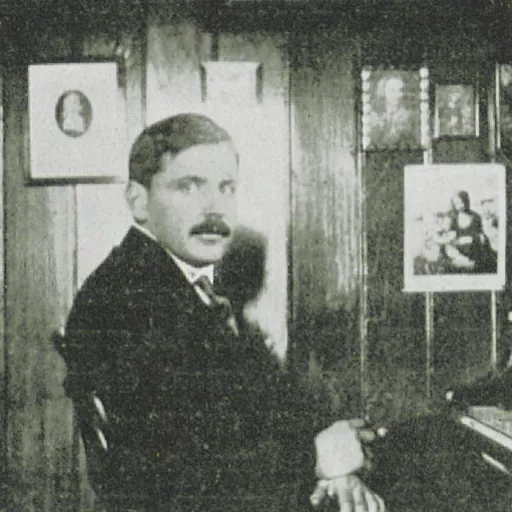
About Othmar Schoeck
Lived 1886 – 1957 (aged 70). Othmar Schoeck was a Swiss conductor, composer and pianist.
Othmar Schoeck (1 September 1886 – 8 March 1957) was a Swiss Romantic composer and conductor. He was known for his considerable output of art songs and song cycles but also wrote operas, notably the one-act Penthesilea, premiered in Dresden in 1927, and instrumental works, including two string quartets and concertos for violin (for Stefi Geyer), cello and horn.
Biography
Early life and career Schoeck was born in Brunnen, studied briefly at the Leipzig Conservatory with Max Reger in 1907/08, but otherwise spent his whole career in Zürich. His father, Alfred Schoeck was a landscape painter, and as a young man, Othmar seriously considered following in his father's footsteps and attended classes at an art school in Zürich before dropping out to go to the Zürich Conservatory.
During World War I Schoeck earned his living in Zurich initially as a chorus director and as a freelance accompanist and conductor. An annuity given him by the Winterthur industrialist Werner Reinhart from 1916 onwards, coupled with the income from his appointment as conductor of the St. Gall Symphony orchestra in 1917 (with special permission to remain resident in Zürich), allowed Schoeck to give up choral conducting and devote more time to composition instead.
Influence of Busoni In 1916, Schoeck became acquainted with Ferruccio Busoni, who had moved to Zurich from Berlin to escape the adverse effects of the war. Busoni was not alone in coming to Zurich. The war had turned "provincial" Zurich, in neutral Switzerland, into an international metropolis. Schoeck was a great admirer of the songs of Hugo Wolf; Busoni disliked them, and he said so. Despite their differences, their relationship quickly developed into one of mutual respect, and even one with a bit of affection. In fact, it was Busoni's suggestion that Schoeck use Ludvig Holberg's Don Ranudo de Colibrados as the subject of an opera.
On 19 June 1917 Philipp Jarnach, a French composer who was also a refugee in Zurich, and an assistant of Busoni, gave Busoni a copy of Martin Buber's book Chinesische Geister- und Liebesgeschichten [Chinese Ghost and Love Stories] (Frankfurt, 1911). Jarnach suggested that one of these short stories might be suitable for an opera. Busoni immediately wrote a libretto, Das Wandbild [The Picture on the Wall], a short scene and pantomime, which he finished eight days later. Jarnach composed a prelude and the first scene, but lost interest and dropped the project. Undaunted, in June 1918 Busoni offered it to Schoeck. Schoeck, who appears to have taken the offer as a sort of challenge, immediately set aside the orchestration of Don Ranudo, and in three days, produced the new opera.
Das Wandbild is set in a Parisian antique shop around 1830. A student, Novalis, is captivated by a picture of a girl hanging on a wall of the shop. The picture comes to life, and in typical Busoni fashion, the scene immediately dissolves into a fantastical Chinese temple. The opera ends with Novalis awaking from his dream-state and escaping from the shop into the reality of the street. It is one of Schoeck's most unusual creations, "almost minimalist in conception." By 1922 his former mentor, Busoni, who was now back in Berlin, wrote a letter to Volkmar Andreae, saying: "Schoeck has completely abandoned me. I have not entirely given him up. He lacks (or lacked) certain ingredients, which are not available at the chemists'. Which should however be manufactured in his own laboratory." After Venus, Schoeck completed the song cycle Elegie in 1922.
In the summer of 1923 Schoeck visited Arthur Honegger in Paris, and he later participated in the Salzburg ISCM festival. Not long afterwards, his affair with de Senger came to an end. His distress over the breakup, combined with the shock of the new music he had heard in Paris and Salzburg, seems to have led to a new maturity in his compositional style. Two weeks after his affair ended, he composed the song Die Entschwundene (1923), which was "as much a farewell to the tonal world of his previous music as to his departed lover." In 1937, Schoeck's opera Massimilia Doni, after the short story by Balzac, premiered in Dresden.
Schoeck was not given to overt signs of gratitude, but he dedicated the song cycle Gaselen (1923), the Sonata for Bass Clarinet and Piano (1927–28), and the Suite in A flat for Strings (1945) to Werner Reinhart.
His work with the German poet Hermann Burte on the opera Das Schloss Dürande, for production at the Berlin State Opera, caused great controversy for Schoeck with the Swiss, because of his association with artists of Nazi Germany. The opera was premiered in Berlin on 1 April 1943 in the presence of Schoeck. Schoeck himself did not harbor Nazi sympathies, but the angry Swiss reaction to his actions damaged his reputation and put great strain on him. He suffered a heart attack in March 1944, but continued to compose.
Death and Legacy Schoeck died in 1957. In 1969, the Swiss government honored Schoeck with a commemorative stamp.
In 1999, one critic wrote that "his best works balance an expressive intensity and an opulence approaching the Straussian with a fine intellectual rigor and seriousness of purpose," and that his songs are "taut yet lyrical, Schubertian in their economy and penetrating textual insight."
In 2018, his Summer Night, Pastoral Intermezzo for Strings, Op. 58, (1945), had its NY premiere at the Naumburg Orchestral Concerts, in the Naumburg Bandshell, Central Park, in the summer series.
Compositions
Popular culture references Wier Chrisemer, Teller and Penn Jillette were The Othmar Schoeck Memorial Society for the Preservation of Unusual and Disgusting Music, which later became the Asparagus Valley Cultural Society.
Don’t just read it —
keep it.
Full-length biographies made to live with: read them, listen on the way to work, watch them tonight.
- E-book
- Audio
- Video
Instant download · yours to keep · every purchase keeps this site free
Important facts
People in Othmar Schoeck's life
Named in this biography and alive at the same time






Related people
Same field, nearest in time



Contemporaries
People whose lives overlapped Othmar Schoeck's

Frequently asked questions
Who was Othmar Schoeck?
Swiss composer (1886-1957)
When was Othmar Schoeck born?
Othmar Schoeck was born on 1 September 1886 in Brunnen.
When did Othmar Schoeck die?
Othmar Schoeck died on 8 March 1957 in Zurich.
What was Othmar Schoeck's occupation?
Othmar Schoeck was a conductor, composer and pianist.
What nationality was Othmar Schoeck?
Othmar Schoeck was Swiss.
Sources & further reading
Cite this page
APA: Biography.guide. (2026). Othmar Schoeck. https://biography.guide/othmar-schoeck/
MLA: "Othmar Schoeck." Biography.guide, https://biography.guide/othmar-schoeck/.
Chicago: "Othmar Schoeck." Biography.guide. https://biography.guide/othmar-schoeck/.
Data last updated: 2026-09-23 · Spot an error? Report a correction.
Portrait: Wikimedia Commons · author & licence
Page generated 2026-09-27 05:08 UTC