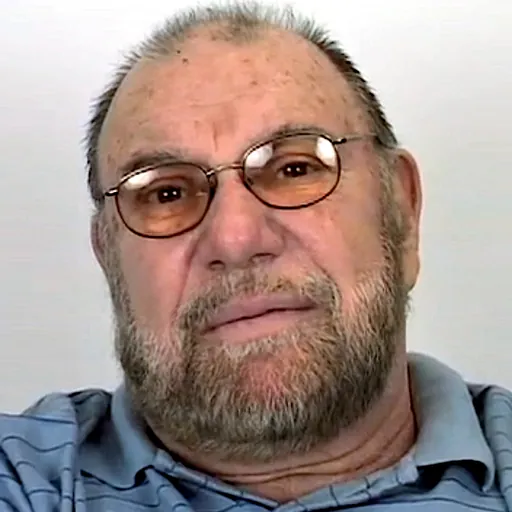
About Osvaldo Romberg
Lived 1938 – 2019 (aged 80–81). Osvaldo Romberg was an Argentine and Israeli artist, sculptor and painter.
Osvaldo Romberg (; 28 May 1938 – 26 November 2019) was an Argentine artist, curator, and professor. He lived and worked in Israel, Philadelphia, New York, and Isla Grande, Brazil.
Life and career
Romberg was born in Buenos Aires in 1938. His parents were Jewish immigrants who emigrated to Argentina. He attended high school at the Colegio Nacional de Buenos Aires. After graduating in 1955, he studied architecture at the University of Buenos Aires between 1956 and 1962.
He taught Painting and Color Theory at different universities in Argentina and Latin America until he was forced to flee the Argentine Dirty War, in 1973. He then settled in Israel, where he taught at the Bezalel Academy of Arts and Design for 20 years. In 1993, he began teaching at the Pennsylvania Academy of the Fine Arts in Philadelphia.
His paintings, books, installations, films, and architectural watercolors have been exhibited internationally. Among others, he exhibited at the Negev Museum of Art, Beersheba (2018); the Museum of Modern Art, Buenos Aires (2012); and the Philadelphia Museum of Art (2011). His works are collected at the Museo de Arte Moderno (Buenos Aires), the Museo de Bellas Artes (Buenos Aires), The Ludwig Museum (Cologne), and the Museum of Modern Art, New York.
He was the Senior Curator at Slought Foundation.
Selected Series of Work
Color Classifications In 1973, Romberg began a didactic investigation of color classification by annotating marks of color, arranged them in grids on paper or canvas. He later extended this practice to the deconstruction of color in the art historical canon.
Paradigma Beginning in 1980, Romberg drew from the writing of analytic philosopher Thomas Kuhn to initiate this series by compressing multiple paradigms of Western painting – often abstraction and representation - onto a single canvas.
Translocations, Building Footprints, and On Scale Starting in 1986, Romberg began reconstructing at full scale the floor plans of historical, and often religious, architectural structures. Made from bricks that are in some cases fashioned from books or newspapers, these “footprints” are built either inside the exhibition space or partially outside, yet intersecting with the space.
Theater of Transparency This is a series of filmic work started in 1997, drawing from the history of sex, modernity, and art history. The protagonists are a life-size troupe of transparent marionettes, whose bodies are projection surfaces for the changing historical and metaphorical images that compose their constantly fluctuating identities.
Don’t just read it —
keep it.
Full-length biographies made to live with: read them, listen on the way to work, watch them tonight.
- E-book
- Audio
- Video
Instant download · yours to keep · every purchase keeps this site free
Important facts
People in Osvaldo Romberg's life
Named in this biography and alive at the same time

Related people
Same field, nearest in time



Contemporaries
People whose lives overlapped Osvaldo Romberg's


Frequently asked questions
Who was Osvaldo Romberg?
Argentine artist (1938-2019)
When was Osvaldo Romberg born?
Osvaldo Romberg was born in 1938 in Buenos Aires.
When did Osvaldo Romberg die?
Osvaldo Romberg died on 24 November 2019 in Israel.
What was Osvaldo Romberg's occupation?
Osvaldo Romberg was an artist, sculptor and painter.
What nationality was Osvaldo Romberg?
Osvaldo Romberg was Argentine and Israeli.
Sources & further reading
Cite this page
APA: Biography.guide. (2026). Osvaldo Romberg. https://biography.guide/osvaldo-romberg/
MLA: "Osvaldo Romberg." Biography.guide, https://biography.guide/osvaldo-romberg/.
Chicago: "Osvaldo Romberg." Biography.guide. https://biography.guide/osvaldo-romberg/.
Data last updated: 2026-09-20 · Spot an error? Report a correction.
Page generated 2026-09-27 05:09 UTC