
About Oskar Fischer
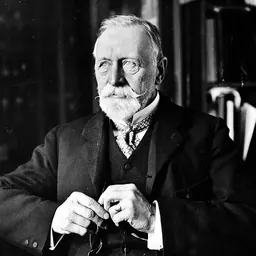
Lived 1876 – 1942 (aged 65). Oskar Fischer was a Czech psychiatrist, physician, neurologist, neuropathologist and university teacher.
Oskar Fischer (12 April 1876 – 28 February 1942) was a Czech academic, psychiatrist and neuropathologist whose studies on dementia and Alzheimer's disease were rediscovered in 2008.
Early life and education Fischer was born into a German-speaking Jewish family in Slaný in central Bohemia, 25 km northwest of Prague, on 12 April 1876. His father was the manager of an agricultural estate there. He completed primary and secondary education in Slaný. Then he attended the medical schools of both Prague University and Strasbourg University, and graduated from Prague University in 1900. This school was one of the two neuropathological schools (the other one was in Munich headed by Emil Kraepelin where Alois Alzheimer worked) framed Alzheimer's disease through empirical discoveries. In fact, these schools were rivals, leading to the designation of the disease as "Alzheimer's disease" in the Emil Kraepelin's book entitled Psychiatry (1910). Because the inclusion of this disease with Alzheimer's name in the book made the Munich school superior over the Prague school.
Fischer supposedly (like Alois Alzheimer) employed new staining and autopsy results, and described "senile plaques" that are still accepted as the characteristic of the disease in addition to "neurofibrillary tangles" discovered by Alzheimer. In June 1907, based on the reports of Beljahow that had been later affirmed by Redlich and Leri Fischer argued that 'miliary necrosis' should be regarded as a marker of senile dementia. Then he published an article in 1907, reporting histopathological findings on senile dementia collected from a sample of 16 postmortem brains from elderly subjects. The report described the brain changes at tissual and cellular levels. He named these lesions as "Sphaerotrichia cerebri multiplex" and used this term in his subsequent articles published in 1910 and 1912. The samples of his studies included 58 positive cases out of total 275 cases. and pathologically by neuritic plaques. Ultimately, both Alzheimer and Fischer agreed on the uniqueness of a new clinicopathological condition, regardless of the age of onset. On the other hand, although N. C. Berchtold and C. W. Cotman of the University of California, Irvine School of Medicine reported Fischer's research on the disease and the competition between the two medical schools in 1998, The reasons for neglecting Fischer's contributions included the nationalist tensions and the anti-Semitic approach of his period He died at the age of 65 in the camp on 28 February 1942 after being beaten to death.
Don’t just read it —
keep it.
Full-length biographies made to live with: read them, listen on the way to work, watch them tonight.
- E-book
- Audio
- Video
Instant download · yours to keep · every purchase keeps this site free
Important facts
People in Oskar Fischer's life
Named in this biography and alive at the same time

Related people
Same field, nearest in time


Contemporaries
People whose lives overlapped Oskar Fischer's

Frequently asked questions
Who was Oskar Fischer?
Czech scientist (1876–1942)
When was Oskar Fischer born?
Oskar Fischer was born on 12 April 1876 in Slaný.
When did Oskar Fischer die?
Oskar Fischer died on 28 February 1942 in Theresienstadt concentration camp, Theresienstadt Small Fortress.
What was Oskar Fischer's occupation?
Oskar Fischer was a psychiatrist, physician, neurologist, neuropathologist and university teacher.
What nationality was Oskar Fischer?
Oskar Fischer was Czech.
Sources & further reading
Cite this page
APA: Biography.guide. (2026). Oskar Fischer. https://biography.guide/oskar-fischer/
MLA: "Oskar Fischer." Biography.guide, https://biography.guide/oskar-fischer/.
Chicago: "Oskar Fischer." Biography.guide. https://biography.guide/oskar-fischer/.
Data last updated: 2026-09-20 · Spot an error? Report a correction.
Page generated 2026-09-27 05:20 UTC