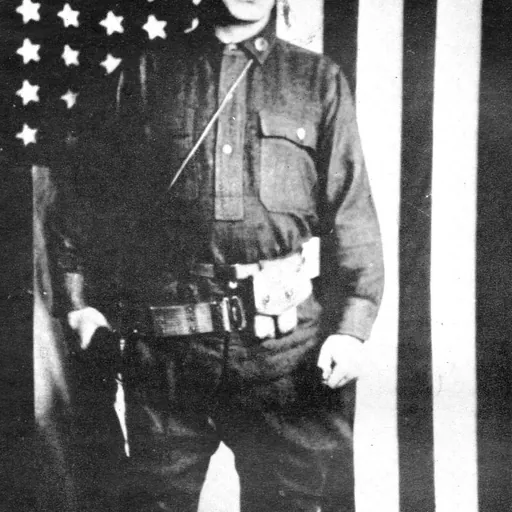
About Oscar C. Pfaus
Lived 1901 – 1968 (aged 66–67). Oscar C. Pfaus was a spy.
Oscar Carl Pfaus (born Oskar Karl Pfaus; born January 30, 1901) was a German immigrant who became an American citizen through military service. He had a succession of jobs before becoming involved in pro-Nazi organizations in Chicago in the early 1930s and becoming a full-time Nazi propagandist there. He was also active in New York.
He returned to Germany in 1938 to work in propaganda for the Deutscher Fichte-Bund with responsibility for Ireland, the United States, and Canada, attempting to cultivate ties in the U.S. through correspondence with Irish-Americans and anyone who might be sympathetic to German interests. His letters were extensively quoted in the proceedings of the Dies committee on Un-American Activities in 1939.
He was recruited to the Abwehr, the German military intelligence agency, which sent him to Ireland in 1939 to make contact with the Irish Republican Army (IRA) and others who might help Germany. The Abwehr eventually sent an agent to the United States who arranged for the IRA to carry out acts of sabotage there.
Pfaus was active in espionage in Paris in 1941 and 1943, and in 1944 he was at Stalag 357, a prisoner of war camp in Thorn, Poland, where he described his role as "camp leader and interpreter". He later served in Czechoslovakia. In 1949, he said he was anti-Nazi and described the Nazi regime as "the former Prussian regimes of terror".
Early life Oskar Karl Pfaus was born in Illingen, Baden-Württemberg, Germany, on January 30, 1901. He emigrated to the United States in 1924
In his letters, Pfaus said he had served in the United States Army, in the Sixth Corps at Fort Sheridan, Illinois, and at Camp Custer, Michigan.
At the time of the 1930 census, he was living in Chicago and working as a machinist. He had filed papers for naturalization as an American citizen and according to evidence later given in Congress, obtained it due to his military service.
Activities in the United States
Pfaus became active in pro-Nazi activities in the early 1930s and at least initially was not an official agent of the German government which at that time was not interested in developing spies in the United States. He does not appear, however, in the official list of nominations.
In Chicago he was a member of the Germania Club of Chicago along with ardent Nazis Walter Kappe and Heinz Spanknöbel and was the Chicago leader of the Friends of New Germany that was founded by Spanknöbel in 1933. Pfaus also started a Nazi group in New York with the Swedish-born Olov Edvin Tietzow, founder of The American Guard.
He edited the Chicago Weckruf und Beobachter, a forerunner of the Deutscher Weckruf und Beobachter, the official newspaper of the German American Bund, the successor organization to the Friends of New Germany, and was a columnist for Pittsburgh's Der Sonntagsbote.
Pfaus returned to Germany in 1938 at the suggestion of Tegeliss Tannhaeuser, the German consul in Chicago, On January 12, 1939, the IRA set out to raise its profile with Germany and to establish a working relationship with the Nazis by sending an ultimatum to Lord Halifax, the British foreign secretary, that if British troops were not withdrawn from Ireland within days, further action would be taken. The IRA subsequently declared war on Britain and began a series of bomb attacks in England on January 16 under the S-Plan or Sabotage Campaign.
Accordingly, in February 1939, Abwehr II, the department responsible for relations with discontented minorities, sent Oscar Pfaus to Ireland under the cover of being a journalist for a German newspaper to make contact with the IRA, the first of 13 agents they sent in 1939–43. He received a briefing from Franz Fromme, whom the Abwehr regarded as an expert on Ireland, and staying until February 14. The British authorities warned the Irish that he was coming but Irish intelligence did not keep him under close surveillance as they thought he was travelling only to spread propaganda. On arrival, he made his way to Dublin city where he rented a room in a boarding house. He met the anti-Semite and anti-democrat William J. Brennan-Whitmore and Liam Walsh, both members of the executive committee of the tiny Celtic Confederation of Occupational Guilds (CCOG), but of interest to the Abwehr, and arranged for Walsh to visit Germany, where he promised to use the CCOG to back German interests. Another of Pfaus's contacts was Maurice O'Connor, an Irish railway clerk who had visited Germany and was pro-Nazi and later took a significant role in the CCOG as it became more radical. O'Connor drew up a pamphlet titled "Who is your enemy?" that was adapted from Pfaus's "We Accuse!", originally published in Chicago.
As a result of Pfaus's visit, the IRA established better connections with the Germans, but they never acquired the munitions and wireless equipment that they hoped for, while the Germans were never able to persuade the IRA to launch a full assault on Northern Ireland to divert British troops away from the mainland, Pfaus's visit and subsequent contacts with the IRA did, however, allow the Germans to become acquainted with IRA support and operations in the United States and in due course to send an agent, Karl Franz Rekowski, to the U.S. where he arranged for the IRA to carry out sabotage attacks such as the 1940 attack on the Hercules Powder Company plant in New Jersey, in which 52 people died and a further 50 were injured. and therefore perhaps not supportive of the British Empire, or anti-Semitic or anti-communist. His letters were extensively quoted from in the proceedings of the Dies committee of the U.S. Congress's House Un-American Activities Committee in September and October 1939:
In March 1939 he wrote to one correspondent about a possible visit to the U.S. for the purpose of "studying Irish-American folklore" and seeking to be introduced to "influential Irish-Americans". In May he wrote to another about the threat to Christianity from the alliance of England and France with its "arch-enemy", "Red Russia", and the role that Irish-Americans could play in protecting American ideals from a "Jew-British-Red combination", a position that was soon undermined after Germany itself formed a pact with the Soviet Union. In June, he wrote asking for help to be put in contact with General George Moseley, his former commanding officer in the U.S. Army and a committed anti-Semite.
In August 1939 he got married in Hamburg with Franz Fromme as best man. When Susan Sweney was interviewed by MI5 in 1945, she said she had worked with Monaghan to smuggle British merchant seamen out of Paris.
Later life After the war, Pfaus lived in Hamburg's Mülhäuser Straße in the British zone of occupation.
Don’t just read it —
keep it.
Full-length biographies made to live with: read them, listen on the way to work, watch them tonight.
- E-book
- Audio
- Video
Instant download · yours to keep · every purchase keeps this site free
Important facts
People in Oscar C. Pfaus's life
Named in this biography and alive at the same time




Related people
Same field, nearest in time

Contemporaries
People whose lives overlapped Oscar C. Pfaus's


Frequently asked questions
Who was Oscar C. Pfaus?
German-American Nazi propagandist
When was Oscar C. Pfaus born?
Oscar C. Pfaus was born on 30 January 1901 in Illingen.
When did Oscar C. Pfaus die?
Oscar C. Pfaus died in 1968.
What was Oscar C. Pfaus's occupation?
Oscar C. Pfaus was a spy.
Sources & further reading
Cite this page
APA: Biography.guide. (2026). Oscar C. Pfaus. https://biography.guide/oscar-c-pfaus/
MLA: "Oscar C. Pfaus." Biography.guide, https://biography.guide/oscar-c-pfaus/.
Chicago: "Oscar C. Pfaus." Biography.guide. https://biography.guide/oscar-c-pfaus/.
Data last updated: 2026-09-20 · Spot an error? Report a correction.
Portrait: Wikimedia Commons · author & licence
Page generated 2026-09-27 04:57 UTC