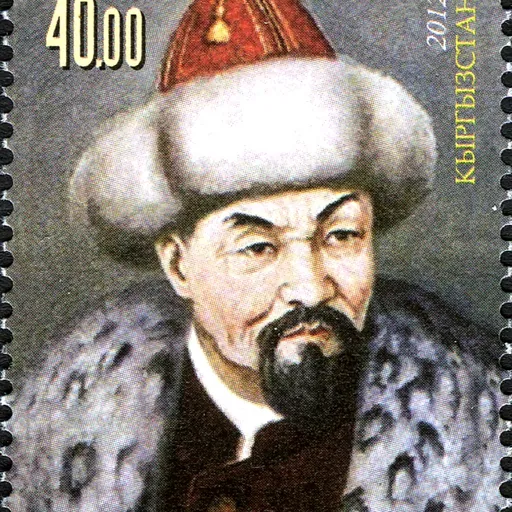
About Ormon Khan
Lived 1792 – 1854 (aged 61–62). Ormon Khan was a statesperson.
Ormon Khan (; – 1854) or Ormon Niyazbek uulu was the first and only khan of the Kara-Kyrgyz Khanate, ruling from 1842 until his death in 1854. A member of the powerful tribe, Ormon's reign saw a centralization of the , with the establishment of legal and judicial systems. Ormon was a close ally of the Russian Empire in the region, winning a series of wars against the Khanate of Kokand and defeating a Kazakh army led by Kenesary Khan, who had been rebelling against the Russians. In 1854, during a conflict with a rival Kyrgyz tribe, Ormon was captured in battle and executed. Ormon's khanate collapsed following his death, with the region falling under Russian control by 1868.
Background Ormon Niyazbek uulu was born around 1792 in the Issyk-Kul valley of Kyrgyzstan. Ormon was a member of the powerful tribe, and his family was very influential in the region. His great-great-grandfather, Mamatkul Biy, had been a high-ranking manap amongst the northern Kyrgyz and was proclaimed khan in 1758. Ormon's grandfather, , permanently settled in the Chüy and Talas valleys. However, Ormon's father, Niyazbek, is said to have made "little impression on Sarybagysh memory" besides being the father of Ormon.
Ormon was trained in horseback riding and fighting with sword and spear from a young age, and he was skilled at kurash wrestling.
Khan of the Northern Kyrgyz Kurultai and coronation During this period, the Kyrgyz tribes were under the nominal authority of the Khanate of Kokand, located primarily in modern Uzbekistan. By the 1840s, Kokand had been in decline due to both external and internal factors, including wars with the Emirate of Bukhara and Qing China, as well as frequent palace coups and civil wars. In 1842, Bukhara invaded Kokand, temporarily occupying the state and executing the khan of Kokand, Muhammad Ali Khan. That summer, the chiefs of the northern Kyrgyz tribes organized a kurultai on the western shore of Issyk-Kul near Kochkor in order to plan how to protect the Kyrgyz tribes from external threats. Also in attendance at the kurultai were ambassadors from Kokand and some southern Kyrgyz tribes.
State structure As khan, Ormon sought to strengthen the foundation of the state. He created an official legal code, referred to as the Ormon ukuu, meaning Teachings of Ormon or Ormon's Edification. In accordance with Kyrgyz traditions, the code included a number of folk rites, including a decree that an oath would be taken by cutting a rod, as well as a decree that Ormon was the sole khan of Kyrgyzstan. The code also introduced a penal system: murder would be punished by a ransom (kuna) of 300 horses, adultery would be 40 horses, and theft would be 9 horses. Additionally, property would be confiscated from those who "confused the horses with iron fetters", and anyone who stole cattle would be sentenced to death. Death sentences were carried out several times annually at a gallows (darga), which was intended to instill fear in both his subjects and neighboring tribes. Other state systems were also implemented. This included a council made up of prominent biys, a system of governors tasked with oversight of the tribes, and a judicial system, in which biys and chiefs served as judges.
Ormon's death led to the collapse of the Kara-Kyrgyz Khanate. Torogeldi and Ormon's son Umetaaly led a series of reprisals against the Bugu, razing settlements and taking many captives. The Bugu were defeated in a battle on the north shore of Issyk-Kul and were forced to retreat towards China, where they hoped the Qing officials in East Turkestan would offer assistance, as Borombay had previously been a Chinese subject. After being rejected by the Chinese, who did not want to assist the Russian-aligned tribe, the Bugu fled to Russia and formally became Russian subjects. Following this, the Russians began establishing outposts along Issyk-Kul, battling Kokand and the Kyrgyz tribes. In 1862, Jantay, who was Ormon's successor as chief of the Sarybagysh tribe, became a Russian subject. The following year, Umetaaly led a rebellion against the Russians, but was defeated at Ak-Talaa and forced to flee to Kashgar in East Turkestan. The remainder of Ormon's khanate would be integrated into the Russian Empire by 1867.
Legacy Ormon remains a popular, though controversial figure, in Kyrgyzstan. His admirers see him as a national hero who united the tribes of northern Kyrgyzstan and created the first Kyrgyz state, referring to him as "Kyzyl Tebetey". However, his critics consider him to have been a tyrant who led a reactionary feudal movement, seeking to centralize the khanate by whatever means necessary. Russian archaeologist compared Ormon to a miniature version of Ivan the Terrible. Several of Ormon's descendants maintain positions in the Kyrgyz government and academia, including Kyrgyz National University professor Ryskul Zholdoshev, film director , and Supreme Council speaker Kanatbek Isaev.
Don’t just read it —
keep it.
Full-length biographies made to live with: read them, listen on the way to work, watch them tonight.
- E-book
- Audio
- Video
Instant download · yours to keep · every purchase keeps this site free
Important facts
People in Ormon Khan's life
Named in this biography and alive at the same time


Related people
Same field, nearest in time


Contemporaries
People whose lives overlapped Ormon Khan's



Frequently asked questions
Who was Ormon Khan?
khan of Kara Kyrgyz Khanate
When was Ormon Khan born?
Ormon Khan was born in 1792 in Issyk-Kul.
When did Ormon Khan die?
Ormon Khan died in 1854 in Semënovka, Issyk Kul.
What was Ormon Khan's occupation?
Ormon Khan was a statesperson.
What nationality was Ormon Khan?
Ormon Khan's recorded nationality: Kara-Kyrgyz Khanate.
Sources & further reading
Cite this page
APA: Biography.guide. (2026). Ormon Khan. https://biography.guide/ormon-khan/
MLA: "Ormon Khan." Biography.guide, https://biography.guide/ormon-khan/.
Chicago: "Ormon Khan." Biography.guide. https://biography.guide/ormon-khan/.
Data last updated: 2026-09-23 · Spot an error? Report a correction.
Portrait: Wikimedia Commons · author & licence
Page generated 2026-09-27 05:06 UTC