
About Orlando B. Potter
Lived 1823 – 1894 (aged 70). Orlando B. Potter was an American politician and lawyer.
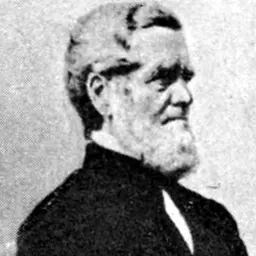
Orlando Brunson Potter (March 10, 1823 – January 2, 1894) was a businessman and member of the United States House of Representatives from New York City. From 1883 to 1885, he served one term in the U.S. House of Representatives. He is primarily recognized for his work to establish the National Banking Act in the United States.
Biography Potter was born March 10, 1823, in Charlemont, Massachusetts, the son of Samuel and Sophia Rice Potter. He attended the district school in Charlemont, Williams College, Williamstown, Massachusetts, and the Harvard Law School, Cambridge, Massachusetts, MA (Hon) 1867, LLD 1889. He was admitted to the bar on February 12, 1845, and commenced law practice in Boston, Massachusetts. He married Martha Green Wiley on October 28, 1850. In May 1853, he moved to New York and engaged in manufacturing and patent law as President of the Grover and Baker Sewing Machine Company. And he pursued agricultural interests with a six hundred acre farm on the Hudson in Ossining, New York. He was engaged in commercial real estate development in Manhattan, having developed several commercial buildings in the city. Most notably, he developed the Potter Building in New York City, and later together with Asahel Clarke Geer and his son-in-law Walter Danforth Geer, formed the New York Architectural Terra-Cotta Company on Long Island. In 1884, he purchased the site at 71 Broadway and began planning development of the Empire Building, to be later completed by his estate.
He is primarily known for his work to devise the National Banking Act of 1863. In an exhaustive letter to U.S. Treasury Secretary Salmon P. Chase on August 14, 1861, Potter outlined the means to develop a national banking system. Much of his plan was incorporated into the National Banking Acts of 1863 and 1864.
Potter was unsuccessful for election in 1878 to the Forty-sixth Congress. However, he was elected as a Democrat to the Forty-eighth Congress (March 4, 1883 – March 3, 1885) from New York's 11th congressional district. He declined to be a candidate for renomination in 1884 after congressional redistricting was completed that year.
He served as member of the Rapid Transit Commission of New York City 1890-1894 as well as a Cornell University and as a trustee of the New York Savings Bank on Bleecker Street. He died suddenly in New York City, January 2, 1894, and he was thought to have been the wealthiest man in New York City to have died intestate. He was interred in Green-Wood Cemetery, Brooklyn along with his wife and three daughters: Mary, Martha, and Blanche.
Don’t just read it —
keep it.
Full-length biographies made to live with: read them, listen on the way to work, watch them tonight.
- E-book
- Audio
- Video
Instant download · yours to keep · every purchase keeps this site free
Important facts
Related people
Same field, nearest in time





Contemporaries
People whose lives overlapped Orlando B. Potter's





Frequently asked questions
Who was Orlando B. Potter?
American politician (1823-1894)
When was Orlando B. Potter born?
Orlando B. Potter was born on 10 March 1823 in Charlemont.
When did Orlando B. Potter die?
Orlando B. Potter died on 2 January 1894 in New York City.
What was Orlando B. Potter's occupation?
Orlando B. Potter was a politician and lawyer.
What nationality was Orlando B. Potter?
Orlando B. Potter was American.
Sources & further reading
· Wikipedia: Orlando B. Potter
Cite this page
APA: Biography.guide. (2026). Orlando B. Potter. https://biography.guide/orlando-b-potter/
MLA: "Orlando B. Potter." Biography.guide, https://biography.guide/orlando-b-potter/.
Chicago: "Orlando B. Potter." Biography.guide. https://biography.guide/orlando-b-potter/.
Data last updated: 2026-09-20 · Spot an error? Report a correction.
Page generated 2026-09-27 05:06 UTC