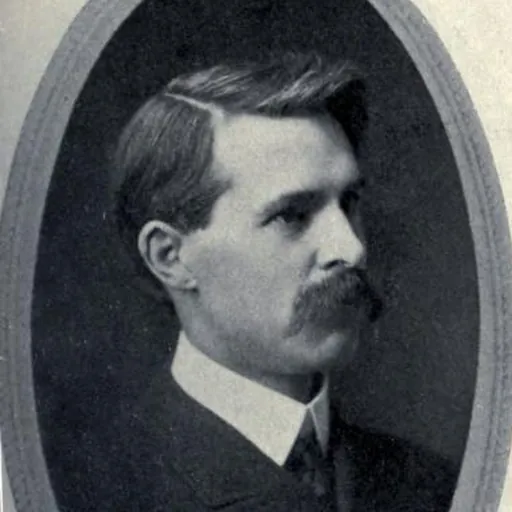
About Orin Grant Libby
Lived 1864 – 1952 (aged 87). Orin Grant Libby was an American historian.
Orin Grant Libby (June 9, 1864, near Hammond, Wisconsin – March 29, 1952, Grand Forks, North Dakota) was an American historian.
Biography Libby was the son of farmer Asa Libby and his wife Julia (Barrows) Libby. As well as farming, his father held several local government positions, and worked in several skilled crafts. In 1886, Libby received a diploma from River Falls State Normal School, and then taught in high schools until 1890, when he entered the University of Wisconsin–Madison as a junior. He received a bachelor's degree from Wisconsin in 1892, and stayed to continue his studies in history. In 1893, he submitted a master's thesis with an emphasis on economic history entitled “De Witt Clinton and the Erie Canal — A State Enterprise.” He ultimately received a Ph.D. at Wisconsin in 1895, his dissertation being entitled The Geographical Distribution of the Vote of the Thirteen States on the Federal Constitution 1787–8. His dissertation examined the economics and geography behind the voting patterns for the Constitution. An influential advisor was Frederick Jackson Turner.
Although Libby's Ph.D. dissertation made a strong positive impression on Turner, and their relationship was initially cordial, Turner began to question his former student's abilities, and their interaction became contentious. While at Wisconsin, in 1900 he married Eva Gertrude Cory. The marriage yielded two children. He continued his interest in ornithology for the rest of his life.
He moved on to become an assistant professor at the University of North Dakota (UND). There he worked on studies of the history of North Dakota, among which were studies of the history of Native Americans. One of the latter studies, The Arikara Narrative of the Campaign against the Hostile Dakotas, June 1876 (1920), won their praise.
He helped found the Mississippi Valley Historical Association (now the Organization of American Historians), and was president of it for a year. Controversy with other UND faculty and its president, Thomas F. Kane, almost resulted in his dismissal in the 1920s, but alumni pressure kept him in his position. The history department divided into a department on American history, which Libby headed, and a department of European history. After his retirement in 1945, the two departments merged into one again. Shortly before his retirement, he resigned as secretary to the state historical society and ceased editing the North Dakota Historical Quarterly, two long-time endeavors.
Don’t just read it —
keep it.
Full-length biographies made to live with: read them, listen on the way to work, watch them tonight.
- E-book
- Audio
- Video
Instant download · yours to keep · every purchase keeps this site free
Important facts
People in Orin Grant Libby's life
Named in this biography and alive at the same time
Related people
Same field, nearest in time

Contemporaries
People whose lives overlapped Orin Grant Libby's




Frequently asked questions
Who was Orin Grant Libby?
American historian (1864-1952)
When was Orin Grant Libby born?
Orin Grant Libby was born on 9 June 1864 in Hammond.
When did Orin Grant Libby die?
Orin Grant Libby died on 29 March 1952 in Grand Forks.
What was Orin Grant Libby's occupation?
Orin Grant Libby was a historian.
What nationality was Orin Grant Libby?
Orin Grant Libby was American.
Sources & further reading
Cite this page
APA: Biography.guide. (2026). Orin Grant Libby. https://biography.guide/orin-grant-libby/
MLA: "Orin Grant Libby." Biography.guide, https://biography.guide/orin-grant-libby/.
Chicago: "Orin Grant Libby." Biography.guide. https://biography.guide/orin-grant-libby/.
Data last updated: 2026-09-21 · Spot an error? Report a correction.
Portrait: Wikimedia Commons · author & licence
Page generated 2026-09-27 04:59 UTC