Onfim
13th-century boy from Novgorod
About Onfim
Born 1250. Onfim was a schoolchild.
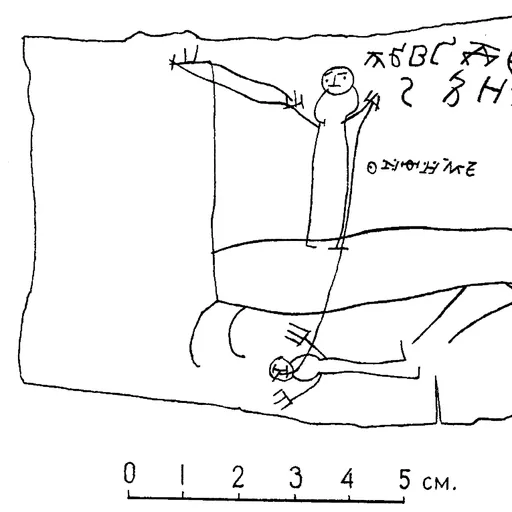
One of Onfim's schoolwork doodles (no. 200), depicting himself as a horseman slaying a person.
Onfim (; ; ) was a Russian boy who lived in the city of Novgorod in the 13th century, sometime around 1220 or 1260. He left his notes and homework exercises scratched in soft birch bark, which was preserved in the clay soil of Novgorod.
Onfim, who was most likely six or seven at the time, wrote in the Old Novgorod dialect, a historical variety of Russian. Besides letters and syllables, he drew "battle scenes and drawings of himself and his teacher."
Background Novgorod, now known as Veliky Novgorod, is the administrative center of Novgorod Oblast. At the time Onfim lived, it was the capital of the Novgorod Republic. Scholars believe that the Novgorod Republic had an unusually high level of literacy for the time, with literacy apparently widespread throughout different classes and among both sexes. It has been suggested that there was widespread literacy across large segments of urban society in medieval Russia; according to one estimate, 20% of the urban male population in Russian city-states were literate around the mid-13th century.
Some south of Saint Petersburg, the city is surrounded by birch forests, whose bark was used for centuries by the locals for writing since it was soft and easily scratched. Since 1951, more than 1100 pieces of birch bark with writing on it have been found, and more continue to be discovered.
In Russian, a birch bark manuscript is called (, 'birch bark', , ), and the academic field that studies them is called berestology (, ). The great number of beryosty is indicative of a high rate of literacy among the population, as is the large number of styluses.
Onfim's writings Onfim left seventeen known birch bark items dating to the mid-13th century. Twelve of those have illustrations, five only text. One of the drawings features a knight on a horse, with Onfim's name written next to him, stabbing someone on the ground with a lance, with scholars speculating that Onfim pictured himself as the knight. The writings are clearly learning exercises: Onfim practiced by writing out the alphabet, repeating syllables, and writing psalms—texts that were presumably familiar to him. His writing includes phrases such as "Lord, help your servant Onfim" and fragments from Psalms 6:2 and 27:3. Most of Onfim's writing consists of citations from the Book of Psalms.
Onfim's homework exercises and "I am a wild beast," . (Item no. 199) Onfim's illustrations include pictures of knights, horses, arrows, and slain enemies. One image, "a portrait of himself, disguised as a fantastic animal," is found on item no. 199 (pictured; it was originally the bottom of a basket made of birch bark), which contains a picture of a four-legged beast with a long neck, pointy ears, and a curly tail. The beast either has an arrow with feathers in its mouth or is spewing fire; one of the accompanying texts says "I am a wild beast". Another text says "Greetings from Onfim to Danilo," most likely a friend or classmate of Onfim. The number of fingers on the pictured people's hands varies from three to eight; Onfim had yet to learn how to count.
The rows of five letters each on the other side of 199 are an alphabet exercise. On item no. 205 (not pictured in this article), Onfim wrote the Cyrillic alphabet and added "On," for his name, in the middle; below that alphabet is what some researchers see as a boat with oars. Item no. 206 contains alphabetic exercises and "'portraits' of little Onfim and his friends." Interestingly, Onfim did not use the yers (ъ ь), and instead replaced them with О and Е; for instances, in item no. 199, Onfim wrote поклоно (poklono; "bow [in supplication] (lit.); greetings, regards (fig.)") (cf. Russian ; as spelt before the 1918 spelling reform) and ꙁвѣре (zvěre, "wild beast"; cf. Russian and ; as spelt before and after the 1918 spelling reform, respectively).
In one of the birch bark items, no. 206, a sequence of four letters with a titlo on top was interpreted as a number and therefore as the current year in which he was carrying out his exercises, in this case, the year 1263. This interpretation became the subject of debate for decades. However, a new interpretation suggests that the letters refer to the first words of the six-o'clock troparion lže v šestу den' že i čas [...] ("Who on the sixth day and hour [...]"), and Onfim used to practice his writing by reproducing liturgical texts.
Gallery
Don’t just read it —
keep it.
Full-length biographies made to live with: read them, listen on the way to work, watch them tonight.
- E-book
- Audio
- Video
Instant download · yours to keep · every purchase keeps this site free
Important facts
Related people
Same field, nearest in time





Frequently asked questions
Who was Onfim?
13th-century boy from Novgorod
When was Onfim born?
Onfim was born in 1250 in Veliky Novgorod.
What was Onfim's occupation?
Onfim was a schoolchild.
What nationality was Onfim?
Onfim's recorded nationality: Novgorod Republic.
Sources & further reading
Cite this page
APA: Biography.guide. (2026). Onfim. https://biography.guide/onfim/
MLA: "Onfim." Biography.guide, https://biography.guide/onfim/.
Chicago: "Onfim." Biography.guide. https://biography.guide/onfim/.
Data last updated: 2026-09-23 · Spot an error? Report a correction.
Portrait: Wikimedia Commons · author & licence
Page generated 2026-09-27 05:05 UTC