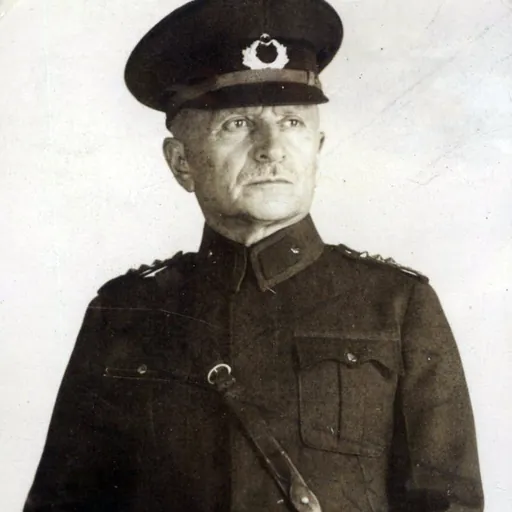
Ömer Fahreddin Türkkan
Turkish general and statesperson
About Ömer Fahreddin Türkkan
Lived 1868 – 1948 (aged 79–80). Ömer Fahreddin Türkkan was a Turkish diplomat, military personnel, politician, writer and kabul.
Early life
He was born in Rusçuk (present day Ruse) to mother Fatma Adile Hanım and father Mehmed Nahid Bey. He had a younger sister Sabiha Hanım, who was married to Alī Ḥaydar Pāshā. Due to the Russo-Turkish War his family moved to Istanbul in 1878. He joined the War Academy, graduating in 1888. His first posting was on the eastern border with Armenia in the Fourth Army. In 1908 he came to Istanbul and joined the First Regular Army. In 1911–12 he was sent to Libya during the Italo-Turkish War and when the First Balkan War broke out, he was the commander of the 31st Division stationed at Gallipoli. His unit recaptured Adrianople (present day Edirne) from Bulgaria and he entered the city along with Enver Pasha.
Family
He married Ayşe Sıdıka Hanımefendi (1884–1959) in 1900, who was the daughter of Ferik Ahmet Paşa. They had five children: Suphiye Türkkan 1904–1978 (daughter) Mehmed Selim Türkkan 1908–1991 (son) Mehmed Orhan Türkkan 1910–1994 (son) Ayşe Nermin Türkkan 1919–1997 (daughter) Ayhan Türkkan 1927~1928–1959 (son)
World War I In 1914, before the Ottoman Army was mobilized, Staff Colonel Fahreddin Bey was appointed the commander of the XII Corps stationed in Mosul. He was promoted to the rank of Mirliva on 12 November 1914 and appointed to the Deputy Commander of the Fourth Army stationed in Aleppo.
Defender of Medina
During World War I, after Hussein bin Ali, Sharif of Mecca, started preparing for a revolt against the Ottoman Empire, Turkish garrisons of the isolated small train stations withstood the continuous night attacks and secured the tracks against increasing number of attacks (around 130 major attacks in 1917 and hundreds in 1918, including more than 300 bombs on 30 April 1918).
With the withdrawal of the Ottoman Empire from the war with the Armistice of Mudros between the Ottoman Empire and the Allies of World War I on 30 October 1918, it was expected that Fahreddin would also surrender. But he refused to do so and rejected the armistice.
During the siege of Medina, Fahreddin sent the Islamic sacred artefacts and manuscripts of Medina to Istanbul in order to protect them from seizure. Most of the manuscripts were returned to Medina by the Ottoman Empire and are now in libraries in the city,
According to eyewitness memoirs of Turkish author Feridun Kandemir, who was a Red Crescent volunteer in Medina at the time, one Friday in the spring of 1918, after prayers in the Masjid al-Nabawi (also known as the Prophet's Mosque), Fahreddin addressed the troops:
"Soldiers! I appeal to you in the name of the Prophet, my witness. I command you to defend him and his city to the last cartridge and the last breath, irrespective of the strength of the enemy. May Allah help us, and may the prayers of Muhammad be with us.
"Officers of the heroic Turkish army! O little Muhammads, come forward and promise me, before our Lord and the Prophet, to honor your faith with the supreme sacrifice of your lives."
Fahreddin Pasha had said that he had a vision in a dream that Prophet Muhammad had ordered him not to submit. In August 1918, he received a call to surrender from Sharif Husain of Mecca. Fahreddin Pasha replied him in these words:
He replied to an ultimatum from British General Reginald Wingate on 15 December 1918 with the words: "I am a Muhammadan. I am an Ottoman. I am the son of Bayer Bay. I am a soldier."
Fahreddin was arrested by his own men and brought to Abdullah on 9 January 1919 at Bir Darwish due to lack of food, supplies and exhaustion. Abdullah entered Medina shortly after the surrender, followed by Ali who entered the city on 2 February 1919. After his release, he joined the Turkish forces under the command of Mustafa Kemal Atatürk and fought against the Greek and French armies occupying Anatolia. After the Turkish War of Independence, he was Turkey's ambassador to Kabul, Afghanistan from 1922 to 1926. In 1936, he was promoted to the rank of Ferik (lieutenant general) and retired from the Turkish Army. Fahreddin Pasha died on 22 November 1948, after suffering a heart attack during a train trip in the vicinity of Eskişehir. In response, Turkish President Recep Tayyip Erdoğan called the Foreign Minister ignorant and said, "Some impertinent man sinks low and goes as far as accusing our ancestors of theft... What spoiled this man? He was spoiled by oil, by the money he has. When my ancestors were defending Medina, you impudent (man), where were yours? First, you have to give account for this." A few days later, the Turkish government changed the name of the Ankara street where the UAE Embassy is located to Fahreddin Pasha.
Gallery
Don’t just read it —
keep it.
Full-length biographies made to live with: read them, listen on the way to work, watch them tonight.
- E-book
- Audio
- Video
Instant download · yours to keep · every purchase keeps this site free
Important facts
People in Ömer Fahreddin Türkkan's life
Named in this biography and alive at the same time




Related people
Same field, nearest in time

Contemporaries
People whose lives overlapped Ömer Fahreddin Türkkan's

Frequently asked questions
Who was Ömer Fahreddin Türkkan?
Turkish general and statesperson (1868–1948)
When was Ömer Fahreddin Türkkan born?
Ömer Fahreddin Türkkan was born in 1868 in Ruse.
When did Ömer Fahreddin Türkkan die?
Ömer Fahreddin Türkkan died on 22 November 1948 in Istanbul.
What was Ömer Fahreddin Türkkan's occupation?
Ömer Fahreddin Türkkan was a diplomat, military personnel, politician, writer and kabul.
What nationality was Ömer Fahreddin Türkkan?
Ömer Fahreddin Türkkan was Turkish.
Sources & further reading
· Wikipedia: Ömer Fahreddin Türkkan
Cite this page
APA: Biography.guide. (2026). Ömer Fahreddin Türkkan. https://biography.guide/omer-fahreddin-turkkan/
MLA: "Ömer Fahreddin Türkkan." Biography.guide, https://biography.guide/omer-fahreddin-turkkan/.
Chicago: "Ömer Fahreddin Türkkan." Biography.guide. https://biography.guide/omer-fahreddin-turkkan/.
Data last updated: 2026-09-21 · Spot an error? Report a correction.
Portrait: Wikimedia Commons · author & licence
Page generated 2026-09-27 05:00 UTC