
About Olympia Fulvia Morata
Lived 1526 – 1555 (aged 28–29). Olympia Fulvia Morata was a writer, classical scholar, poet, scientist and university teacher.
Olimpia Fulvia Morata (or Morato; 1526/1527 – 26 October 1555) was an Italian poet, translator and classical scholar. One of the few women in sixteenth-century Europe who worked primarily in the classical languages rather than in the vernacular, she died in Heidelberg, having left Italy due to her Protestant faith.
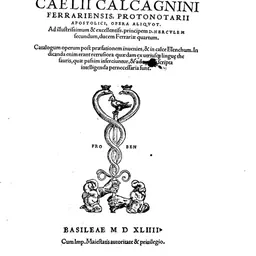
Early life and activity Morata was born in Ferrara to Fulvio Pellegrino Morato and Lucrezia Gozi, and was initially educated at home by her father. A former tutor in the Este court of Ferrara who was sympathetic to Protestantism, Morata's father focused her education on Latin and Greek, which she learned to read, write, and speak fluently. Morata was viewed as a prodigy, and her accomplishments were praised by other scholars such as Celio Calcagnini. Such praise was however highly gendered, with Morata also declaring her abandonment of traditional female pursuits in her poetry.
In 1539 Morata entered the court of Duke Ercole II d'Este of Ferrara, whose wife Renée of France had supported the foundation there of a school for girls led by the German humanist Kilian Senf. In addition to acting as a companion and tutor to the duke and duchess's daughters, between 1540 and 1548 Morata studied grammar, rhetoric, geography, Greek and Latin at the court in Ferrara, as well as deepening her knowledge of the Bible there. Her studies of the last were aided by texts that had been specially gathered for the education of girls at court, some of which would have been considered heterodox at the time. Renée's household was indeed a center of Protestantism in Italy, which besides international visitors like John Calvin also hosted Italian Protestants such as Antonio Brucioli, and Morata herself. Grunthler however did not live to see this edition: he and Morata's brother Emilio died soon after her from the plague. They were all buried together in the Church of St Peter in Heidelberg. and the Heidelberg University offers a scholarship for female scientists and doctors that is named after her. She is the subject of a FrauenOrt and a statue in Schweinfurt, where a school has also been named after her.
Don’t just read it —
keep it.
Full-length biographies made to live with: read them, listen on the way to work, watch them tonight.
- E-book
- Audio
- Video
Instant download · yours to keep · every purchase keeps this site free
Important facts
People in Olympia Fulvia Morata's life
Named in this biography and alive at the same time


Related people
Same field, nearest in time

Contemporaries
People whose lives overlapped Olympia Fulvia Morata's






Frequently asked questions
Who was Olympia Fulvia Morata?
Italian classical scholar
When was Olympia Fulvia Morata born?
Olympia Fulvia Morata was born in 1526 in Ferrara.
When did Olympia Fulvia Morata die?
Olympia Fulvia Morata died on 26 October 1555 in Heidelberg.
What was Olympia Fulvia Morata's occupation?
Olympia Fulvia Morata was a writer, classical scholar, poet, scientist and university teacher.
Sources & further reading
· Wikipedia: Olympia Fulvia Morata
· DBpedia: Olympia Fulvia Morata
Cite this page
APA: Biography.guide. (2026). Olympia Fulvia Morata. https://biography.guide/olympia-fulvia-morata/
MLA: "Olympia Fulvia Morata." Biography.guide, https://biography.guide/olympia-fulvia-morata/.
Chicago: "Olympia Fulvia Morata." Biography.guide. https://biography.guide/olympia-fulvia-morata/.
Data last updated: 2026-09-20 · Spot an error? Report a correction.
Page generated 2026-09-27 05:32 UTC