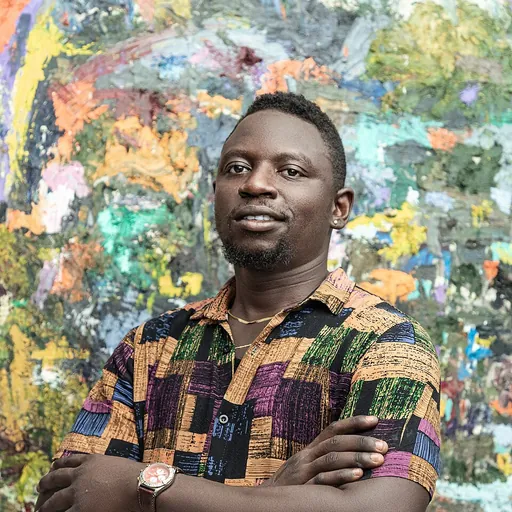
Oluwole Omofemi
Nigerian painter and artist
About Oluwole Omofemi
Oluwole Omofemi (born Godwin Oluwole Omofemi on 2 June 1988) is a Nigerian artist and curator based in Ibadan, Oyo State, Nigeria. He is mostly known for painting the last commissioned painting of Queen Elizabeth II before her death. He has held several solo and joint exhibitions both in Nigeria and abroad. - the third largest city in Nigeria by population. This endeared him to his grandfather who accepted him wholeheartedly and led him to bear his grandfather's name “Adekunle” which means “the crown or royalty fills up the family” in Yoruba language. A part of his growing years was in Agenebode, Etsako with his mother after his parents split up when he was younger. He started painting since childhood, having been influenced by the environment he grew up in to explore his artistic talent. He was always a keen observer of his environment since his growing years and had bouts of loneliness and this has ended up being a great asset in his artistic career.
Career Omofemi held his first solo exhibition titled “Iriri”, which translates to “Experience” from Yoruba in 2019 at the Alexis Gallery, Lagos. In 2020, Omofemi held his exhibition titled “The Way We Are”. The exhibition which was made up of seventeen oil and acrylic paintings on canvas was held at the Signature African Art's Mayfair Gallery in London. 2021 also had him display his work in the Out of Africa Gallery in Barcelona in an exhibition titled “Emancipation”. He has had art exhibitions in art galleries in Belgium, Italy, France, Spain, Ghana, United Kingdom, United States and Nigeria. Having been introduced to the editor of Tatler Richard Dennen by rugby player and art collector Maro Itoje, in May 2022, Omofemi was commissioned by Tatler magazine to make a painting of the late Queen Elizabeth II. The painting covered the special platinum jubilee edition of the magazine. This painting was to be the last commissioned painting of her before her death.
He pointed out Tope Fatunmbi and Ebenezer Akinola as his mentors. He does this as an intrinsic way of capturing femininity and the African identity and African heritage while running natural commentary on both its history and contemporary times. According to Okay Africa, this is his way of portraying an African “emblem of liberation, identity, and power” and is “a way of conserving African heritage and tradition”, preserving afrocentrism. He also iterated in an interview with The Sun that: The hair is special to me just as you have rightly said because of its unique features and symbolic representation. The incident which led to my indulgence in painting hair as a subject matter, particularly afro, began in the late 1960s and early 70s when the civil rights exponents drew more attention to the love-yourself gospel which helped to project confidence, beauty and sparkle to the perception of blacks and their diasporic identity. He does contemporary art and abstract art as well. In his painting of the Queen of England, he painted her with black hair to capture both youth - as opposed to grey hair - as well as integrate his signature style into the painting. He also uses the pop art palette for his signature color range and mix, forming a major part of his color theory. Los Angeles, US 2020 The Way we were Signature African Art London, UK 2019 Iriri (Experience) Allexis Gallery Lagos, Nigeria
Group shows
Don’t just read it —
keep it.
Full-length biographies made to live with: read them, listen on the way to work, watch them tonight.
- E-book
- Audio
- Video
Instant download · yours to keep · every purchase keeps this site free
Important facts
Frequently asked questions
Who was Oluwole Omofemi?
Nigerian painter and artist
When was Oluwole Omofemi born?
Oluwole Omofemi was born in Ibadan.
Sources & further reading
Cite this page
APA: Biography.guide. (2026). Oluwole Omofemi. https://biography.guide/oluwole-omofemi/
MLA: "Oluwole Omofemi." Biography.guide, https://biography.guide/oluwole-omofemi/.
Chicago: "Oluwole Omofemi." Biography.guide. https://biography.guide/oluwole-omofemi/.
Data last updated: 2026-09-21 · Spot an error? Report a correction.
Portrait: Wikimedia Commons · author & licence
Page generated 2026-09-27 05:00 UTC