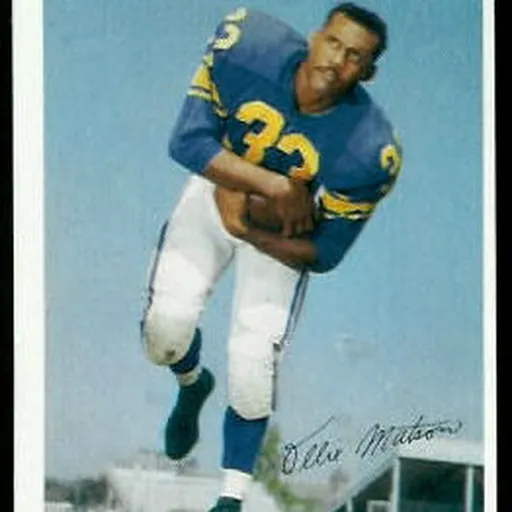
Ollie Matson
American football player and sprinter
About Ollie Matson
Lived 1930 – 2011 (aged 80). Ollie Matson was an American sprinter, athletics competitor and american football player.
Ollie Genoa Matson II (May 1, 1930 – February 19, 2011) was an American Olympic medal winning sprinter and professional football player. He played as a halfback and return specialist in the National Football League (NFL) from 1952 to 1966 primarily for the Chicago Cardinals and the Los Angeles Rams. He played college football for the San Francisco Dons and was selected by the Cardinals in the first round (third overall) of the 1952 NFL draft.
Matson was named an NFL first team All-Pro seven times and selected to the Pro Bowl six times during the course of his professional career. He was elected to the Pro Football Hall of Fame in 1972, and later included in the NFL's 1950s all-decade team during the league's 100th anniversary celebration.
Early life Matson was born on May 1, 1930, in Trinity, Texas, near Houston. His parents separated when he was young, and his mother moved to California later, leaving him to be raised by his grandparents. He moved to San Francisco when he was 14 to rejoin his mother. Matson graduated from George Washington High School in San Francisco in 1948. In 1947, he set a San Francisco high school football scoring record with 102 points. In his senior year, he entered an open meet held at Kezar Stadium and ran the 440-yard dash competitively for the first time, chasing Jamaican sprinter Herb McKenley, the holder of the world record to a new record of 46.1 seconds. Matson finished second in 47 seconds. Races were held on cinder tracks in those times.
College career
Matson attended the City College of San Francisco (CCSF) prior to transferring to the University of San Francisco (USF). In his one football season at CCSF, he scored 19 touchdowns and led the team to a Northern California title.
As a sophomore at USF in 1949, Matson was considered among the top running backs in the country. He had touchdown runs of 92, 80, 61, 60, and 39 yards, among others, in just his first five games. During those five games, he had over 1,000 total yards from rushing, receiving, and returning punts and kickoffs. USF coach Joe Kuharich, who himself was a star player at Notre Dame and in the NFL said he had seen star professional players who could not do what Matson did on offense; and that in addition, Matson was also a "far greater defensive player".
As a junior in 1950, he had recurrent leg problems and suffered a knee injury. Even though injured, he still scored 81 points, and the Associated Press (AP) named him first team All-Pacific Coast as a defensive back. Matson played in a game in 1950 against the University of Tulsa, even after Tulsa had tried to get USF to leave its black players behind for the game. During the game, the Tulsa players hit him with their fists, knees and elbows, leaving him "'with two black eyes, a bloody nose, and [his] face puffed up like a pound cake". He scored three touchdowns in the game, however, every one of them was called back.
In 1951, Matson's senior year at USF, he led the nation in rushing yardage (1,566) and touchdowns (21) en route to leading the Dons to an undefeated season. He averaged 51.5 minutes per game, starring on defense as well as offense, with five interceptions and many passes knocked down. He was selected as an AP All-American at defensive back, and finished ninth in Heisman Trophy balloting that year. He also was selected to the International News Service's (INS) All-America team. The INS also selected him to its All-Pacific Coast first team as a running back.
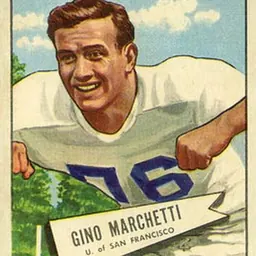
Despite its 9–0 record, the 1951 San Francisco team, which included future NFL Hall of Fame linemen Gino Marchetti and Bob St. Clair, was not invited to a bowl game. It was later reported that the Orange, Sugar and Gator Bowls—all hosted in the Deep South—did not consider inviting any teams that had black players, and USF refused to play without its two African-American members, Matson and Burl Toler. However, it has also been reported that the Dons were invited to play in the Orange Bowl if they did not bring Matson and future NFL game official Burl Toler, the only other black player on the team, to the game. The Dons players, led by Marchetti, unanimously refused to play if it required leaving their teammates behind, and did not participate in the Orange Bowl.
He played in the December 1951 East-West Shrine game, and in the 1952 Chicago College All-Star game against the Los Angeles Rams.
While at USF, Matson became a member of Kappa Alpha Psi fraternity. He went on to share 1952 Rookie of the Year honors with Hugh McElhenny of the San Francisco 49ers. Matson was named first-team All-Pro by the AP and second-team All-Pro by United Press International (UPI), and was selected to play in the Pro Bowl. He returned two kickoffs for touchdowns in his rookie year, including a 100-yard return, both leading the league; and was second in yards per kickoff return (31.2).
Matson missed the entire 1953 season while serving in the United States Army. and the Fort Ord team defeated the Quantico Marines Devil Dogs in the December 1953 edition of the Poinsettia Bowl, an armed forces football championship game held several times in the early 1950s, with Matson scoring two touchdowns against the Marines.
Matson returned to the Cardinals in 1954, and averaged 5.0 yards per rushing attempt and 18 yards per reception, while starting in eight games. He had a total of 506 rushing yards and 611 receiving yards, with seven total touchdowns. He had an interception as a defensive back. He returned 11 punts including one for a touchdown, and 17 kickoffs including a 91-yard touchdown return. He was selected to the Pro Bowl for a second time, and was named first-team All-Pro by the AP, UPI, Newspaper Enterprise Association (NEA) and The Sporting News.
In 1955, Matson led the league in punt return total yards (245), longest punt return (78 yards) and punt returns for touchdowns (2), to go along with 712 total yards rushing and receiving. and again was named first-team All-Pro by the AP, UPI, The Sporting News and the NEA. In 1956, he had a career high in rushing with 924 yards (4.8 yards per attempt), and a 105-yard kickoff return for a touchdown. and was again named first-team All-Pro by the AP, NEA and UPI and first-team All-Conference by The Sporting News.
After three poor years in 1952 (4–8), 1954 (2–10) and 1955 (4–7–1), the Cardinals finally had a winning record in 1956 (7–5). However, in 1957, the team fell back with a 3–9 record. During the 1957 season, Matson was used extensively as a wide receiver by Chicago Cardinals head coach Ray Richards. He had over 350 less rushing yards than the previous season; but over 250 more yards receiving and a nearly 10 yards per reception higher average. and was again named first-team All-Pro by the AP, NEA and UPI and first-team All-Conference by The Sporting News. This would be his last year as a first-team All-Pro.
The Cardinals 1958 record was an even worse 2–9–1.
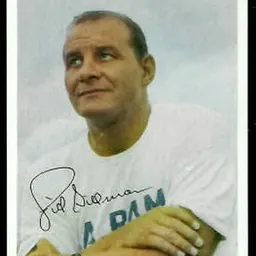
Los Angeles Rams Following the 1958 season, Matson was traded by the Cardinals to the Los Angeles Rams for eight players and a high 1960 draft choice. While Rams coach Sid Gillman originally wanted Matson when he became the Rams coach two years earlier, he thought the price paid in the trade was too much for a 29-year old Matson, but was overruled by the team's executives, including general manager and future NFL commissioner Pete Rozelle. In 1959, Matson had 863 rushing yards with six touchdowns in only nine starts, averaging a career best 5.4 yards per attempt, to go along with 130 receiving yards. The Rams still used him to return punts and kickoffs as well. In 1961, he did have 29 receptions for 537 yards (18.5 yards per reception) with three touchdowns, including a 96-yard touchdown. where he barely played in 1963.
In 1964, Matson started in nine games total, rushing for 404 yards (4.2 yards per carry) with four touchdowns, and had 17 receptions for 242 yards and another touchdown. He retired after two more years in Philadelphia, primarily in a reserve role. and he was eighth all-time in career rushing yards.
Honors Matson was inducted to the Pro Football Hall of Fame in 1972. Joe Kuharich gave his enshrinement speech. He was inducted into the College Football Hall of Fame in 1976. Matson was inducted into the University of San Francisco Athletics Hall of Fame in 1959.
In his later years Matson had dementia (he had been mostly bedridden for several years), which was linked to Chronic traumatic encephalopathy (CTE), a progressive degenerative disease, diagnosed post-mortem in individuals with a history of multiple concussions and other forms of head injury. According to his son, due to his degenerative brain disease Matson would wash the family's four cars almost daily and barbecue chicken at 6:30 am during his later years.
According to his nephew, Matson had not spoken in the four years prior to his passing.
Death
On February 19, 2011, Ollie Matson died of dementia complications (respiratory failure) surrounded by family at his home in Los Angeles, California. He is one of at least 345 NFL players to be diagnosed after death with chronic traumatic encephalopathy (CTE), which is caused by repeated hits to the head. The researchers who diagnosed him after death found his stage 4 CTE one of the most severe cases they had seen.
Don’t just read it —
keep it.
Full-length biographies made to live with: read them, listen on the way to work, watch them tonight.
- E-book
- Audio
- Video
Instant download · yours to keep · every purchase keeps this site free
Important facts
People in Ollie Matson's life
Named in this biography and alive at the same time



Related people
Same field, nearest in time



Contemporaries
People whose lives overlapped Ollie Matson's
Frequently asked questions
Who was Ollie Matson?
American football player and sprinter (1930–2011)
When was Ollie Matson born?
Ollie Matson was born on 1 May 1930 in Trinity.
When did Ollie Matson die?
Ollie Matson died on 19 February 2011 in Los Angeles.
What was Ollie Matson's occupation?
Ollie Matson was a sprinter, athletics competitor and american football player.
What nationality was Ollie Matson?
Ollie Matson was American.
Sources & further reading
Cite this page
APA: Biography.guide. (2026). Ollie Matson. https://biography.guide/ollie-matson/
MLA: "Ollie Matson." Biography.guide, https://biography.guide/ollie-matson/.
Chicago: "Ollie Matson." Biography.guide. https://biography.guide/ollie-matson/.
Data last updated: 2026-09-23 · Spot an error? Report a correction.
Portrait: Wikimedia Commons · author & licence
Page generated 2026-09-27 05:07 UTC