
Olivia de Palermo
5th‑century Sicilian teenage virgin and martyr, Christian saint, venerated in Palermo and Tunis
About Olivia de Palermo
Lived 448 – 463 (aged 14–15). Olivia de Palermo was an Italian consecrated virgin.
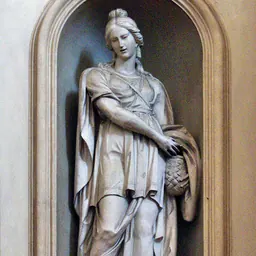
Olivia of Palermo (, ), Palermo, 448 – Tunis, 10 June 463, while according to another tradition she is supposed to have lived in the late 9th century AD in the Muslim Emirate of Sicily is a Christian virgin-martyr who was venerated as a local patron saint of Palermo, Sicily, since the Middle Ages, as well as in the Sicilian towns of Monte San Giuliano, Termini Imerese, Alcamo, Pettineo and Cefalù.
Her feast day is on 10 June,
The oldest textual sources of her Life include a Gallo-siculo Breviary of the twelfth century, which records her memory and is still preserved in Palermo,
Moreover, Sicily's well-known writer of the 17th century, the poet Petru Fudduni (born Pietro Fullone) wrote a poem in 114 octaves about her. At the same time, a dramatic opera of Gioacchino Bona Fardella, a tragedy in three acts, was also famous in its day. It was begun in 1893, replacing the oldest Christian monument in the city – a chapel built by Father Jean Le Vacher in 1650 – and was opened on Christmas Day 1897.
Saint Olivia and Islam in Tunisia Al-Zaytuna Mosque (Mosque of Olive), in Tunis, Tunisia. Interior Courtyard and main minaret. The Great Mosque of Al-Zaytuna ("Mosque of Olive") is the oldest in Tunis, the capital of Tunisia, and covers an area of with nine entrances. The exact date of the mosque's foundation varies according to different historical sources. Modern historians have been divided over whether it should be attributed to Ubayd Allah ibn al-Habhab in the early 8th century or to Hasan ibn al-Nu'man at the end of the 7th century. Most scholars support the second scenario
One legend states that it was called "Mosque of Olive" because it was built on an ancient place of worship where there was an olive. Another account, transmitted by the 17th century Tunisian historian Ibn Abi Dinar, This ancillary legend related to the discovery of the saint's relics is widespread in Sicily, however it is connected to other Saints as well. The Italian teacher and writer Giuseppe Agnello carefully undertook to sift the hagiographic tradition from the literary one and did not see anything more than a random homonymous saint of Palermo conflated with the heroine of the mystery play dedicated to her, which was studied extensively by Alessandro d'Ancona and Alexander Veselovsky (who in turn cited Ferdinand Wolf ).
Don’t just read it —
keep it.
Full-length biographies made to live with: read them, listen on the way to work, watch them tonight.
- E-book
- Audio
- Video
Instant download · yours to keep · every purchase keeps this site free
Important facts
Related people
Same field, nearest in time

Frequently asked questions
Who was Olivia de Palermo?
5th‑century Sicilian teenage virgin and martyr, Christian saint, venerated in Palermo and Tunis
When was Olivia de Palermo born?
Olivia de Palermo was born in 448 in Palermo.
When did Olivia de Palermo die?
Olivia de Palermo died on 10 June 463 in Tunis.
What was Olivia de Palermo's occupation?
Olivia de Palermo was a consecrated virgin.
What nationality was Olivia de Palermo?
Olivia de Palermo was Italian.
Sources & further reading
· Wikipedia: Olivia de Palermo
Cite this page
APA: Biography.guide. (2026). Olivia de Palermo. https://biography.guide/olivia-de-palermo/
MLA: "Olivia de Palermo." Biography.guide, https://biography.guide/olivia-de-palermo/.
Chicago: "Olivia de Palermo." Biography.guide. https://biography.guide/olivia-de-palermo/.
Data last updated: 2026-09-20 · Spot an error? Report a correction.
Page generated 2026-09-27 05:27 UTC