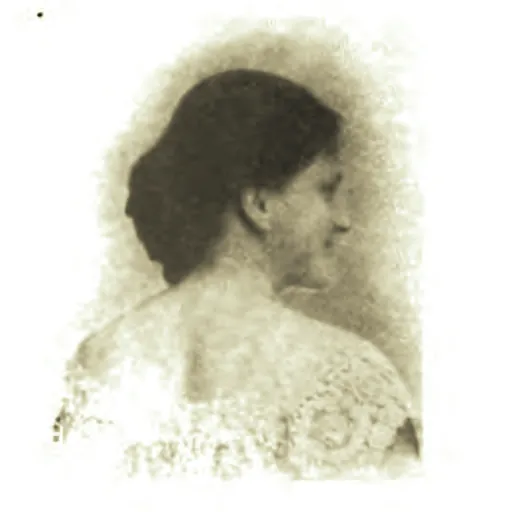
About Olive Percival
Lived 1869 – 1945 (aged 75). Olive Percival was a writer.
Olive May Graves Percival (July 1, 1868 – February 18, 1945) was a writer, photographer, gardener, artist, and bibliophile in Los Angeles. Although she earned her living as an insurance clerk, she wrote for a variety of magazines, authored several books, and was sought after as a lecturer on gardens, New England antiques, Japanese ceramics, and children’s books, among other subjects.
Early years Percival was born near Sheffield, Illinois, in a log cabin on her family’s farm. Growing up, there was tension between her parents, most likely as result of debt related to the family farm. In 1887, she moved to Los Angeles with her mother and sister, lured by the climate and the prospect of year-round gardening.
Her home was often the setting for garden teas, moon-viewing parties, and memorable salons attended by local and visiting celebrity authors, artists, and book lovers. Her diaries from 1889 to 1943 are peopled with artists, actors, writers, society leaders, career women, and others active in the intellectual life of Los Angeles during that time. One guest thought of the occasions as a mingling of “the inconvenient and the cultivated.”
Writing Percival began writing for publication in 1896 and sold her first poem and first article just before her 28th birthday. Eventually, she began to regularly contribute to the Los Angeles Times, writing articles on subjects ranging from women’s suffrage to gardening. After the Los Angeles Times bombing in 1910, she penned an article titled Would Woman's Vote Suppress Anarchy, which appeared in the October 16, 1910, issue: If ever we needed the full representation of the whole people in government affairs, that need is terribly emphasized by this distressing occurrence. As for equal suffrage, I have never in my life heard one sane argument against it. I think the only argument that men who are opposed to the measure have ever advanced in justification of their unfair and un-American position, is that they do not want women to lose their delicacy and charm by rough contact with matters political. This is not 'sentiment' but sentimentality. . . . There is no sense or intelligence about it. Women must live in the world as truly as men and in many instances they are as well equipped for the actualities of life as men. . . .
If there is to be anything democratic or republican about the government of America, that independence must be based upon the liberty of all of its citizens. . . . When half of the people of any country are disenfranchised, that country has no freedom. We pretend to be progressive and we boast our splendid republicanism, but our republic is more despotic than any monarchy unless all who are taxed have a voice in the control of public affairs.
Her books include Leaf-Shadows and Rose-Drift, Being Little Songs from a Los Angeles Garden (1911) and Mexico City: An Idler’s Note-Book (1901) which featured some of her own photographs and was reviewed favorably. In her will, she arranged for the publication of two of her manuscripts, Our Old-fashioned Flowers (Pasadena, CA 1947) and Yellowing Ivy (Los Angeles, CA 1946). In 2005, the Huntington Library Press published excerpts from her book-length manuscript Children’s Garden Book, as Olive Percival’s Children’s Garden Book. The Huntington Library has seven hundred of her photographs, many of which are a record of her garden. Others are of scenes in Mexico, Los Angeles, San Pedro, and San Francisco. She often printed them herself—purposely on blueprint paper—because the colors reminded her of Oriental porcelain.
In 1949, Los Angeles nurseryman Paul Howard patented an Olive Percival Rose.
Percival also collected old hats while making new ones. Her hat making extended to her dolls, for whom she made nearly two hundred little hats. She also made paper dolls, inspired by a letter about antique paper dolls from Wilbur Macey Stone, an authority on children’s literature and toys. The Denison Library now houses over 300 of Percival’s dolls, clothes, and other accessories.
Chinese and Japanese collections Percival was considered an authority on many aspects of Chinese and Japanese art, lending pieces from her collections of prints, porcelain, scroll paintings, lacquer, bronzes, sword guards, and stencils to local art groups for special exhibitions.
Her interest in the Japanese and their culture lead her to protest anti-Japanese measures,
Don’t just read it —
keep it.
Full-length biographies made to live with: read them, listen on the way to work, watch them tonight.
- E-book
- Audio
- Video
Instant download · yours to keep · every purchase keeps this site free
Important facts
People in Olive Percival's life
Named in this biography and alive at the same time

Related people
Same field, nearest in time



Contemporaries
People whose lives overlapped Olive Percival's

Frequently asked questions
Who was Olive Percival?
American artist and writer (1869–1945)
When was Olive Percival born?
Olive Percival was born on 1 July 1869.
When did Olive Percival die?
Olive Percival died on 18 February 1945.
What was Olive Percival's occupation?
Olive Percival was a writer.
Sources & further reading
Cite this page
APA: Biography.guide. (2026). Olive Percival. https://biography.guide/olive-percival/
MLA: "Olive Percival." Biography.guide, https://biography.guide/olive-percival/.
Chicago: "Olive Percival." Biography.guide. https://biography.guide/olive-percival/.
Data last updated: 2026-09-21 · Spot an error? Report a correction.
Portrait: Wikimedia Commons · author & licence
Page generated 2026-09-27 04:58 UTC