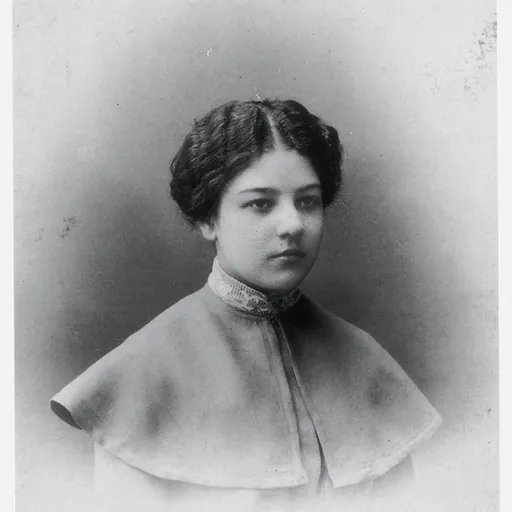
About Olga Rozanova
Lived 1886 – 1918 (aged 32). Olga Rozanova was a Russian poet, illustrator, draftsperson, painter, collagist and writer.
Olga Vladimirovna Rozanova (also spelled Rosanova, Russian: Ольга Владимировна Розанова) (22 June 1886 – 7 November 1918, Moscow) was a Russian avant-garde artist painting in the styles of Suprematism, Neo-Primitivism, and Cubo-Futurism.
Biography
Early life Olga Rozanova was born in Melenki, a small town near Vladimir. Her father, Vladimir Rozanov, was a district police officer and her mother, Elizaveta Rozanova, was the daughter of an Orthodox priest. She was the family's fifth child; she had two sisters, Anna and Alevtina, and two brothers, Anatolii and Vladimir. Rozanova's father died in 1903, and her mother became the head of the household.
She graduated from the Vladimir Women's Gymnasium in 1904.
Artistic career
After arriving in Moscow, she attended the Bolshakov Art School, where she worked under Nikolai Ulyanov and sculptor Andrey Matveev. She audited courses at the Stroganov School of Applied Art in 1907 but was not accepted for admission. After this, she trained in the private studio of Konstantin Yuon. Unlike most of the other female avant-garde artists, Rozanova was the only one who did not study abroad to learn about European art.
By 1910, she was fairly well-known in Russian art circles.
From 1913 to 1914, Cubo-Futurist ideas appeared in her work, but she appears to have been especially inspired by Futurism.
She met the poet Aleksei Kruchenykh in 1912; he then introduced her to the Russian Futurist concept of zaum (translated as "beyonsence") poetry, a language with no fixed meanings and constant neologisms. Rozanova would write her own poetry in that style, and also illustrated books of zaum poetry,
From 1917 to 1918 she created a series of non-objective paintings which she called tsv'etopis'''. Her Non-objective composition, 1918 also known as Green stripe anticipates the flat picture plane and poetic nuancing of color of some Abstract Expressionists. She maintained that the creation of pictures based on the "Abstract Principle" constitute three stages: the intuitive principle; the individual transformation of the visible; and, abstract creation. In her criticism of photography, Rozanova agreed with Oscar Wilde that photography is for the "servile artist".
Her work is in the collections of the Museum of Modern Art, the Philadelphia Museum of Art, the Thyssen-Bornemisza Museum, and the Carnegie Museum of Art,
Rozanova's work was included in the 2021 exhibition Women in Abstraction at the Centre Pompidou.
Major works In a Cafe (c.1911-1912) - One of Rozanova's earlier pieces, In a Café, depicts a man and a woman on opposing sides of a table, the man with his head in his hand and the women with a drink in hers. Rozanova makes use of vibrant colors and thick lines to create a piece with aspects of French avant-garde and Russian Neo-Primitivistic art. The Factory and the Bridge (c. 1913) - The Factory and the Bridge was included in the First Free International Futurist Exhibition in 1914. This piece had inspiration from the Italian Futurism movement, and its bright colors gives it an expressionist tone. Metronome (c. 1914) - A piece from the middle of her career, Metronome was displayed at the Last Futurist Exhibition 0,10 in Petrograd in 1915. Playing Cards series (1915) - One of her most famous works, the series represents the height of her artistic career. It consists of portraits of her peers set as designs for playing cards.
Gallery
Don’t just read it —
keep it.
Full-length biographies made to live with: read them, listen on the way to work, watch them tonight.
- E-book
- Audio
- Video
Instant download · yours to keep · every purchase keeps this site free
Important facts
more
Olga Rosanova, Olga RosanowaPeople in Olga Rozanova's life
Named in this biography and alive at the same time



Related people
Same field, nearest in time
Contemporaries
People whose lives overlapped Olga Rozanova's






Frequently asked questions
Who was Olga Rozanova?
Russian artist (1886-1918)
When was Olga Rozanova born?
Olga Rozanova was born on 21 June 1886 in Melenki.
When did Olga Rozanova die?
Olga Rozanova died on 7 November 1918 in Botkin Hospital, Moscow.
What was Olga Rozanova's occupation?
Olga Rozanova was a poet, illustrator, draftsperson, painter, collagist and writer.
What nationality was Olga Rozanova?
Olga Rozanova was Russian.
Sources & further reading
Cite this page
APA: Biography.guide. (2026). Olga Rozanova. https://biography.guide/olga-rozanova/
MLA: "Olga Rozanova." Biography.guide, https://biography.guide/olga-rozanova/.
Chicago: "Olga Rozanova." Biography.guide. https://biography.guide/olga-rozanova/.
Data last updated: 2026-09-20 · Spot an error? Report a correction.
Page generated 2026-09-27 05:09 UTC