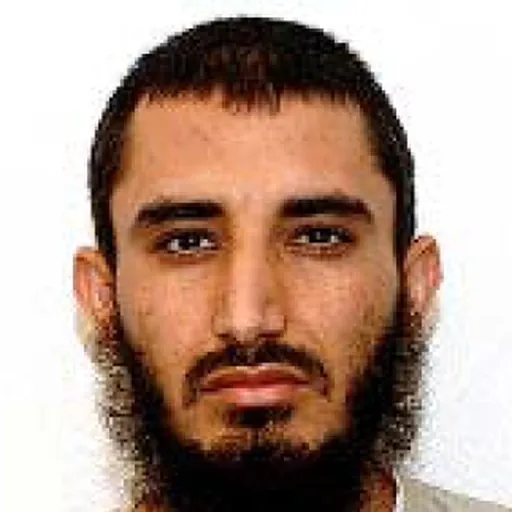
Obaidullah
Afghan Guantanamo detainee
About Obaidullah
Born 1980.
Obaidullah (born 1980) is a citizen of Afghanistan who was one of the last remaining Afghan detainees held in extrajudicial detention in the United States Guantanamo Bay detention camp, in Cuba. He was captured as an Enemy combatant on July 20, 2002, transferred to Guantanamo on October 28, 2002, and transferred to the United Arab Emirates on August 15, 2016.
Obaidullah's Guantanamo Internment Serial Number is 762. American intelligence analysts estimate that Obaidullah was born in 1980 in Khost, Afghanistan.
Capture and detention On July 20, 2002, two dozen American Special Armed Forces soldiers, acting on an anonymous tip, raided Obaidullah's family home and took him into custody along with his cousins. At the time, Obaidullah was carrying a notebook which the U.S. alleges contained diagrams for improvised explosive devices.
In a statement made during his habeas corpus proceedings, Obaidullah stated:
The Americans came while my family and I were all sleeping in our home in the village of Milani, close to Khost City. At that time I was approximately 19 years old. On that night, I heard noises and the soldiers woke me up. I was very confused about what was going on, and why they were in my home, but I and my family cooperated with them. Even though I was not resisting, they tied my feet together and my hands together with plastic cuffs. Then they put a hood over my head and forced me to sit for hours against a wall. The plastic cut into my hands and it was painful to sit that way for so long. I was terrified about what would happen to me.
Chapman Airfield From his home, Obaidullah was transported to Chapman Airfield, a forward operating base. Obaidullah described his treatment at Chapman airbase in a statement made during his habeas corpus proceedings:
After I got to the military base, there were several soldiers who told me to put my hands up and then to hold them straight out to the front of me. I did what they told me to do. They then put two sandbags on my arms and made me walk around back and forth with them like that all night. They were extremely heavy, and if I dropped the bags, the soldiers put them back on my arms. They got so heavy that I had to kind of place them on my stomach as I moved. They did not let me sleep at all for the rest of that night but forced me to keep moving with bags on my arms. When they moved me from one location to another, the soldiers were extremely rough and shoved me around with their knees and elbows in a very painful and frightening way. In the morning before sunrise, I was taken into a room and interrogated by three or four soldiers. They told me that they would kill me if I didn't talk. After I told them I didn't know the answers to their questions, one of them knocked me to the floor. He took out a long knife and started sharpening it in front of me. I could hear the sounds of the knife being sharpened. He then lifted my hood and showed me the knife. He put it on the back of my head and said now start talking… I was terrified and fully believed that they might kill me.
Guantanamo Obaidullah was transferred to Guantanamo on October 28, 2002.
He stated:
I had not participated in hunger strikes, or organized protests in the past. I have been patiently challenging my imprisonment in US civil courts. But the latest actions in the camps have dehumanized me, so I have been moved to take action. Eleven years of my life have been taken from me, and now by the latest actions of the authorities, they have also taken my dignity... Despite the difficulties in continuing the strike, and the health effects I am experiencing and witnessing, we plan to remain on strike until we are treated with dignity... I am losing all hope because I have been imprisoned at Guantánamo for almost eleven years now and still do not know my fate. In 2004, the United States Supreme Court ruled, in Rasul v. Bush, that Guantanamo captives were entitled to being informed of the allegations justifying their detention, and were entitled to try to refute them.
Office for the Administrative Review of Detained Enemy Combatants
Combatant Status Review Tribunals were held in a 3x5 meter trailer where the captive sat with his hands and feet shackled to a bolt in the floor.
Following the Supreme Court's ruling the Department of Defense set up the Office for the Administrative Review of Detained Enemy Combatants.
Scholars at the Brookings Institution, led by Benjamin Wittes, listed the captives still held in Guantanamo in December 2008, according to whether their detention was justified by certain common allegations:
Obaidullah was listed as one of the captives who had faced charges before a military commission.
Habeas Petition Following the U.S. Supreme Court's ruling in Boumediene v. Bush that Guantanamo detainees are entitled to habeas corpus proceedings, Obaidullah filed a petition for habeas corpus in the U.S. District Court for the District of Columbia in July 2008. Two months later, the Bush administration filed charges against him in the military commissions at Guantanamo.
On October 19, 2010, Judge Richard Leon of the U.S. District Court of the District of Columbia ruled that Obaidullah's detention was lawful. Judge Leon denied Obaidullah's petition for writ of habeas corpus after finding he was "more likely than not" an insurgent. The court held that the lower court had correctly determined that it was "more likely than not" that Obaidullah was a member of al Qaeda, relying on the secret source whose tip to the U.S. military led to the raid on Obaidullah's family compound. The identity of this source and the information received have not been revealed to Obaidullah or his attorneys.
"Individuals who had lived in Obaidullah's village identified two males who were not originally from the same village but had lived there for a period, and who were rumoured to have sold false information to Americans," a Navy intelligence officer investigating Obaidullah's case in Afghanistan said in a sworn statement. "It was stated that those two men later disappeared and it is not known whether they are alive". This would allow Obaidullah a new trial in the district court on the grounds that new evidence had been uncovered. This evidence was attested to in a declaration by Lieutenant Commander Richard Pandis, an NCIS investigator assigned to the case. The motion was denied on January 30, 2013.
Formerly secret Joint Task Force Guantanamo assessment
On April 25, 2011, whistleblower organization WikiLeaks published formerly secret assessments drafted by Joint Task Force Guantanamo analysts. His 8-page Joint Task Force Guantanamo assessment was drafted on June 16, 2008. It was signed by camp commandant Rear Admiral David M Thomas Jr. He recommended continued detention at Guantanamo.
Joint Review Task Force
When he assumed office in January 2009 President Barack Obama made a number of promises about the future of Guantanamo. He promised the use of torture would cease at the camp. He promised to institute a new review system. That new review system was composed of officials from six departments, where the OARDEC reviews were conducted entirely by the Department of Defense. Obaidullah was one of the 71 individuals deemed too innocent to charge, but too dangerous to release. Although Obama promised that those deemed too innocent to charge, but too dangerous to release would start to receive reviews from a Periodic Review Board less than a quarter of men have received a review.
Charges
On September 10, 2008, charges were filed against Obaidullah for "conspiracy" and "providing material support for terrorism" under the Military Commissions Act of 2006. According to Reuters: The charges allege he hid mines and other explosives in the Khost area of Afghanistan from October 2001 to July 2002 and carried a notebook describing "how to wire and detonate explosive devices in preparation for acts of terrorism."
Anne Richardson, one of his lawyers, described how, when his defense team were able to disprove the allegations used to justify detaining him, and on which the charges he faced were based, the prosecution chose to drop the charges, instead of allowing him to prove his innocence, at trial, which would have justified freeing him.
Incarceration in Guantanamo Obaidullah appears on a Department Defense list of "71 Guantanamo Detainees Determined Eligible to Receive a Periodic Review Board as of April 19, 2014." Obaidullah was participating in a hunger strike along with half of the other Guantanamo detainees as of April 23, 2013. Obaidullah received his Periodic Review Board (PRB) hearing on April 19, 2016. The decision of the PRB was released Friday, May 20, 2016, and the PRB approved Obaidullah for release into an appropriate environment in an accepting nation, not necessarily his original home country of Afghanistan, similar to conditions placed upon previously released detainees.
Transfer to the United Arab Emirates
On August 15, 2016, the USA transferred Obaidullah, and fourteen other men, to the United Arab Emirates.
Don’t just read it —
keep it.
Full-length biographies made to live with: read them, listen on the way to work, watch them tonight.
- E-book
- Audio
- Video
Instant download · yours to keep · every purchase keeps this site free
Important facts
People in Obaidullah's life
Named in this biography and alive at the same time


Contemporaries
People whose lives overlapped Obaidullah's




Frequently asked questions
Who is Obaidullah?
Afghan Guantanamo detainee
When was Obaidullah born?
Obaidullah was born in 1980 in Khost.
Sources & further reading
· DBpedia: Obaidullah (detainee)
Cite this page
APA: Biography.guide. (2026). Obaidullah. https://biography.guide/obaidullah-1980/
MLA: "Obaidullah." Biography.guide, https://biography.guide/obaidullah-1980/.
Chicago: "Obaidullah." Biography.guide. https://biography.guide/obaidullah-1980/.
Data last updated: 2026-09-21 · Spot an error? Report a correction.
Portrait: Wikimedia Commons · author & licence
Page generated 2026-09-27 04:59 UTC