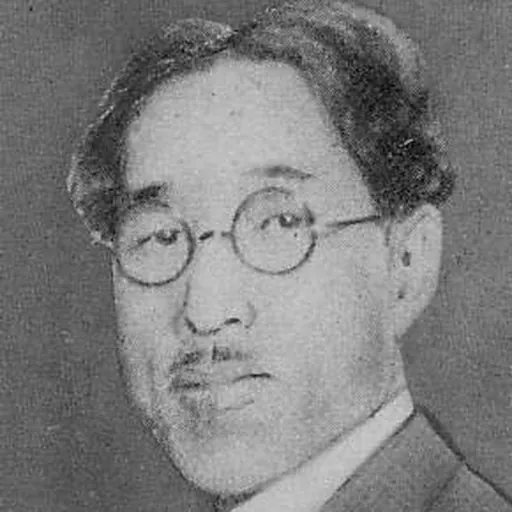
About Nyozekan Hasegawa
Lived 1875 – 1969 (aged 93). Nyozekan Hasegawa was a Japanese journalist, critic, thinker and politician.
Hasegawa Manjirō (長谷川 萬次郎, né Yamamoto, 30 November 1875 – 11 November 1969), known by his pen name , was a Japanese social critic and journalist during the Taishō and Shōwa eras. He was one of the most important and widely read supporters of liberalism and democracy in inter-war Japan.
Biography Nyozekan was born in the Fukagawa district of Tokyo, as the son of Yamada Tokujirō. He was adopted into his paternal grandmother's family, and took their name of Hasegawa. From 1885 to 1897, Nyozekan was a student at Dōjinsha, a school founded by Masanao Nakamura. He later attended the Tokyo Hōgakuin legal school (now part of Chuo University). He graduated in 1898 with a degree in criminal law. He was hired by Kuga Katsunan as a journalist in 1903, for the newspaper Nihon. In 1907, he was scouted by Miyake Setsurei and changed to the Nihon oyobi Nihonjin ("Japan and the Japanese") magazine. A few years later, he returned to newspaper journalism by changing jobs to the Osaka Asahi Shimbun.
His writings reveal his leftist political leanings, and in 1918, he resigned in protest after the newspaper was censured by the government.
In 1919, Nyozekan and fellow liberal journalist Oyama Ikuo founded the political magazine Warera ("We"), in which they sought to promote political reform and social democracy, while combating Japan's ever growing militarism and ultranationalism. In 1932, he published one of his most important works, Nihon fuashizumu hihan ("Critique of Japanese Fascism"), an analysis of the growing phenomena of "Japanese fascism”.
Increasing government repression and application of the Peace Preservation Laws in the mid-1930s, resulted in Nyozekan's arrest and a brief period in prison. This prompted Nyozekan to change to more subdued style, arguing that the Japanese people and national culture were inherently liberal, rational and democratic, and comparable to British classical liberalism. Although he was forced to keep a low profile, he did not compromise his opposition to militarism and totalitarianism.
Surprisingly to some, although Hasegawa wrote essays protesting that journalism must remain neutral and above politics, he also wrote in favor of the Greater East Asia Co-Prosperity Sphere, in which he saw the potential for the favorable development of Asia economically and culturally under Asian, rather than European influence.
In 1946, Hasegawa became a member of the House of Peers for its last session before the abolition of the Meiji Constitution. In 1947, he was elected to the Japan Art Academy, and in 1948 he was awarded the Order of Culture by the Japanese government.
His grave is at the temple of Seirin-ji in Bunkyō, Tokyo.
Don’t just read it —
keep it.
Full-length biographies made to live with: read them, listen on the way to work, watch them tonight.
- E-book
- Audio
- Video
Instant download · yours to keep · every purchase keeps this site free
Important facts
People in Nyozekan Hasegawa's life
Named in this biography and alive at the same time

Related people
Same field, nearest in time


Contemporaries
People whose lives overlapped Nyozekan Hasegawa's


Frequently asked questions
Who was Nyozekan Hasegawa?
Japanese journalist, thinker and politician (1875-1969)
When was Nyozekan Hasegawa born?
Nyozekan Hasegawa was born on 30 November 1875 in Fukagawa-ku.
When did Nyozekan Hasegawa die?
Nyozekan Hasegawa died on 11 November 1969 in Odawara.
What was Nyozekan Hasegawa's occupation?
Nyozekan Hasegawa was a journalist, critic, thinker and politician.
What nationality was Nyozekan Hasegawa?
Nyozekan Hasegawa was Japanese.
Sources & further reading
· Wikipedia: Nyozekan Hasegawa
Cite this page
APA: Biography.guide. (2026). Nyozekan Hasegawa. https://biography.guide/nyozekan-hasegawa/
MLA: "Nyozekan Hasegawa." Biography.guide, https://biography.guide/nyozekan-hasegawa/.
Chicago: "Nyozekan Hasegawa." Biography.guide. https://biography.guide/nyozekan-hasegawa/.
Data last updated: 2026-09-23 · Spot an error? Report a correction.
Portrait: Wikimedia Commons · author & licence
Page generated 2026-09-27 05:06 UTC