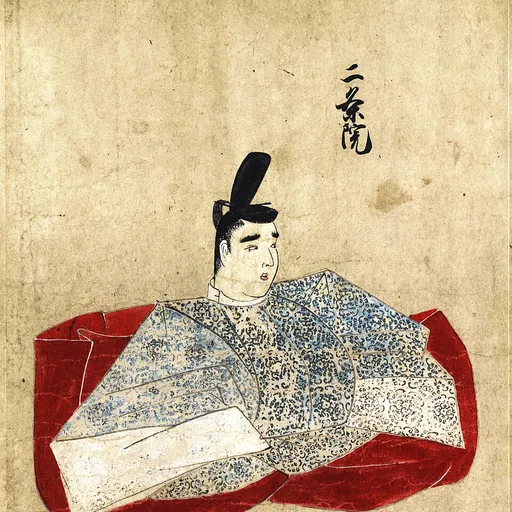
About Nijō
Lived 1143 – 1165 (aged 22). Nijō was a Japanese ruler.
was the 78th emperor of Japan, according to the traditional order of succession. His reign spanned the years from 1158 through 1165.
Genealogy Before his ascension to the Chrysanthemum Throne, his personal name (his imina) was Morihito-shinnō (守仁親王).
He was the eldest son of Emperor Go-Shirakawa. He was the father of Emperor Rokujō.
Empress: Imperial Princess Yoshiko (姝子内親王) later Takamatsu-in (高松院), Emperor Toba’s daughter. Empress: Fujiwara no Ikushi (藤原育子), Fujiwara no Tadamichi’s daughter Tai-Kōtaigō: Fujiwara Masuko (藤原多子) Later Grand Empress Dowager Omiya, Tokudaiji Kin'yoshi's daughter. Toku-no-Kimi (督の君), Minamoto Tadafusa’s daughter also Fujiwara no Narichika’s Wife Kasuga-dono (春日殿), Nakahara Moromoto’s daughter First Daughter: Imperial Princess Yoshiko (僐子内親王; 1159-1171) Umeryo-kimi (右馬助), Minamoto Mitsunari’s daughter First Son: Imperial Prince Priest Son'e (尊恵法親王; 1164-1192) Ōkura-daisuke (大蔵大輔) Second Son: Imperial Prince Nobuhito (順仁親王) become Emperor Rokujo Minamoto Tadafusa’s daughter Third Son: Shine (真恵)
Events of Nijō's life Nijō was proclaimed as heir to Emperor Go-Shirakawa.
Hōgen 1, 2nd day of the 7th month (1156): Cloistered Emperor Toba-in died at age 54. Hōgen 1, 10th–29th days of the 7th month (1156): The Hōgen Rebellion, also known as the Hōgen Insurrection or the Hōgen War. Hōgen 4, on the 11th day of the 8th month (1158): In the third year of Go-Shirakawa-tennōs reign (後白河天皇二十五年), the emperor abdicated; and the succession (‘‘senso’’) was received by his eldest son. Shortly thereafter, Emperor Nijō is said to have acceded to the throne (‘‘sokui’’).
After Nijō was formally enthroned, the management of all affairs continued to rest entirely in the hands of the retired emperor, Go-Shirakawa.
Heiji 1, 9th–26th day of the 12th month (1159): The Heiji Rebellion, Eiman 1 (1165): The infant son of Emperor Nijō was named heir apparent and therefore Crown Prince, and would soon after become Emperor Rokujō. Eiman 1''', 27th–28th day of the 7th month (1165): The former Emperor Nijō died at age 22.
KugyōKugyō (公卿) is a collective term for the very few most powerful men attached to the court of the Emperor of Japan in pre-Meiji eras.
In general, this elite group included only three to four men at a time. These were hereditary courtiers whose experience and background would have brought them to the pinnacle of a life's career. During Nijō's reign, this apex of the Daijō-kan included: Kampaku, Konoe Motozane, 1143–1166. Sadaijin, Konoe Motozane. Hōgen (1156–1159) Heiji (1159–1160) Eiryaku (1160–1161) Ōhō (1161–1163) Chōkan (1163–1165) Eiman (1165–1166)
Ancestry
Don’t just read it —
keep it.
Full-length biographies made to live with: read them, listen on the way to work, watch them tonight.
- E-book
- Audio
- Video
Instant download · yours to keep · every purchase keeps this site free
Important facts
Family & relationships
People in Nijō's life
Named in this biography and alive at the same time


Related people
Same field, nearest in time


Contemporaries
People whose lives overlapped Nijō's




Frequently asked questions
Who was Nijō?
Emperor of Japan
When was Nijō born?
Nijō was born on 31 July 1143.
When did Nijō die?
Nijō died on 5 September 1165.
What was Nijō's occupation?
Nijō was a ruler.
What nationality was Nijō?
Nijō was Japanese.
Sources & further reading
Cite this page
APA: Biography.guide. (2026). Nijō. https://biography.guide/nijo/
MLA: "Nijō." Biography.guide, https://biography.guide/nijo/.
Chicago: "Nijō." Biography.guide. https://biography.guide/nijo/.
Data last updated: 2026-09-20 · Spot an error? Report a correction.
Page generated 2026-09-27 05:09 UTC